
Gynecomastia surgery in Seoul: 2-week results for chest protrusion persisting since adolescence

Patient Registration Info
| Age | Weight | Height | BMI |
|---|---|---|---|
|
20s |
79kg |
178cm |
25 |
Surgical site
Surgical site : Gynecomastia | Grade 2-A
Should Gynecomastia Surgery Be Performed Immediately If It Is Diagnosed During Adolescence?
Gynecomastia that develops during puberty
may naturally decrease over time.
For minors, rather than deciding on surgery immediately,
changes in the chest may be monitored for a certain period.
However, if the projection remains unchanged after follow-up
and discomfort continues, an ultrasound examination
can be performed to reassess the glandular tissue
and determine the appropriate timing for treatment.
If chest projection causes discomfort in daily life,
it is understandable to want to address it as soon as possible.
However, when the patient is still a minor,
a diagnosis of gynecomastia does not necessarily mean
that surgery should be performed immediately.
Gynecomastia that develops during puberty
may naturally decrease as growth continues.
For this reason, after the initial diagnosis,
it may be necessary to monitor how the size
and projection of the chest change over time.
On the other hand, if the chest projection remains
even after a period of observation and discomfort
in daily life continues, further examination can be performed
to determine whether glandular tissue is still present
and to consider the appropriate treatment approach.
This patient was also diagnosed with gynecomastia
during adolescence and did not undergo surgery immediately.
Instead, the condition was monitored
for a certain period before proceeding further.

[Preoperative Evaluation of Persistent Chest Projection Since Adolescence Before Gynecomastia Surgery]
The patient had noticed that both sides of his chest
projected forward since his teenage years.
He continued to feel self-conscious about his chest shape
in daily life and had tried both diet and exercise,
but there was little change in the anterior chest projection.
As the condition persisted,
he visited the clinic with his parents.
An ultrasound examination performed while he was still a minor
confirmed glandular tissue in both sides of the chest.
However, surgery was not performed immediately.
Instead, the chest was monitored for a certain period
to observe any changes over time.
Even after this period, the chest projection did not decrease significantly,
and the discomfort he experienced in daily life continued.
After reaching adulthood, he underwent another examination.
[Patient Information and Gynecomastia Ultrasound Findings]
Age: 20
Height / Weight: 178 cm / 79 kg
BMI: 25.0
Gynecomastia Diagnosis: Bilateral true gynecomastia, Simon Grade 2A
Skin Elasticity: Moderate
Before surgery, the anterior chest projected forward,
particularly around the nipples and areolas.
The areolar areas were positioned higher than
the surrounding chest contour, making the central chest projection
appear even more prominent.
On palpation, firm, lump-like tissue could be felt
around the areolas.
Ultrasound examination also confirmed enlarged glandular tissue
behind both areolas.
The glandular tissue first identified while the patient was a minor
was still present when he was reexamined as an adult,
with findings consistent with Simon Grade 2A true gynecomastia.
Therefore, surgery was planned to remove the enlarged glandular tissue
through areolar incisions, while liposuction would also be performed
to reduce the fat distributed along the lower and outer chest.

[Changes in Anterior Chest Projection 2 Weeks After Surgery for Gynecomastia Present Since Adolescence]
Let’s compare the results 2 weeks after surgery.
The most noticeable change is the reduced height
of the previously projecting areolar areas.
Before surgery, the areas around the areolas projected forward,
making the anterior chest appear more prominent.
At 2 weeks after surgery, the height of these areas
had decreased, creating a flatter overall chest contour.
Because this is still an early stage of recovery,
swelling and tissue condition may continue to change over time.
However, the anterior chest projection that had concerned
the patient for many years already appeared reduced
compared with before surgery.
[Changes in Anterior Chest Volume from the Oblique View 2 Weeks After Male Gynecomastia Surgery]
From the oblique view, the reduction in overall
anterior chest volume is more noticeable.
Before surgery, the center of the chest projected forward
with a rounded contour, while the volume in the lower chest
created noticeable shadowing.
At 2 weeks after surgery, the forward chest thickness
had decreased, and the shadowing along the lower chest
also appeared less pronounced.
The chest contour appeared smoother,
with a more natural transition into the upper body.
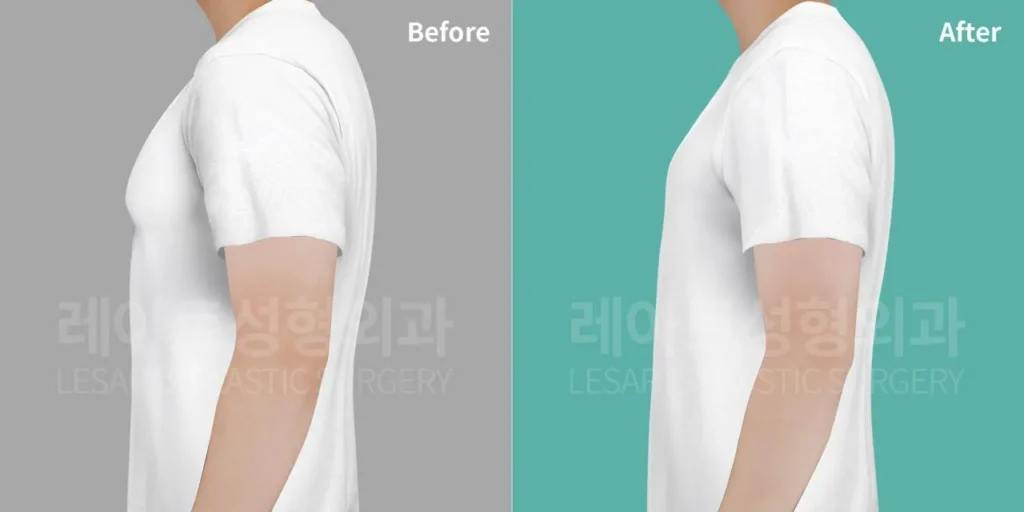
[Changes in T-Shirt Fit 2 Weeks After Surgery for Gynecomastia Present Since Adolescence]
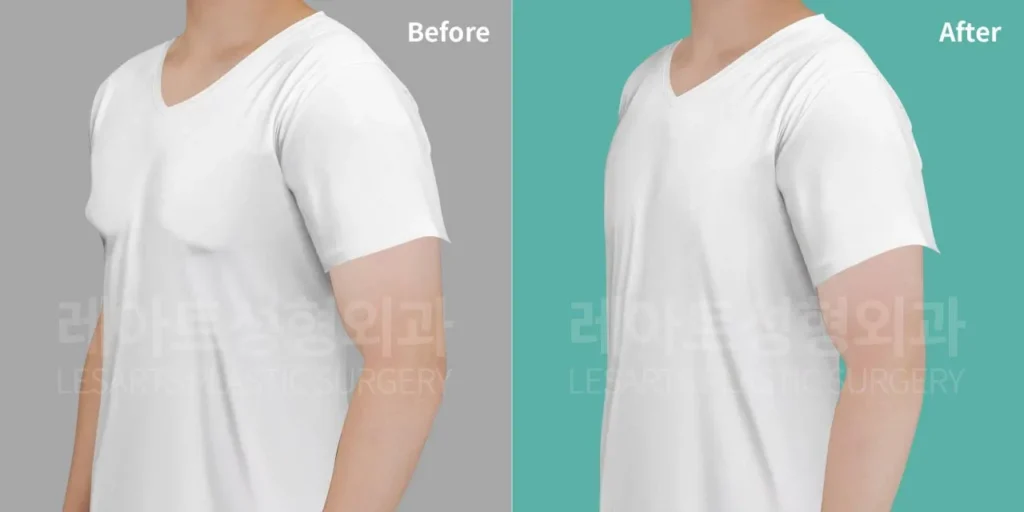
[Changes in T-Shirt Fit 2 Weeks After Surgery for Gynecomastia Present Since Adolescence]
Gynecomastia that develops during adolescence
often involves more than concerns about
the appearance of an enlarged chest.
When wearing a school uniform, gym clothes, or a thin T-shirt,
the chest may appear noticeably prominent.
Some adolescents may also feel uncomfortable
changing clothes during physical education classes
or exposing their upper body at a swimming pool or public bath.
For this reason, both patients and their parents
may have concerns about when surgery
should be considered.
This patient had also experienced discomfort for years
because of chest projection that began in adolescence.
At 2 weeks after surgery, the chest volume
that had previously projected through a T-shirt was reduced,
allowing the shirt to fall more naturally over the upper body.
The patient was also satisfied with the change
in his chest shape and T-shirt fit.
A diagnosis of gynecomastia during adolescence
does not necessarily mean that surgery
should be performed immediately in every case.
Because breast changes that develop during puberty
may decrease over time, the chest can first be monitored
for a certain period to observe how the condition changes.
In this patient, ultrasound examination while he was still a minor
confirmed glandular tissue in both sides of the chest,
but surgery was not performed immediately.
Instead, the condition was monitored over time.
However, the chest projection remained after he reached adulthood,
and repeat examination continued to show glandular tissue
behind both areolas.
The glandular tissue was therefore removed,
along with liposuction in the necessary areas.
At 2 weeks after surgery, the projection around the areolas
had decreased, creating a flatter anterior chest contour.
Because the patient had experienced discomfort for years
when wearing clothing that easily revealed the chest shape,
such as school uniforms, gym clothes, and thin T-shirts,
he was also satisfied with the changes he noticed in daily life.
For gynecomastia that begins during adolescence
and remains a concern for an extended period,
the decision about surgery should not be based on age alone.
It is important to evaluate how the chest has changed
since the symptoms first appeared and whether glandular tissue
and chest projection remain after a period of follow-up.
If the size and projection of the anterior chest
do not change over time, an ultrasound examination
can be used to evaluate the current glandular tissue.
After a detailed consultation with a medical professional,
the appropriate treatment approach and timing
can then be determined.
Adolescent Gynecomastia FAQ
Q1. Does gynecomastia that develops during adolescence require immediate surgery?
Gynecomastia that develops during puberty
may naturally decrease over time.
For this reason, the condition may be monitored
for a certain period before considering surgery.
Q2. How long should I wait before having another examination?
There is no single follow-up period
that applies to every patient.
Changes in chest size and projection should be monitored
after the initial diagnosis, and if symptoms persist,
the timing of a repeat examination can be discussed
with a medical professional.
Q3. Can adolescent gynecomastia go away with exercise or dieting?
Exercise and weight loss may help reduce
the amount of fat in the chest.
However, true gynecomastia involving developed glandular tissue
may not improve as much as desired
through exercise or weight loss alone.
Q4. Is an ultrasound examination necessary to diagnose gynecomastia?
An ultrasound examination can help determine
whether glandular tissue behind the areola is enlarged
and evaluate the surrounding fat.
Q5. Is 2 weeks after gynecomastia surgery the final result?
No. Two weeks is still an early stage of recovery.
As swelling decreases and the tissues stabilize,
the chest shape may continue to change gradually.
▼ Visit Lesarts Plastic Surgery in Gangnam, Seoul, Korea ▼