
[Medical Column] Can Gynecomastia Surgery Also Correct Inverted Nipples?
Can gynecomastia surgery also correct inverted nipples?
Gynecomastia surgery may improve inverted nipples by releasing fibrous bands and
ductal structures that pull the nipples inward during glandular tissue removal and dissection.
However, improvement is not guaranteed, and excessive tissue removal can
increase the risk of complications,including nipple necrosis.
Written by Dr. Jihoon Moon, Lesarts Plastic Surgery
This medical column was written directly by the attending surgeon.
※ Unauthorized reproduction, editing, or redistribution is prohibited. ※
1. Introduction: Most Patients Worry About Protrusion, But What If Inverted Nipples Are Also Present?
Most patients who visit our clinic for gynecomastia consultations
are primarily concerned about excessive chest volume
or protruding nipples that become noticeable through clothing.
In other words, nipple protrusion is one of the main concerns
addressed during gynecomastia consultations.
However, we occasionally encounter patients
who have the opposite concern.
These are cases where gynecomastia and inverted nipples
occur together.
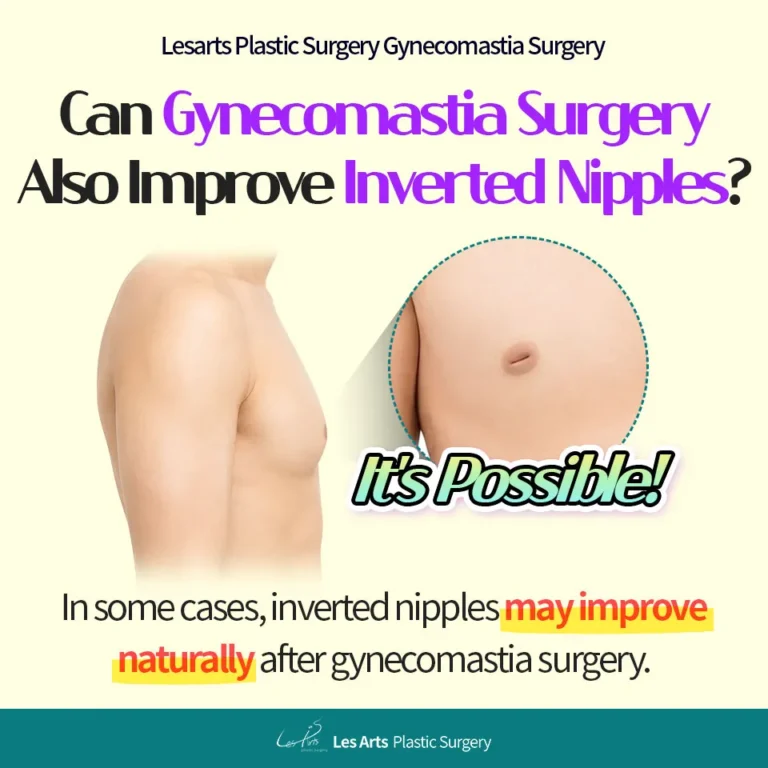
“Doctor, my chest protrudes more than other people’s,
but my nipples are actually sunken inward.Could gynecomastia surgery also help bring my inverted nipples outward?”
Today, I would like to discuss inverted nipples associated with gynecomastia,
a condition that is not particularly common
but can cause additional distress for those affected.
To begin with, there are cases where inverted nipples
naturally improve following gynecomastia surgery.
However, there are important medical limitations and precautions
that must be kept in mind.
2. Causes of Inverted Nipples and Their Connection to Gynecomastia Surgery
How can gynecomastia surgery help bring inwardly retracted nipples outward?
To understand this, we first need to look at the structures
that pull the nipples inward.
Medically speaking, beneath the nipple are lactiferous ducts
and the fibrous bands surrounding them.
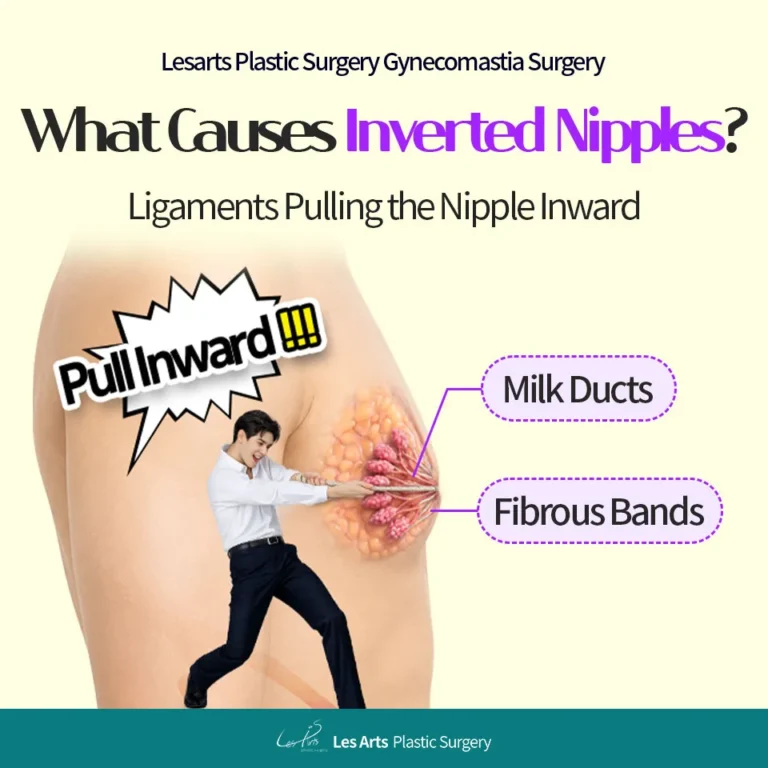
When explaining this to patients, I often refer to these structures as
“ligaments that pull the nipple downward” to make the concept easier to understand.
These fibrous tissues act like ropes, firmly pulling the nipple deep into the chest and preventing it from protruding outward.
Interestingly, an essential part of gynecomastia surgery overlaps with the process of releasing these fibrous structures.
Gynecomastia surgery generally involves two main steps.
1. Direct excision of excessively developed glandular tissue
2. Liposuction of the surrounding subcutaneous fat and dissection of the subcutaneous tissue
During the removal of firm glandular tissue concentrated directly
beneath the nipple and the treatment of the surrounding subcutaneous tissue,
the fibrous bands or ductal structures that strongly pull the nipple inward may naturally be severed or loosened.
*Note: Unlike in women, preserving the lactiferous ducts is generally not necessary in men.*
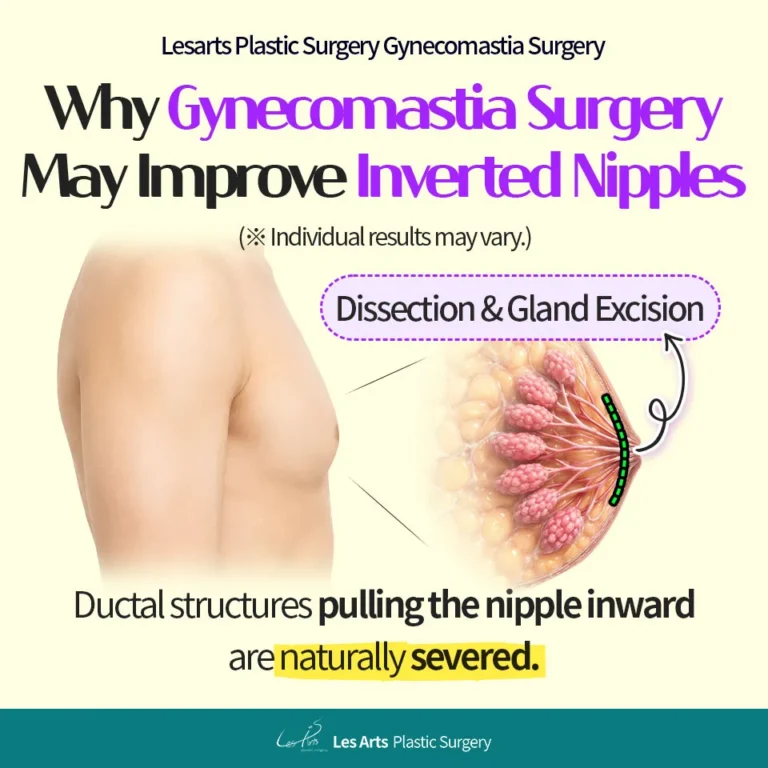
Just as a tightly tied rope is released,
the pulling force holding the nipple inward is reduced,
allowing the previously inverted nipple
to naturally protrude outward after gynecomastia surgery.
This can be a welcome additional improvement.
3. An Honest Explanation in the Consultation Room: “Improvement Is Possible, but Not Guaranteed”
You might then ask,
“Does that mean gynecomastia surgery will completely correct inverted nipples?”
However, I never make such a definitive promise to my patients.
“There are certainly cases where inverted nipples improve after gynecomastia surgery.
However, I cannot guarantee this outcome 100%.”
There are two clear reasons
why I take this cautious approach when explaining the procedure.

First, the Risk of an Unwanted Complication: Nipple Necrosis
Aggressive skin dissection and excessive removal of subcutaneous tissue
beneath the nipple in an attempt to fully correct inverted nipples
can lead to serious complications.
The nipple and areola are highly sensitive areas
with a dense network of blood vessels
that depend on a delicate microvascular blood supply.
If too much emphasis is placed on correcting nipple inversion,
removing tissue too deeply or extensively beneath the nipple
may damage the small blood vessels supplying it.
In the worst-case scenario, this can lead to irreversible damage
known as nipple necrosis.
The primary goal of gynecomastia surgery
is to create a flat, natural contour across the chest.
Aggressive dissection that threatens the viability of the nipple
cannot be justified solely for the additional benefit
of improving inverted nipples.

Second, Uncertainty in Bilateral Nipple Inversion (Possibility of Uneven Improvement)
When gynecomastia and inverted nipples are present on both sides,
even if the same surgeon uses the same surgical technique on both breasts,
one nipple may improve completely
while the other may show only partial improvement.
The human body is not perfectly symmetrical.
The thickness of the fibrous bands pulling each nipple inward,
the degree of fibrosis, and the depth of glandular tissue adhesions
can differ between the two sides.
Therefore, it is important to understand in advance
that the appearance of the nipples may differ after surgery.
4. What If Only One Nipple Is Inverted? Other Causes Should Be Considered
If an inverted nipple is present on only one side,
a condition known as unilateral nipple inversion,
there is another important factor to consider.
If nipple inversion develops suddenly
or becomes significantly more pronounced on one side,
it may not simply be caused by glandular tissue pulling the nipple inward
or congenital fibrous bands.

This is because tumors (lumps), inflammatory conditions,
or other breast lesions beneath the nipple
may pull on the surrounding tissues,
causing the nipple to retract inward.
Therefore, for patients with gynecomastia
accompanied by nipple inversion on only one side,
a detailed ultrasound examination must be performed before surgery
to carefully determine whether any underlying pathological conditions
other than glandular tissue are present beneath the nipple.
Gynecomastia Surgery Before and After Case Analysis
↓↓↓
5. Conclusion: Doing Our Best While Prioritizing Safety
In summary, glandular tissue excision and subcutaneous dissection
performed during gynecomastia surgery
may provide an excellent opportunity to release inverted nipples.
As a surgeon, I always do my best
not only to fully address the patient’s gynecomastia,
but also to improve the inverted nipples
that have caused them distress for so long.
However, I remain cautious about pursuing excessive correction
that goes beyond the limits of surgical safety.
If you are concerned about both gynecomastia and inverted nipples,
I recommend taking a realistic and safety-focused approach:
“While recognizing the possibility of improving inverted nipples
through gynecomastia surgery,
the procedure should always be performed within safe surgical limits.”
FAQ
Q1. How can gynecomastia surgery improve inverted nipples?
During gynecomastia surgery, enlarged glandular tissue is removed and surrounding subcutaneous tissue is dissected.
This process may naturally release the fibrous bands and ductal structures pulling the nipples inward,
allowing them to protrude more normally.
Q2. Is inverted nipple correction guaranteed after gynecomastia surgery?
No. Although inverted nipples may improve naturally during gynecomastia surgery,
complete correction cannot be guaranteed. The outcome depends on the underlying tissue structures
and the extent of release that can be safely achieved.
Q3. Why can aggressive inverted nipple correction be dangerous?
Excessive dissection or tissue removal beneath the nipple
can damage the small blood vessels supplying the nipple and areola. This may compromise blood circulation and,
in severe cases, lead to nipple necrosis. Surgical safety must take priority over additional nipple correction.
Q4. Can both inverted nipples improve differently after gynecomastia surgery?
Yes. Even when both sides are treated using the same surgical technique,improvement may differ.
Variations in fibrous band thickness, tissue fibrosis, and glandular adhesions can cause one nipple to improve more than the other.
Q5. Why is an ultrasound examination important for unilateral inverted nipples?
When only one nipple is inverted, particularly if the inversion develops suddenly or becomes more pronounced,
other underlying conditions should be considered. An ultrasound examination can help identify tumors,
inflammatory conditions, or other breast lesions before gynecomastia surgery.
▼ Visit Lesarts Plastic Surgery in Gangnam, Seoul, Korea ▼