
Mini abdominoplasty in Seoul: can the incision be longer? 7-month results after umbilical floating
Patient Registration Info
| Age | Weight | Height | BMI |
|---|---|---|---|
|
40s |
63kg |
159cm |
25 |
Surgical site
Surgical site : Abdomen, Thighs, Hip Dips, S-Type, Umbilical Floating| liposuction aspirate volume : 3,900cc
Fat Grafting: Hip Dips (Right: 200 cc / Left: 230 cc)
Can Mini Tummy Tuck Incisions Be Longer Than Expected?
Because of the word “mini,” it is easy to assume
that a mini tummy tuck always involves a short incision.
However, the actual incision length depends on
the amount of skin that needs to be removed
and the extent of lower abdominal sagging.
Rather than simply minimizing the incision length,
the procedure should be planned to adequately
tighten and remove excess lower abdominal skin.
After childbirth, a heavy or sagging lower abdomen
cannot always be explained by excess fat alone.
If folds or wrinkles remain even after weight loss,
it may be necessary to evaluate whether
the abdominal skin has lost elasticity.
When subcutaneous fat is the main concern,
liposuction can help reduce abdominal volume.
However, if the skin has already stretched and folded,
liposuction alone may not be enough
to achieve the desired improvement.
In these cases, a tummy tuck may be considered
to remove and tighten excess skin
while bringing separated rectus muscles
back toward the midline.
The appropriate tummy tuck technique depends
on where the skin laxity is located
and how extensive the correction needs to be.
Therefore, rather than choosing a procedure
based on its name alone, the abdominal condition
should first be carefully evaluated.
This patient visited Lesarts considering a mini tummy tuck
to improve skin sagging concentrated
below the belly button after childbirth.
Her goal was not simply to reduce abdominal volume,
but to tighten the stretched skin
and create a smoother lower abdominal contour.
[Preoperative Condition Showing Skin Sagging Below the Belly Button and Lower Abdominal Folds]
During the consultation, the patient showed
skin laxity concentrated below the belly button.
The stretched skin overlapped the lower abdomen,
making the lower abdominal fold noticeable
even while standing upright.
Rectus diastasis was also present,
and fat was distributed throughout the abdomen,
so both skin sagging and abdominal thickness
needed to be addressed.
When the patient bent forward,
the loose skin shifted further downward,
making the sagging and folds of the lower abdomen
even more noticeable.
[S-Type Mini Tummy Tuck Plan with Belly Button Floating]
The patient’s main concerns were
skin sagging and folding below the belly button.
Because the existing belly button was positioned
relatively high, we planned an S-type mini tummy tuck
with the belly button floating technique to correct
both the loose lower abdominal skin and rectus diastasis.
Belly button floating does not involve creating
a new belly button. Instead, as the surrounding skin
is pulled downward, the existing belly button naturally
moves approximately 1–2 cm lower.
The patient was informed in advance
that her belly button could sit slightly lower
after surgery.
Because it is called a “mini” tummy tuck,
many patients assume the incision will also be short.
However, the length of a tummy tuck incision
depends on the vertical amount of skin being removed
and the extent of skin sagging.
If a large amount of skin needs to be removed
but the incision is kept too short, excess skin
may gather at both ends or the abdomen
may not be tightened sufficiently.
For this patient, we therefore explained that
adequately removing and tightening the loose lower abdominal skin
was more important than simply minimizing the incision length.
The patient also chose to prioritize
proper correction of the lower abdominal sagging
rather than insisting on a shorter incision.
Abdominal liposuction was performed at the same time
to reduce abdominal thickness and create
a smoother contour from the waist to the lower body.
Liposuction of the outer thighs and hip line,
along with hip dip fat grafting, was also planned
to create more balanced proportions
between the upper and lower body.
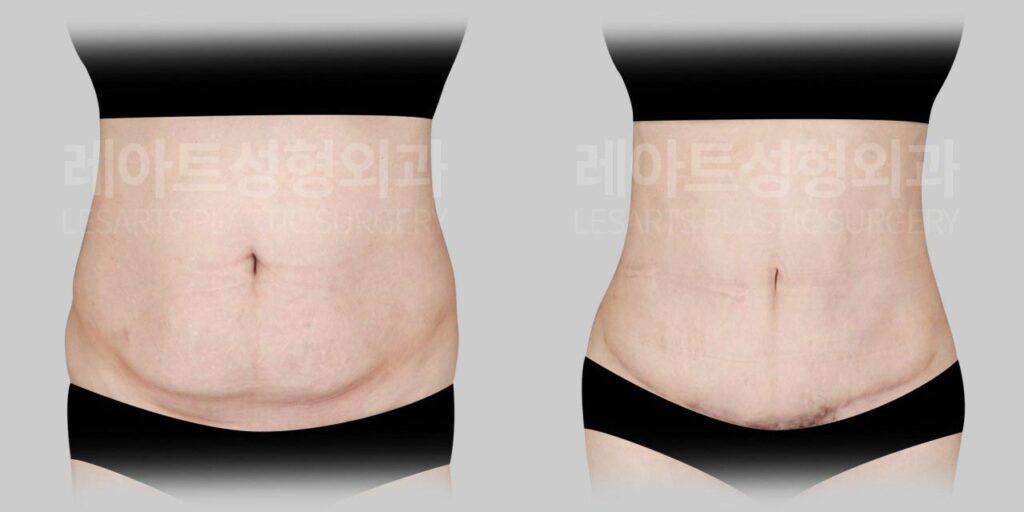
[Changes in Lower Abdominal Skin Sagging and Waistline 7 Months After Tummy Tuck]
Let’s compare the changes 7 months after
an S-type mini tummy tuck with belly button floating.
The loose skin that previously sagged below
the belly button was tightened, reducing
the folds and heaviness of the lower abdomen.
The front of the abdomen also appears
smoother than before surgery.
The protruding abdominal wall was corrected,
while abdominal liposuction helped reduce
the thickness of the abdomen and flanks.
As the volume along both sides of the waist decreased,
the curve leading into the pelvis became
more naturally defined.
Fat grafting to the hip dip area also helped
create a smoother transition from the waist
to the outer hip contour.
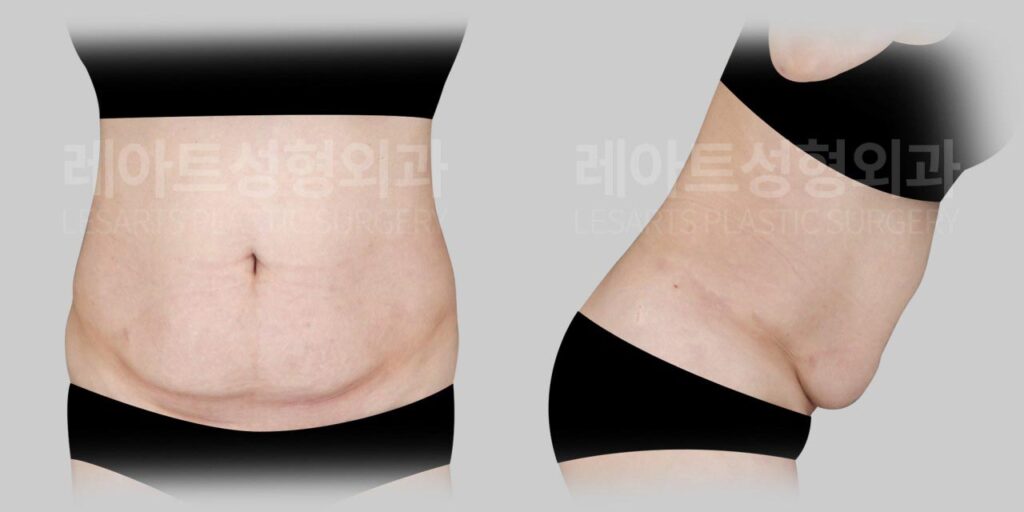
[Changes in Lower Abdominal Protrusion and Skin Sagging 7 Months After Tummy Tuck]
Before surgery, loose skin and abdominal wall laxity
made the lower abdomen appear heavy
and protrude forward.
After surgery, the excess skin was removed
and the abdominal wall was tightened,
creating a flatter and firmer abdominal contour.
Fat in the abdomen and flanks was also reduced,
resulting in a slimmer torso profile
when viewed from the side.
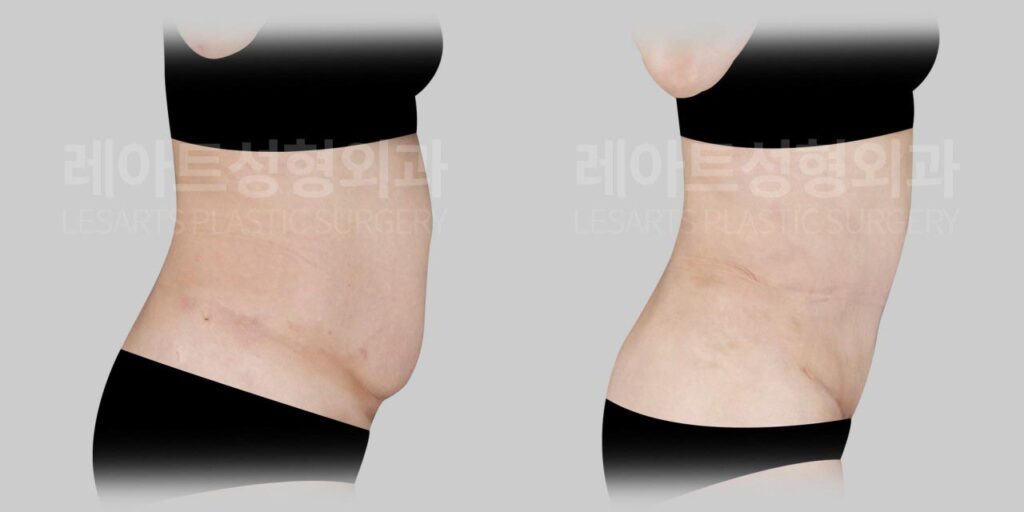
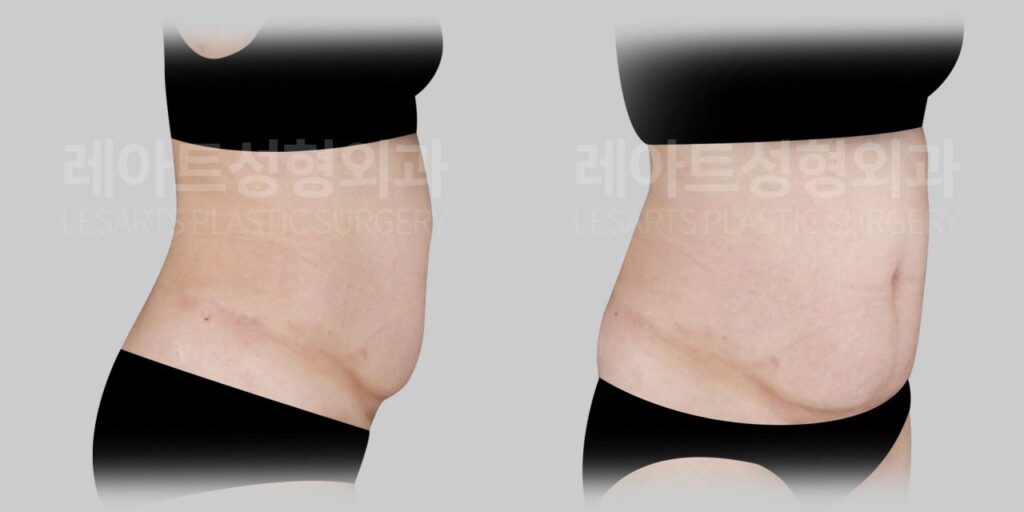
[Changes in Lower Abdominal Protrusion Seen from the Side 7 Months After Tummy Tuck]
From the side view, the reduction in
skin sagging and abdominal fullness concentrated
around the lower abdomen is even more noticeable.
Before the tummy tuck, the lower abdomen sagged downward,
giving the upper body a heavier appearance.
After surgery, the contour from the upper abdomen
to the lower abdomen appears smoother,
lighter, and more streamlined.
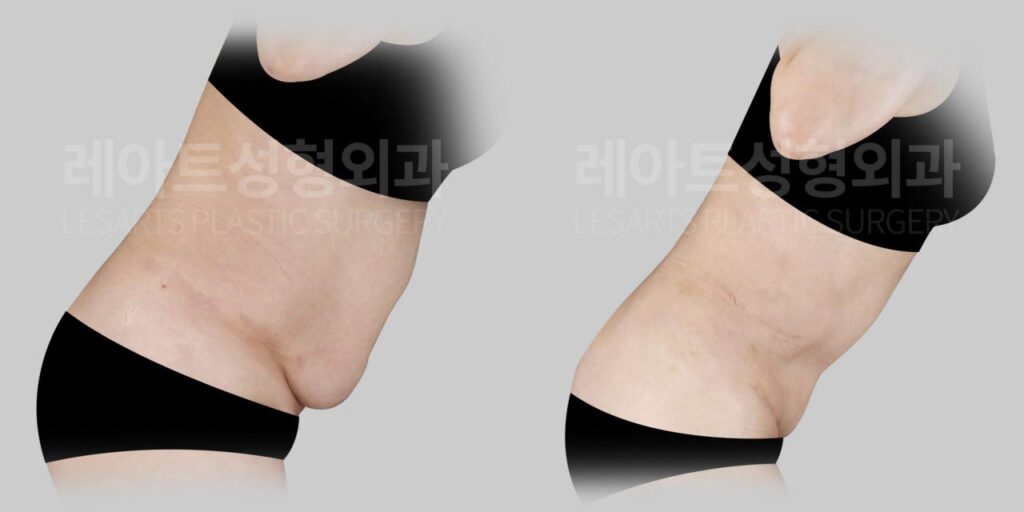
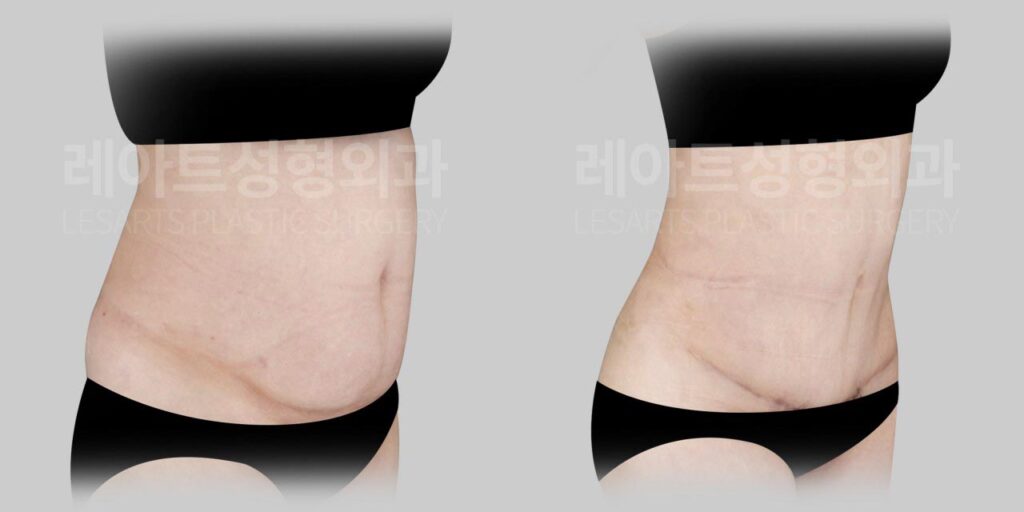
[Changes in Lower Abdominal Skin Folds When Bending Forward 7 Months After Tummy Tuck]
This patient’s skin sagging became especially noticeable
when changing posture.
Before surgery, bending forward caused the lower abdominal skin
to shift downward and form deep folds.
After surgery, the amount of overlapping skin was reduced
even when the patient changed position.
As the abdominal skin now sits closer to the torso,
the front abdominal contour remains firmer
even when bending forward.
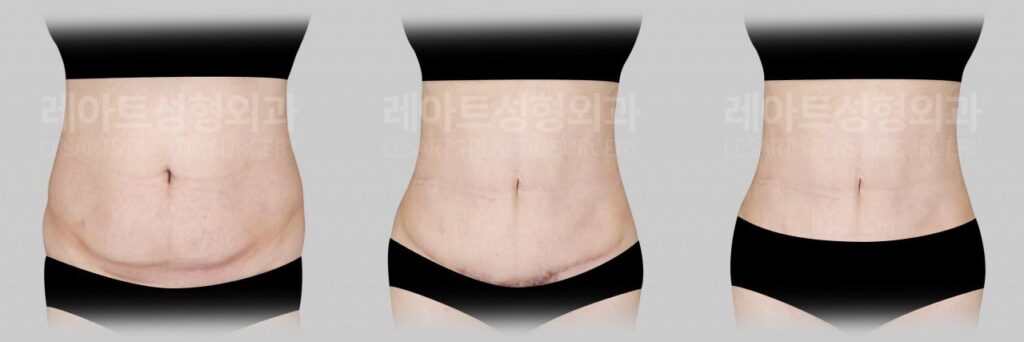
[Incision Line Within the Panty Line and Scar Healing 7 Months After Tummy Tuck]
The tummy tuck incision is positioned low
on the lower abdomen, allowing it to be naturally
covered when wearing underwear.
At 7 months after surgery, the redness
of the scar has also begun to fade
compared with the earlier recovery period.
Because scars continue to mature gradually over time,
consistent scar care and regular follow-up
remain important.
In this patient, a relatively large amount of skin
needed to be removed, so the incision was designed
to extend toward the front of the hips.
A mini tummy tuck does not always mean
that the incision will be short. The incision length
can vary depending on the extent of skin laxity
and the amount of skin that needs to be removed.
Therefore, if lower abdominal sagging or skin folds
remain after childbirth, it is important to consider
the current skin condition and the extent of correction needed
rather than choosing a procedure based solely
on the expected incision length.
Mini Tummy Tuck FAQ
Q1. Is the incision always short with a mini tummy tuck?
Even with a mini tummy tuck, the incision may be longer
depending on the amount of skin that needs to be removed
and the extent of skin sagging.
If the incision is made too short,
the loose skin may not be adequately corrected.
Q2. Does belly button floating change the position of the belly button?
As the surrounding skin is pulled downward,
the existing belly button may naturally move
approximately 1–2 cm lower.
The actual change depends on
the extent of skin removal.
Q3. Can rectus diastasis be corrected with a mini tummy tuck?
Depending on the location and extent
of the rectus muscle separation,
rectus diastasis repair may be performed together.
The abdominal wall should be evaluated
during consultation to determine whether correction is possible.
Q4. Can tummy tuck and liposuction be performed together?
If excess subcutaneous fat is present along with
abdominal skin sagging, liposuction may be performed
to reduce the thickness of the abdomen and flanks.
Q5. Is scar care still necessary 7 months after a tummy tuck?
At 7 months, scar redness may be fading
as the scar continues to mature.
Ongoing scar care and regular follow-up
are recommended based on the condition of the scar.
▼ Visit Lesarts Plastic Surgery in Gangnam, Seoul, Korea ▼