
Abdominal liposuction in Seoul: waistline changes 1.5 months after removing stubborn love handles
Patient Registration Info
| Age | Weight | Height | BMI |
|---|---|---|---|
|
20s |
48kg |
160m |
19 |
Surgical site
Surgical site : Abdomen|liposuction volume : 2,400 cc
Can Abdominal Liposuction Define the Waistline in a Slim Body Type?
Even when overall body fat is relatively low,
fat concentrated around the flanks and navel
can make the waistline appear less defined.
By evaluating the current fat distribution
along with the shape of the rib cage and pelvis,
targeted fat reduction can create a more defined line
from the waist to the hips.
Some patients considering abdominal liposuction
believe that surgery means they will no longer need to diet,
while others think liposuction is unnecessary
if they lose enough weight.
However, dieting and liposuction serve different purposes
rather than producing exactly the same changes.
Dieting can help reduce overall body weight and body fat,
but it may have limitations when it comes to contouring
stubborn areas such as the flanks or around the navel
into a specific shape.
Likewise, liposuction is not a substitute
for weight loss.
It is better understood as a procedure that targets
areas where fat is concentrated based on the patient’s body shape,
while continued body management remains important afterward.
In this case, we will look at a patient with a relatively slim build
who was concerned about stubborn flank fat that did not improve easily
with exercise, and examine how her waistline changed
after abdominal liposuction.
The patient had an overall slim body type,
but was particularly concerned that fat remaining around the flanks
made her waistline appear less defined.
She wanted to reduce the thickness of the flanks
to create a slimmer and more defined transition
from the waist to the hips.
[Patient Information]
Height: 160 cm
Weight: 48.8 kg
BMI: 19.1
Although she did not have a large amount of overall body fat,
subcutaneous fat was concentrated around the flanks,
making the waistline appear wider.
Because there was relatively sufficient distance
between the rib cage and pelvis, reducing the thickness
of the flanks was expected to reveal the natural waistline
created by her existing skeletal structure.
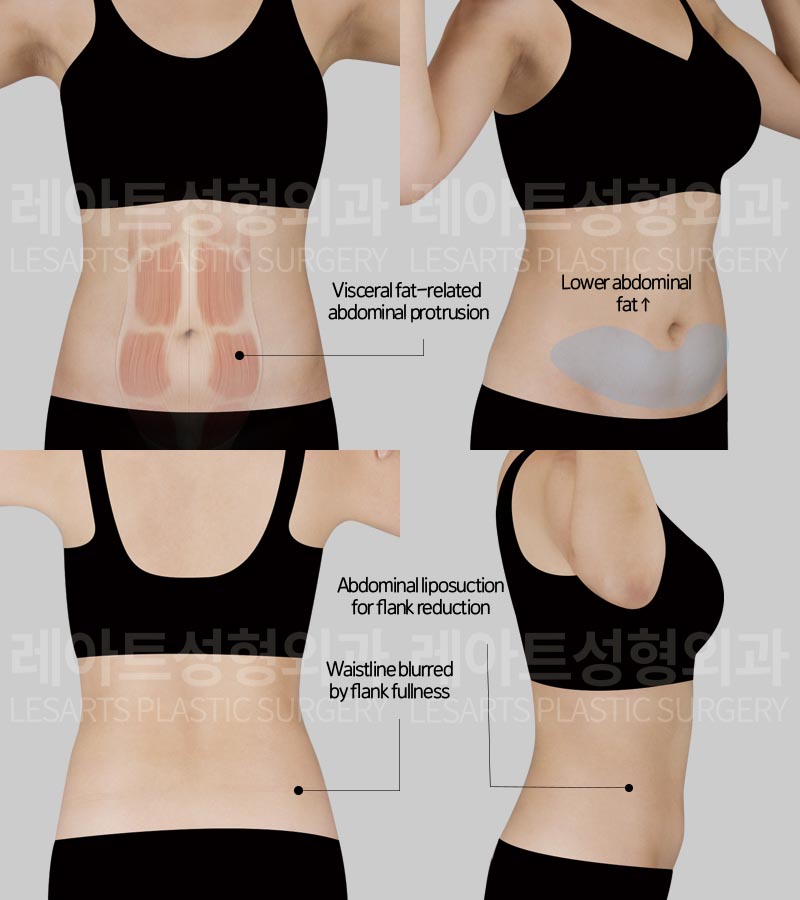
[Preoperative Waistline with Persistent Flank Fat Despite Exercise]
Because the flanks were the patient’s primary concern,
the procedure was planned to focus on reducing
the thickness of this area.
However, rather than simply removing as much fat as possible,
it was important to adjust the depth of liposuction by area
to create a natural transition from the waist to the hips.
Some asymmetry in the patient’s skeletal structure
was also identified before surgery. Therefore, instead of removing
the same amount from both sides, the procedure was planned
to achieve the best possible balance based on her existing body shape.
The front abdomen also showed some projection
that appeared to be influenced by visceral fat
in addition to subcutaneous fat.
Because visceral fat cannot be removed through liposuction,
the patient was informed that continued lifestyle management,
including diet and exercise, would still be important after surgery.
▶ ▶ View Abdominal Liposuction Before & After Cases
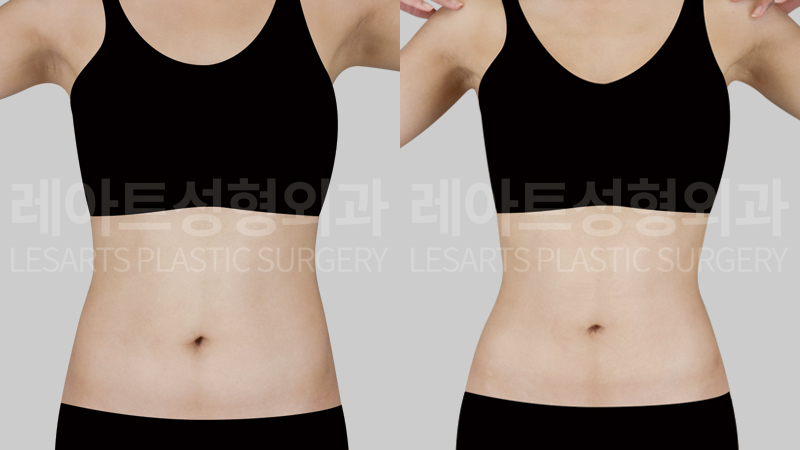
[Changes in the Flanks and Waistline 1.5 Months After Abdominal Liposuction – Front View]
Let’s compare the changes seen
1.5 months after abdominal liposuction.
Before surgery, the thickness of the flanks
made the waistline appear wider. After surgery,
the reduced volume on both sides made
the waistline appear more defined.
As the slimmer waistline transitions naturally into the hips,
the overall body proportions also appear more balanced.
Because the patient already had a relatively slim build,
the goal was not to remove an excessive amount of fat.
Instead, liposuction focused on the prominent areas of the flanks
to naturally enhance the contours of her existing body shape.
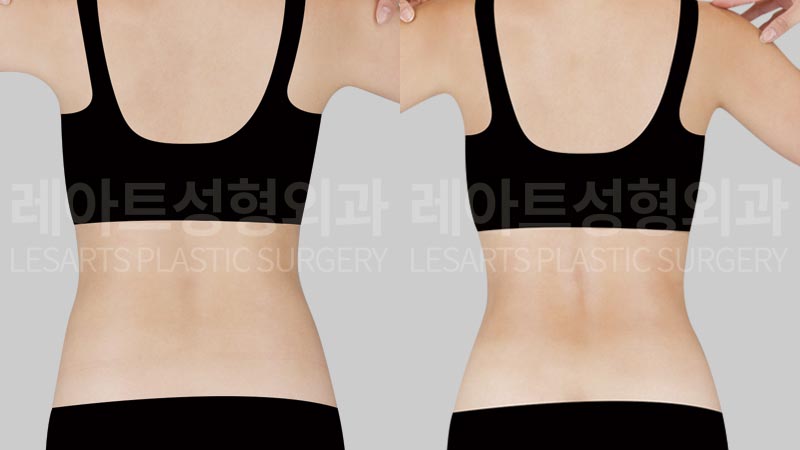
[Changes in the Flanks and Waistline 1.5 Months After Abdominal Liposuction – Back View]
From the back, the reduced volume on both sides
of the waist made the previously less-defined hip line
appear more naturally visible.
The patient had some pre-existing skeletal asymmetry.
The depth and range of liposuction were adjusted
on each side to achieve a more natural balance
without making the existing asymmetry more noticeable.
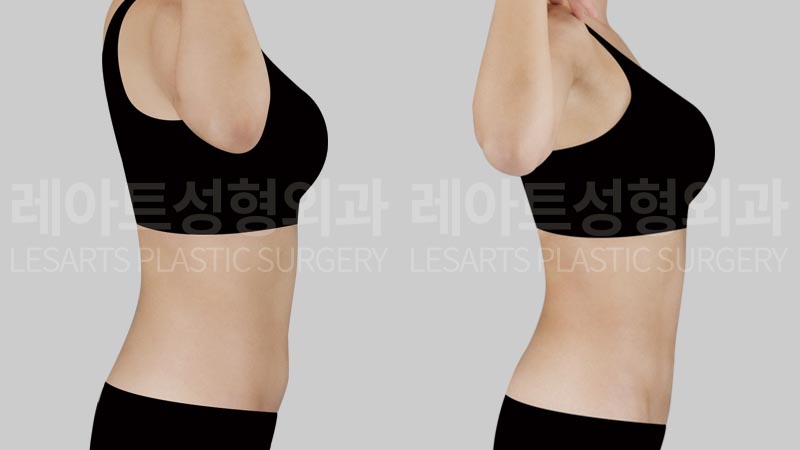
[Changes in Abdominal Thickness and Lower Abdomen 1.5 Months After Abdominal Liposuction – Side View]

[Changes in the Flanks and Waist Contour 1.5 Months After Abdominal Liposuction – Three-Quarter View]
From the side view, changes in the thickness
of both the front abdomen and flanks can be seen.
Before surgery, the lower abdomen projected forward,
making the upper body appear somewhat heavier.
After surgery, reducing the subcutaneous fat created
a slimmer and cleaner abdominal contour.
However, because visceral fat also contributed
to the projection of the front abdomen, the goal was not
to eliminate all abdominal fullness through liposuction.
Instead, removable subcutaneous fat was reduced,
with continued lifestyle management recommended afterward.
From the three-quarter view, the change in the flanks,
which had been the patient’s main concern,
is even more noticeable.
As the flanks became slimmer, the waist curve
appeared more defined, while the hip line below
became naturally more prominent.
Maintaining healthy lifestyle habits and stable body weight
after abdominal liposuction can also help preserve
the newly defined waistline.
If stubborn flank fat remains despite repeated dieting,
it is important to evaluate the current fat distribution,
skeletal structure, and cause of abdominal projection
before planning an approach suited to the desired waistline.
▶ View Abdominal Liposuction Procedure Details
Abdominal Liposuction FAQ
Q1. Can slim patients undergo abdominal liposuction?
Even with a low overall body weight, abdominal liposuction
may be considered if there is removable subcutaneous fat
around areas such as the flanks or navel.
The actual fat thickness and skin condition should be evaluated
to determine whether the procedure is appropriate.
Q2. Can abdominal liposuction reduce flank fat?
If concentrated subcutaneous fat around the flanks
makes the waistline appear wider, reducing the thickness
of this area can help create a more defined waistline.
Q3. Can liposuction remove visceral fat?
Abdominal liposuction removes subcutaneous fat
located beneath the skin.
Visceral fat located deeper inside the abdomen
cannot be removed through liposuction and should be managed
through measures such as diet and exercise.
Q4. Can I have abdominal liposuction if I have skeletal asymmetry?
Liposuction cannot change the underlying skeletal structure,
but the amount and depth of fat removal on each side
can be adjusted to help reduce visible differences.
Q5. Do I still need to manage my weight after abdominal liposuction?
Liposuction is not a substitute for weight loss.
Maintaining healthy eating habits and regular exercise
after surgery can help preserve the improved abdominal contour.
▼ Visit Lesarts Plastic Surgery in Gangnam, Seoul, Korea ▼