
Gynecomastia Surgery | Simon Grade 2A, 2 Weeks After Surgery – Lesarts Plastic Surgery
Can Simon Grade 2A gynecomastia show noticeable improvement just 2 weeks after surgery?
Yes. Even at 2 weeks, reduced lower-chest volume,
a flatter areola, and a more masculine chest contour
may already be noticeable, although swelling and bruising can still remain.
[ Learn More About Gynecomastia at Lesarts Plastic Surgery ]
Written by Dr.Kukhan Lee, Lesarts Plastic Surgery
This article was written directly by the attending surgeon.
※Unauthorized reproduction, editing, or redistribution is prohibited.※
Hello, I am Kukhan Lee from Lesarts Plastic Surgery.
As the long rainy season comes to an end,
the summer heat is now in full swing.
As temperatures rise, clothing naturally becomes lighter,
but for many men with a noticeable chest protrusion,
even wearing a single thin T-shirt can feel uncomfortable.
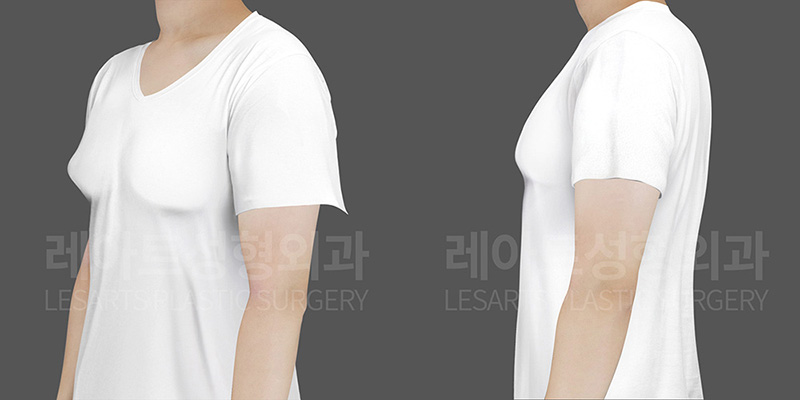
Chest Protrusion and T-Shirt Fit Before Gynecomastia Surgery
If your chest has remained prominent
despite regular exercise and weight loss,
it may be worth considering Gynecomastia
as a possible cause.
Today, we will look at the 2-week recovery
of a patient diagnosed with
Simon Grade IIa Gynecomastia.
The patient was a man in his 20s
who had long been concerned about
the size and protrusion of his chest.
He first noticed the prominent chest contour
around puberty, and despite consistent exercise
and weight loss as an adult,
there was little visible improvement.
He eventually visited our clinic
for further evaluation.
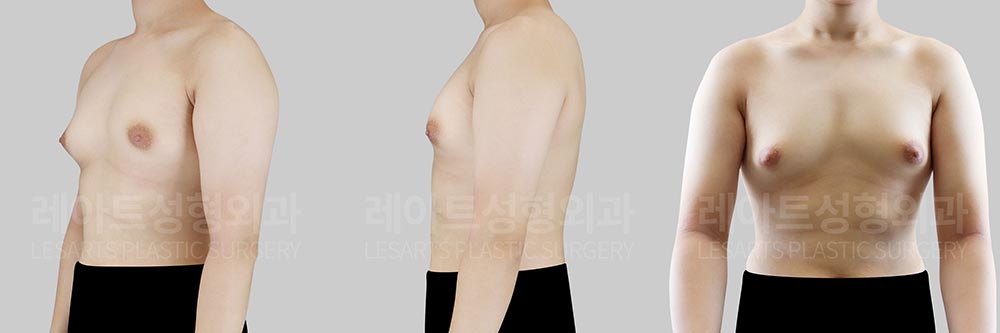
Gynecomastia Symptoms – Increased Chest Size, Enlarged Areolae, and Nipple Protrusion
Physical examination revealed moderate to significant breast enlargement,
but there was no noticeable skin sagging
or breast ptosis.
Both the nipples and areolae were
larger than average, with overall findings
consistent with moderate to significant Gynecomastia.
Aside from the cosmetic concern,
there were no associated symptoms such as
breast pain or nipple discharge.
Ultrasound examination confirmed
significant overgrowth of glandular breast tissue.
Compared with typical Gynecomastia cases,
the degree of glandular development
was particularly pronounced.
Overall, the patient was diagnosed
with Simon Grade IIa Gynecomastia.
The Simon classification is not based solely
on physical findings, but also reflects
the physician’s clinical assessment.
Considering glandular size alone,
this case could potentially have been
classified as Grade III.
However, I considered the presence
of skin laxity and breast ptosis
to be the more important criteria.
As glandular tissue becomes larger and heavier,
the skin is more likely to stretch,
increasing the risk of breast ptosis.
In such cases, residual skin laxity
or wrinkling may remain
even after surgery.
This patient, however, had excellent skin elasticity,
and ultrasound examination showed
adequate skin thickness.
Despite the large amount of glandular tissue,
there was minimal skin sagging,
which supported the diagnosis of Simon Grade IIa.
The patient was also concerned
about his enlarged nipples and areolae.
However, I initially recommended performing
only subcutaneous mastectomy
to treat the Gynecomastia.
The enlarged areolae were likely caused
in large part by pressure from
the overdeveloped glandular tissue.
Therefore, removing the glandular tissue
could allow the areolar diameter
to decrease naturally without additional surgery.
Although areola reduction surgery can reduce size,
it may create an unnatural transition
between the areola and surrounding skin,
so it should be approached carefully.
We also decided to monitor
the nipple size after surgery first.
Once Gynecomastia is corrected,
the highest point of the chest contour
shifts from the lower chest toward the upper chest.
As a result, nipple protrusion often becomes
much less noticeable than before surgery.
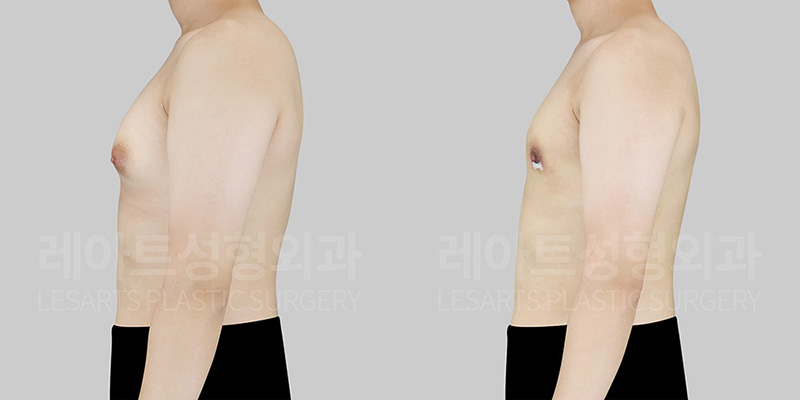
[14 Days After Gynecomastia Surgery]
This image was taken 2 weeks after surgery,
following removal of the sutures.
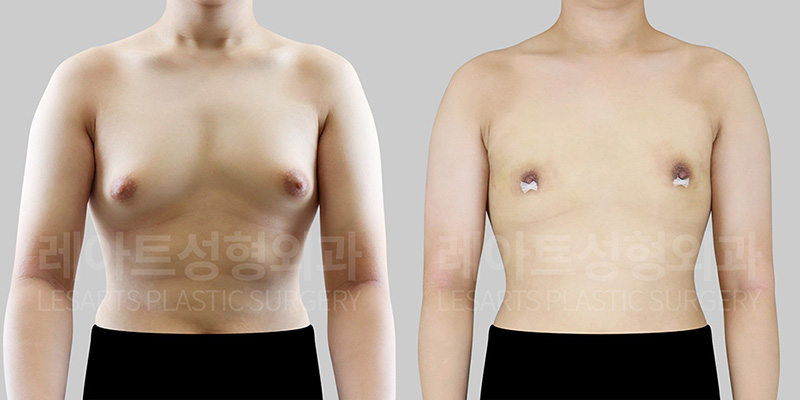
Early Results After Gynecomastia Surgery – Dr. Lee Gukhan, Lesarts
Although some swelling and bruising
are still present at this stage,
the overall change in chest contour
is already clearly visible.
The enlarged lower chest was corrected
by removing the overdeveloped glandular tissue
and performing liposuction where needed.
This created a flatter, more natural shape
and a more masculine overall chest contour.
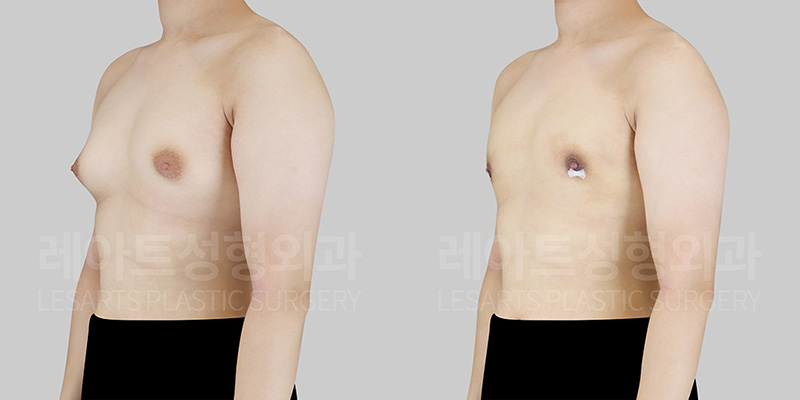
Gynecomastia After Suture Removal – Dr. Lee Gukhan, Lesarts Plastic Surgery
Early Results After Gynecomastia Surgery – Dr. Lee Gukhan, Lesarts Plastic Surgery
Significant changes were visible
from the front, oblique, and side views
compared with before surgery.
The patient was also highly satisfied
with the overall result.
The areola size decreased naturally
after surgery.
The previously enlarged and protruding areolae
became flatter, and the areolar diameter
also decreased following removal
of the glandular tissue.
During this contraction process,
the areolae may temporarily appear darker.
This is a natural change that occurs
as pigment previously spread over a wider area
becomes concentrated within a smaller area
and is generally not a cause for concern.
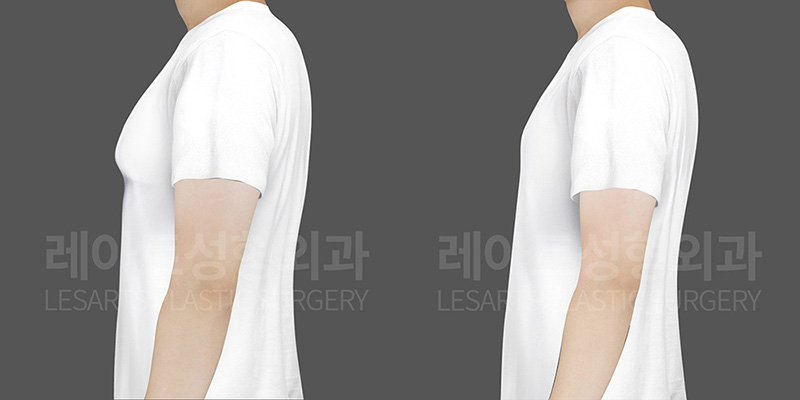
Although the nipples remain relatively large,
reducing the lower-chest volume shifted
the highest point of the chest
toward the upper chest.
As a result, nipple protrusion under clothing
was noticeably reduced compared with
before Gynecomastia surgery.

T-Shirt Fit Before and After Gynecomastia Surgery – Dr. Lee Gukhan, Board-Certified Plastic Surgeon
Chest Contour Changes 2 Weeks After Gynecomastia Surgery – Lesarts Plastic Surgery
As recovery progresses and the patient
incorporates chest-strengthening exercises,
greater upper-chest volume may further enhance
the overall contour and balance.
If concerns about nipple size persist,
nipple reduction surgery may be considered
approximately 3 months after surgery.
Because this patient had significant
glandular tissue overgrowth, there was
a possibility of residual skin sagging
or wrinkling after correction.
However, his skin elasticity was excellent,
and adequate skin thickness was maintained.
This allowed the skin to contract well
after Gynecomastia surgery, contributing
to a stable and natural result.
Since it has only been 2 weeks
since surgery, further improvement can be expected
as swelling continues to decrease
and the tissues gradually stabilize.
Over time, the chest is expected
to develop an even more natural contour.
View More Gynecomastia Surgery Cases
▽▼▽
If Gynecomastia makes you uncomfortable
wearing a thin T-shirt or taking your shirt off
at the pool or beach, you do not have
to continue dealing with the concern alone.
If the chest contour does not improve
despite exercise or weight loss,
it may be worth checking whether
Gynecomastia is the underlying cause.
With an accurate diagnosis and appropriate treatment,
you can work toward a more comfortable
and confident everyday life.
FAQ
Q1. What is Simon Grade IIa gynecomastia?
Simon Grade IIa gynecomastia involves moderate chest enlargement without significant skin excess or breast ptosis.
The final classification may also depend on skin elasticity, gland size, and the physician’s clinical assessment.
Q2. Can gynecomastia improve with exercise or weight loss?
Exercise and weight loss can reduce chest fat, but enlarged glandular tissue may remain.
If chest protrusion persists despite weight management, an ultrasound examination can help determine whether gynecomastia is present.
Q3. Can enlarged areolas become smaller after gynecomastia surgery?
Yes. When areolar enlargement is caused by pressure from overdeveloped glandular tissue,
removing the gland may allow the areola to flatten and decrease naturally in size.
For this reason, areola reduction surgery may not always be necessary.
Q4. What changes can be seen two weeks after gynecomastia surgery?
At two weeks, swelling and bruising may still remain, but changes in overall chest contour can already be visible.
In this case, the lower chest became flatter, and the previously protruding areola also appeared less prominent.
Q5. When can nipple reduction be considered after gynecomastia surgery?
It is generally better to observe how the chest contour changes as swelling subsides and the tissues stabilize.
In this case, if nipple size remains a concern, nipple reduction may be considered around three months after surgery.
▼ Visit Lesarts Plastic Surgery in Gangnam, Seoul, Korea ▼