Breast fat transfer in Korea: upper breast volume and fat retention at 7 months
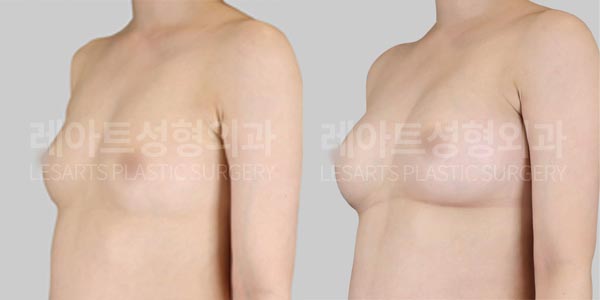
Patient Registration Info
| Age | Weight | Height | BMI |
|---|---|---|---|
|
20s |
55kg |
161cm |
21 |
Surgical site
Surgical site : Breast| liposuction volume : -|Fat Transfer: –
Can the volume from breast fat grafting be maintained for up to 7 months?
In the early stages after breast fat grafting,
breast volume may change as swelling subsides
and some of the transferred fat is absorbed.
Over time, the surviving fat settles
into the surrounding tissue, and by around 7 months,
the breast size and shape can be evaluated
in a relatively stable state.
Among patients considering breast fat grafting,
many are more concerned about restoring
upper breast fullness than increasing overall breast size.
Rather than simply increasing bra cup size,
the goal is often to preserve the natural breast shape
while restoring volume where it is lacking,
creating a fuller and more natural-looking breast contour.
After significant weight loss,
fat volume in the breasts may also decrease,
causing the upper breasts to appear flatter
or making the breasts look more deflated than before.
The patient featured in this case
also wanted a natural increase in breast volume
while improving the hollow, flat appearance
of the upper breast.
She visited Lesarts Plastic Surgery
to discuss breast fat grafting
based on these aesthetic goals.
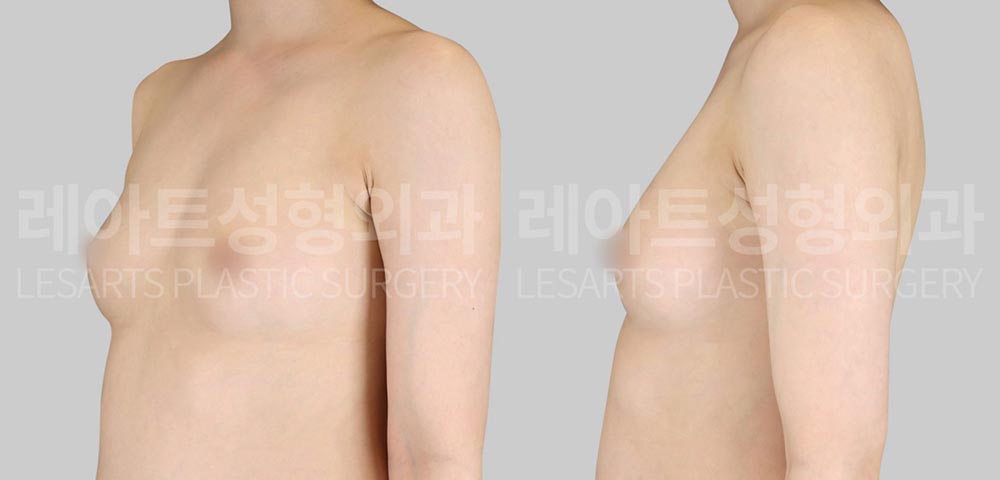
[Preoperative Breast Condition with Insufficient Upper Breast Volume]
Before surgery, the patient had
relatively low overall breast volume,
with particularly noticeable flatness
in the upper breast area.
Even when wearing a bra,
the upper portion of the breast
did not fully fill the cup,
making the breasts appear
lower and smaller than desired.
Although the natural breast curve
was already present,
the lack of upper breast fullness
made both the front and side views
appear less three-dimensional.
Adequate upper breast volume
can create a naturally fuller contour
when wearing tube tops
or fitted clothing,
giving the breasts a firmer
and more balanced appearance.
In this patient, however,
the upper breast was relatively deficient
compared with the lower breast volume,
making the visual center of the breasts
appear lower.
As a result, the breasts appeared
slightly droopy even though
significant skin sagging was not present.
We therefore planned breast fat grafting
with a focus on restoring
the deficient upper breast volume
while creating a smooth transition
throughout the entire breast contour.
After the harvested fat
was processed to remove
unnecessary components,
it was injected across multiple tissue layers
rather than concentrated in one area,
allowing the transferred fat
to contact the surrounding tissue evenly.
The existing lower breast volume
was preserved, while the upper
and central breast areas were enhanced
to create a smoother,
more continuous breast curve.
Unlike breast implants,
breast fat grafting does not involve
placing a predetermined shape
into the breast.
For this reason, the surgical plan
must take into account
the patient’s existing breast shape,
skin characteristics,
and the amount of fat available for transfer.
In the following photos taken
7 months after breast fat grafting,
we will examine how the upper breast volume
and overall breast contour changed.
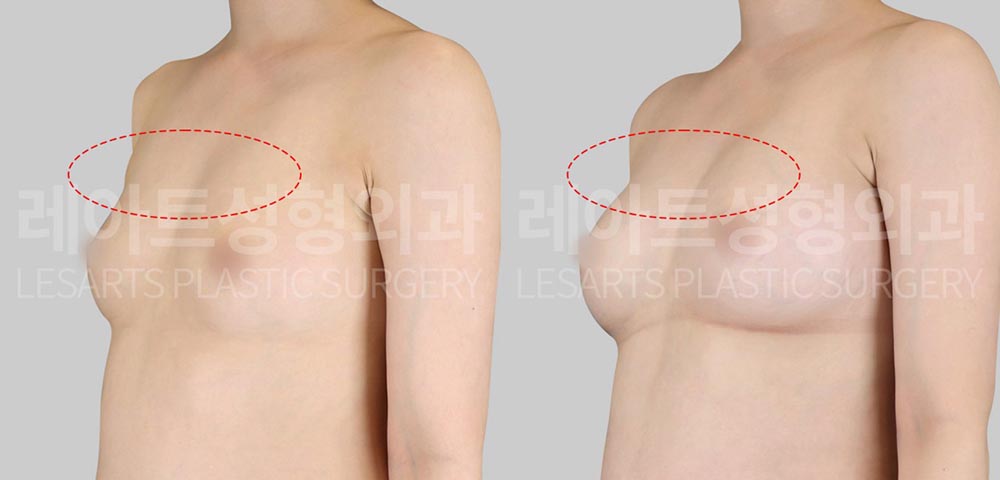
[7 Months After Breast Fat Grafting: Overall Volume Changes from the Oblique View]
These photos show the results
7 months after breast fat grafting.
The upper breast area,
which appeared relatively flat before surgery,
has been naturally filled, creating
a smoother curve from the upper
to the lower breast.
Overall breast volume has also increased,
but rather than creating excessive projection
in one specific area, the added volume
blends naturally with the patient’s
existing breast shape.
At 7 months after surgery,
most of the initial swelling
and fat absorption process has passed.
The volume visible at this stage
is primarily maintained by the fat
that has successfully survived.
When wearing a bra,
the restored upper breast fullness
allows the breasts to sit more naturally
within the cups, while the central breast contour
also appears more defined.
The key change is not simply
an increase in overall breast size.
By restoring upper breast volume,
the overall height and balance
of the breasts have also improved.
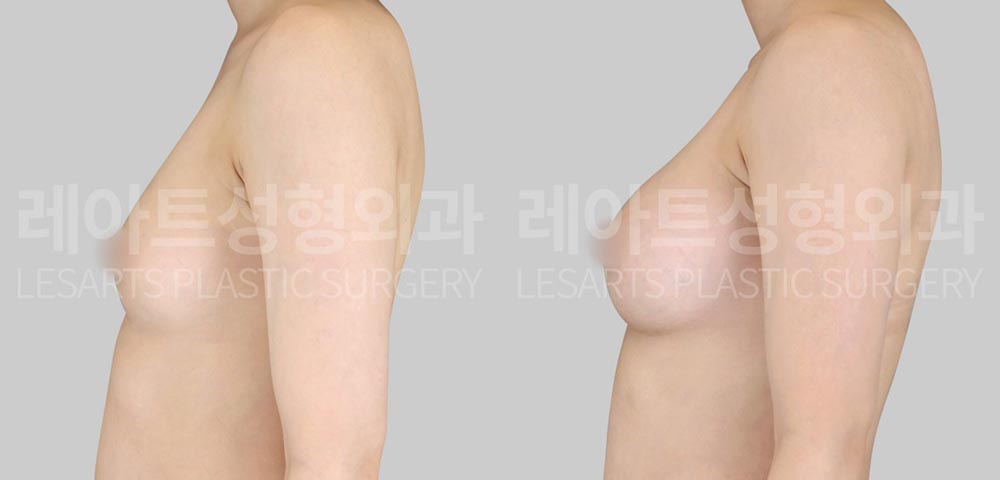
[7 Months After Breast Fat Grafting: Changes in Upper Breast Contour from the Side View]
From the side view,
the improvement in upper breast volume
is even more noticeable.
Before surgery, the upper breast appeared flat,
while the lower breast volume was relatively prominent,
making the breasts appear somewhat droopy.
After surgery, volume extends smoothly
from the upper breast to the central breast,
creating a fuller and firmer-looking
overall breast contour.
As the upper breast became fuller,
the starting point of the breast appears higher,
while the transition between the upper body
and breast looks more natural,
adding greater dimension to the side profile.
Because fat grafting uses the patient’s own fat,
the breasts can maintain relatively natural
movement and softness.
However, the amount of fat that can be transferred
and the long-term fat survival rate
vary from patient to patient.
There may also be limits to the degree
of size increase achievable in a single procedure.
In this patient, both the upper breast fullness
and overall breast volume remained stable
at the 7-month follow-up,
naturally improving the flat upper breast contour
that had been a concern before surgery.
An important aspect of breast fat grafting
is not simply injecting a large amount of fat
at one time.
The fat should be distributed appropriately
across suitable tissue layers and areas
to support stable fat survival.
If too much fat is concentrated
in a single area, complications such as
fat clumping, calcification,
or oil cysts may occur.
For this reason, an appropriate amount
should be carefully distributed
according to the condition of the breast tissue.
After surgery, patients should avoid
strong pressure or repeated stimulation
of the breasts and follow
the recommended postoperative care instructions.
Significant weight loss may also reduce
the size of the surviving fat cells.
Maintaining a relatively stable body weight
can therefore help preserve breast volume
over the long term.
If your goal is not only
to increase overall breast size,
but also to improve concerns such as
upper breast hollowness or volume asymmetry,
the surgical plan should consider
your existing breast shape, skin condition,
and the amount of fat available for transfer.
#breastfatgrafting
#upperbreastvolume
#fatgraftsurvival
#breastcontouring
#lesartsplasticsurgery
FAQ
Q1. How long does fat absorption continue after breast fat grafting?
During the early recovery period,
breast volume may change as swelling subsides
and some of the transferred fat is absorbed.
These changes generally continue over several months.
After this period, the surviving fat
tends to remain relatively stable.
Q2. Can breast volume decrease even 7 months after fat grafting?
Most of the initial fat absorption
has already occurred by this stage.
However, significant weight loss can reduce
the size of the surviving fat cells.
Conversely, weight gain may also increase breast volume.
Q3. Can breast fat grafting be used to fill only the upper breasts?
Depending on the existing breast shape
and skin condition, fat can be grafted
primarily to the upper breast area.
However, the surrounding areas should also be considered
when determining the injection range
to create a smooth, natural contour.
Q4. Can I achieve my desired breast size with one fat grafting procedure?
The amount of change achievable in one procedure
depends on the available donor fat, skin capacity,
and individual fat survival.
If a significant increase in breast size is desired,
additional fat grafting or other surgical options
may need to be considered.
Q5. Can I wear compression underwear after breast fat grafting?
Garments that strongly compress the breasts
should generally be avoided during early recovery
to prevent unnecessary pressure on the grafted areas.
The appropriate timing and type of underwear
should be determined according to the surgical extent
and recovery progress based on your surgeon’s guidance.
▼ Visit Lesarts Plastic Surgery in Gangnam, Seoul, Korea ▼