Revision abdominal liposuction in Seoul: reshaping a thicker waistline after weight gain
Patient Registration Info
| Age | Weight | Height | BMI |
|---|---|---|---|
|
30s |
58kg |
156cm |
24 |
Surgical site
Surgical site : Abdomen| liposuction volume : 4,100cc
Can Weight Gain After Abdominal Liposuction Require Revision Surgery?
Even if you have previously undergone abdominal liposuction,
revision surgery may be considered if weight gain
has caused the remaining fat layer to become thicker again.
However, every patient is different.
Scar tissue from the first procedure,
the amount of remaining fat, and skin quality
must all be carefully evaluated before planning revision surgery.
In this case, we introduce a patient
who underwent revision abdominal liposuction
after significant weight gain.
The patient had previously received
abdominal liposuction at another clinic.
However, after gaining a considerable amount of weight,
the abdomen gradually became fuller again,
particularly around the navel and lower abdomen.
Fat also accumulated along the flanks
and above the hip bones,
making the waistline appear less defined.
Because the entire abdomen felt heavier
and less contoured than before,
revision abdominal liposuction was planned.

[Revision Abdominal Liposuction: Preoperative Analysis of the Waistline and Lower Abdominal Fullness]
Before surgery, noticeable fullness was present
around the navel and lower abdomen.
The transition from the flanks
to the upper hip area also required refinement.
From the front, the fullness of the lower abdomen
obscured the natural definition between
the waist and hips.
From the side, the abdomen projected forward,
particularly around the navel and lower abdomen.
Fat along the lower back and flanks
also blended together,
making the torso appear wider
and less defined from behind.
Rather than making the abdomen
as thin as possible,
the patient wanted balanced contouring
of the area around the navel, lower abdomen, and flanks
to create a smoother, more natural transition
from the waist to the hips.
However, the abdominal protrusion
was influenced not only by subcutaneous fat
beneath the skin,
but also by visceral fat inside the abdominal cavity.
Because abdominal liposuction removes
only subcutaneous fat,
it cannot directly remove visceral fat.
For this reason, the patient was advised
that once the reduced fat layer and surrounding tissues
had sufficiently healed,
typically beginning around six weeks after surgery,
maintaining healthy eating habits and regular exercise
would be important for long-term body contour management.
Instead of aggressively reducing
only one part of the abdomen,
this revision procedure was planned
to evenly refine the thickness around the navel,
lower abdomen, flanks, lower back,
and upper hip area for a smooth, continuous contour.
Special attention was paid
to preventing abrupt depressions in the flanks
or contour irregularities above the hips,
creating a more balanced
and naturally defined waistline.
▶ View More Abdominal Liposuction Cases
The following before-and-after photographs
demonstrate how revision abdominal liposuction
improved the waistline
and reduced lower abdominal fullness.

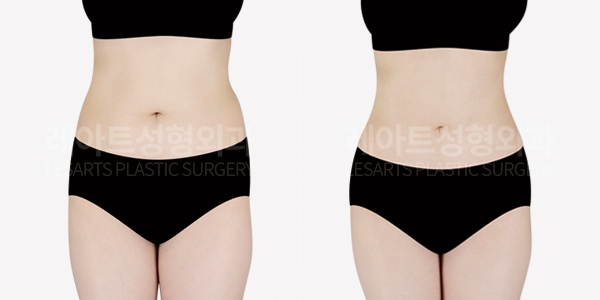
[Revision Abdominal Liposuction: 7.5-Month Before-and-After Comparison of the Front View]
Comparing the preoperative appearance
with the results at 7.5 months after surgery,
the thickness extending from the area around the navel
to the lower abdomen was noticeably reduced,
creating a flatter and more refined central abdomen.
The fullness of the flanks also decreased,
allowing the waistline to become more naturally defined.
The transition from the waist to the hips
appeared smoother and more balanced than before.
Before surgery, the thickness of the lower abdomen
and flanks gave the torso
a relatively straight, boxy appearance.
After revision abdominal liposuction,
the waist curved inward more naturally,
creating clearer definition between the upper body and hips.

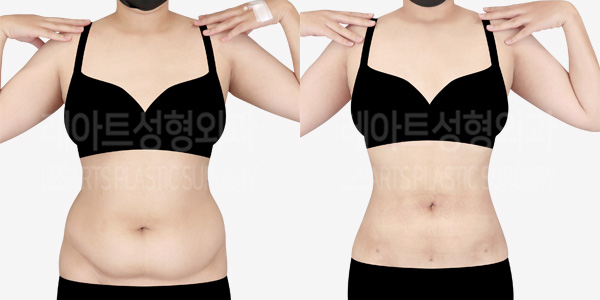
[Revision Abdominal Liposuction: 7.5-Month Before-and-After Comparison of the Back View]
From the back, the fat layer extending
across the lower back and upper hips
was noticeably reduced,
making the torso appear lighter
and more streamlined.
Before surgery, the lower back and flanks
blended together,
making the natural waist indentation
less visible.
At 7.5 months after surgery,
the center of the waist was more clearly defined,
while the thickness above the hips decreased,
creating a sharper transition
between the waist and pelvis.
Not only from the front,
but also from the back,
the overall width of the torso was reduced,
resulting in a slimmer
and more balanced abdominal contour.

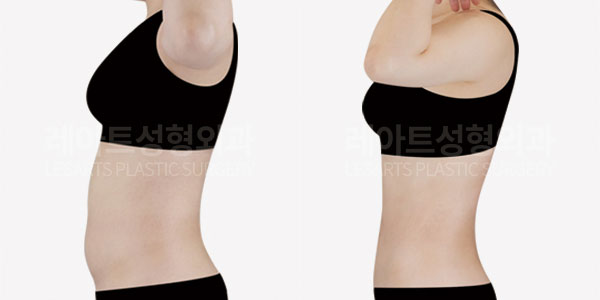
[Revision Abdominal Liposuction: 7.5-Month Before-and-After Comparison of the Side View]
From the side, the forward projection
of the abdomen was noticeably reduced,
and the transition from the upper abdomen
to the lower abdomen became smoother
and more naturally contoured.
The reduction in fullness,
particularly in the lower abdomen,
created a flatter appearance
along the front of the abdominal wall.
In addition to removing subcutaneous fat
through abdominal liposuction,
the patient also maintained postoperative
weight management.
As a result, the abdominal protrusion
that had been influenced by visceral fat
also became less noticeable,
contributing to a slimmer overall abdominal profile.

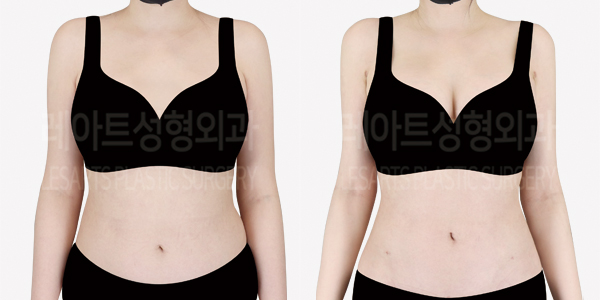
[Revision Abdominal Liposuction: 7.5-Month Before-and-After Oblique View Comparison]
The oblique view also demonstrates
a slimmer contour along the flanks,
while the thickness above the hips
was reduced, allowing the waistline
to appear more naturally defined.
Before surgery, the fullness of the flanks
blended into the lower abdomen,
making the waist contour appear less distinct.
At 7.5 months after revision abdominal liposuction,
the thickness of the anterior abdomen decreased,
and the transition from the flanks
to the hips became smoother,
creating a more balanced and natural body contour.

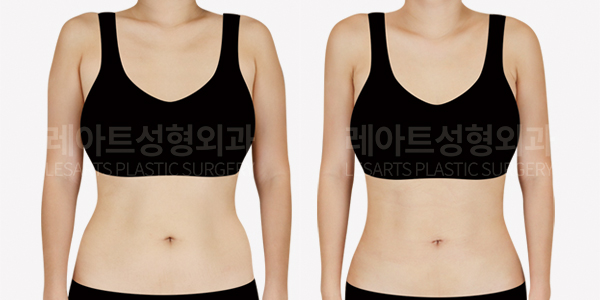
[Revision Abdominal Liposuction: Before Surgery vs. 9-Month Postoperative Selfie Comparison]

[Revision Abdominal Liposuction: Before Surgery vs. 9-Month Postoperative Selfie Comparison]
Even in the selfies taken 9 months after surgery,
the improved abdominal contour remained stable
from both the front and side views.
From the front, the area around the navel
and lower abdomen appeared slimmer,
allowing the waistline to become
more naturally defined.
From the side, the thickness of the anterior abdomen
was noticeably reduced,
creating a smoother silhouette
even when wearing fitted clothing.
Because this was a revision abdominal liposuction,
the patient was initially concerned
about possible contour irregularities
or unevenness after surgery.
However, after recovery,
the patient reported a high level of satisfaction
with the overall abdominal contour.
Liposuction permanently reduces
the number of fat cells in the treated area,
but it does not prevent future weight gain.
If body weight increases after surgery,
the remaining fat cells can enlarge,
causing the abdomen
and surrounding areas to become fuller again.
During the early recovery period,
swelling and firmness are expected.
Wearing a compression garment
and following the recommended postoperative care plan
are essential for optimal healing.
Once the tissues have stabilized,
maintaining a healthy diet
and regular exercise
is important for preserving long-term results.
Because revision abdominal liposuction requires consideration of existing scar tissue, tissue changes from the previous procedure,
and the distribution of remaining fat, surgical planning is often more complex than for a primary liposuction procedure.
Rather than focusing solely on removing as much fat as possible,
it is important to determine a safe amount of fat removal
while creating a smooth, natural abdominal contour
through careful consultation and individualized surgical planning.
#revisionabdominalliposuction
#abdominalliposuction
#waistcontouring
#weightgain
#lesartsplasticsurgery
Revision Abdominal Liposuction FAQ
Q1. Can fat come back after weight gain following abdominal liposuction?
The fat cells removed during abdominal liposuction do not regenerate.
However, the remaining fat cells can enlarge with weight gain,
causing the abdomen and surrounding areas
to become thicker again.
Q2. Can the same area be treated with revision liposuction?
Yes, revision surgery may be considered
depending on the amount of remaining fat,
skin elasticity, and the degree of scar tissue.
However, not every patient is a candidate.
A thorough examination of the current abdominal condition
is necessary before planning revision surgery.
Q3. Can abdominal liposuction remove visceral fat?
No. Abdominal liposuction removes
only subcutaneous fat beneath the skin.
Because visceral fat inside the abdominal cavity
cannot be removed with liposuction,
long-term management through diet and exercise
is still necessary.
Q4. Is revision abdominal liposuction more difficult than the first procedure?
Yes. Scar tissue and adhesions
from the previous surgery
may make the procedure more complex.
The remaining fat must be carefully contoured
while accounting for these changes,
requiring more detailed surgical planning.
Q5. When can I exercise after abdominal liposuction?
The appropriate time to resume exercise
depends on the extent of surgery
and your individual recovery.
Light walking is usually recommended first,
while more strenuous exercise
should be resumed gradually
according to your surgeon’s guidance.
▼ Visit Lesarts Plastic Surgery in Gangnam, Seoul, Korea ▼