Thigh liposuction in Korea: inner thigh and saddlebag contour changes after 1.5 months

Patient Registration Info
| Age | Weight | Height | BMI |
|---|---|---|---|
|
30s |
53kg |
167cm |
19 |
Surgical site
Surgical site : Inner thighs, Chanel line, Saddlebags| liposuction volume : 1,600cc
In this post,
we would like to introduce
a patient who underwent
thigh liposuction surgery.
The patient visited our clinic
to improve the appearance of
prominent saddlebag fullness
along the outer thighs,
which made the lower body contour
appear shorter and heavier.
Rather than achieving
excessively thin legs,
the patient hoped for
a more natural refinement
that complemented her existing
skeletal structure,
with smoother saddlebag contours
and a more seamless transition
along the inner thigh line.
As the weather becomes warmer
and clothing styles become lighter,
many individuals begin wearing
shorter bottoms and fitted pants
more frequently.
As a result,
an increasing number of patients,
like this individual,
are choosing thigh liposuction
not only to reduce overall
thigh circumference,
but also to selectively refine
specific contour irregularities.
We hope this case review
will be helpful for those considering
thigh contouring surgery.
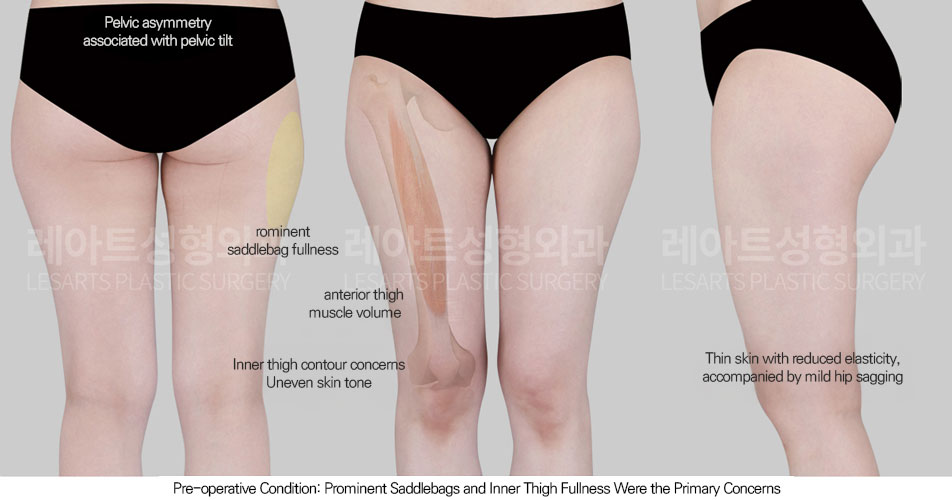
The patient had an overall
well-balanced skeletal structure.
However, prominent saddlebag fullness
along the outer thighs
created a lower body contour
that appeared shorter
and somewhat heavier.
When saddlebag fullness becomes pronounced,
the highest point of the outer thigh
is often perceived as
the starting point of the legs
when viewed from the front.
As a result,
the legs tend to appear shorter,
while the overall thigh width
appears broader,
which can negatively affect
body proportions and balance.
In this patient’s case,
pelvic asymmetry was also identified,
resulting in noticeable differences
between the right and left lower body contours.
For this reason,
it was explained that
simply removing as much saddlebag fat
as possible would not be ideal.
Instead,
careful consideration of
the patient’s skeletal framework
and side-to-side asymmetry
was essential to achieve
a more harmonious outcome.
Although the patient’s primary concern
was the saddlebag area,
the body is not a flat structure,
and continuity of the overall contour
must also be taken into account
during surgical planning.
Particular caution was required
along the inner thighs
to avoid creating wrinkles,
surface irregularities,
or an uneven contour.
The posterior thigh area
was planned to be refined
while maintaining a smooth transition
with the saddlebag region
and preserving adequate support
for the weight of the buttocks,
allowing for a more natural appearance.
In addition,
the patient had relatively thin skin
with less-than-optimal elasticity.
Excessive fat removal in such cases
may increase the risk of
surface irregularities,
wrinkling,
or an uneven contour.
Therefore,
the depth and extent of liposuction
were carefully adjusted
to achieve the smoothest
and most balanced result possible.
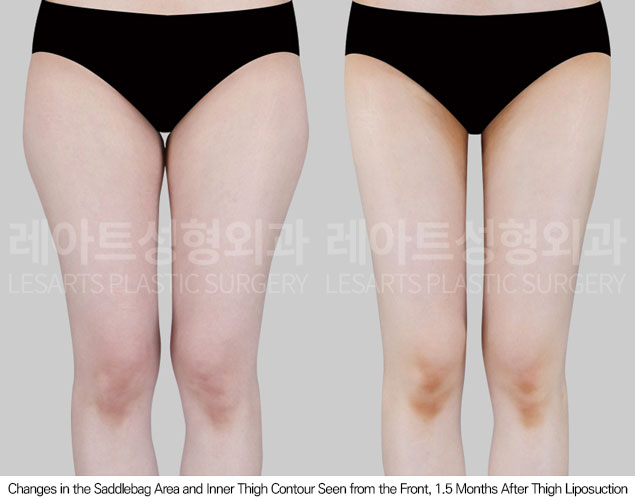
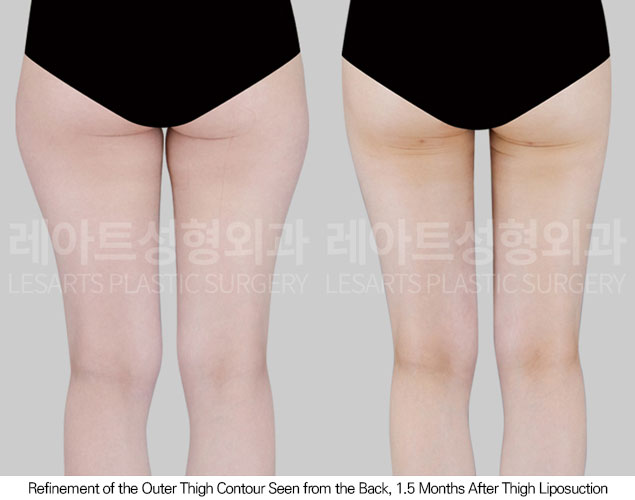
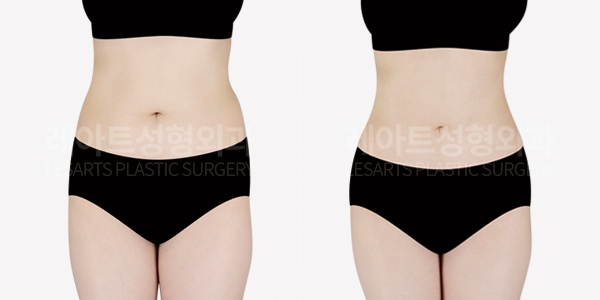
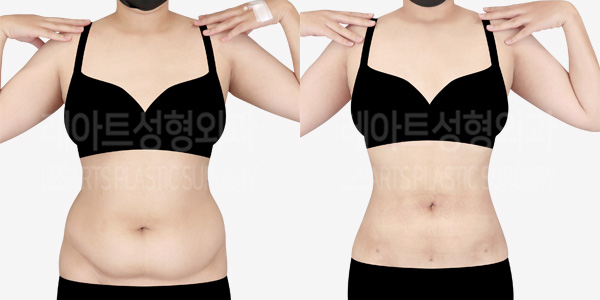
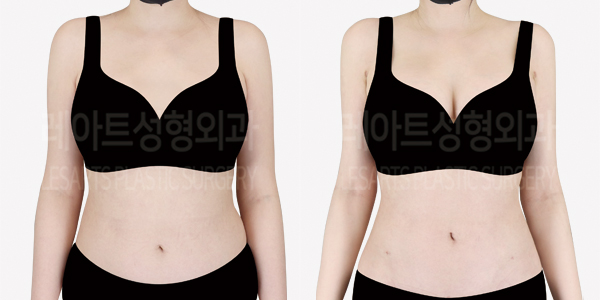
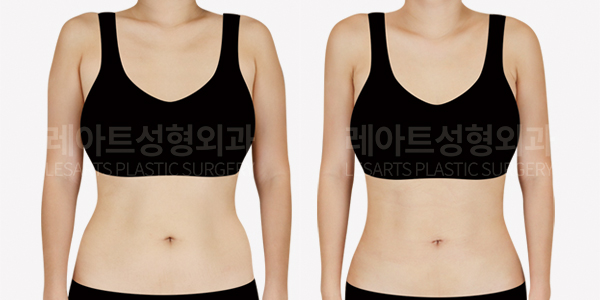
These photos compare
the patient’s appearance
before thigh liposuction
and approximately 1.5 months after surgery.
The prominent saddlebag fullness
that previously projected outward
along the outer thighs
has been significantly reduced,
creating a longer, slimmer,
and more streamlined lower body contour.
The pre-existing pelvic asymmetry
also appears less noticeable,
resulting in a more balanced
and natural silhouette.
Most importantly,
the patient’s primary concerns—
the saddlebag area
and the inner thigh contour—
have been refined,
creating the appearance of
straighter, more proportionate legs.
As a result,
the overall body proportions
appear noticeably improved,
giving the lower body
a lighter and more harmonious appearance.
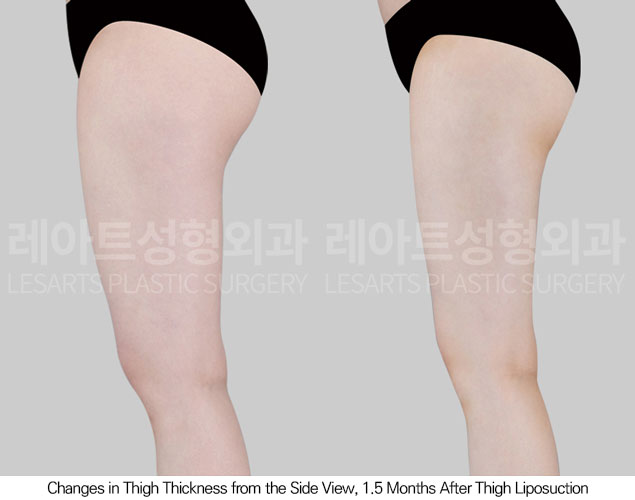
The anterior thighs in this patient
were influenced more by
muscle volume than fat accumulation.
For this reason,
rather than aggressively reducing
the anterior thigh contour,
it was important to preserve
a smooth and harmonious transition
throughout the entire lower body silhouette.
As a result,
a natural reduction in volume
was achieved without making
the underlying muscles appear prominent,
allowing the legs to appear
longer and more proportionate
from the side view as well.
The posterior thighs were also treated
with a conservative approach.
Instead of pursuing excessive size reduction,
the surgical plan focused on
refining the transition from
the saddlebag region
to the infragluteal fold,
creating a lighter and more natural contour
while maintaining overall body balance.
The patient is currently
approximately 1.5 months post-operatively,
a period during which
residual swelling and tissue remodeling
are still expected.
As in this patient’s case,
individuals with thin skin
and reduced skin elasticity
may benefit from wearing
compression garments
for a longer period of time
to promote a smoother,
more elastic contour during recovery.
This aspect of post-operative care
was carefully discussed with the patient.
Ultimately,
successful liposuction surgery
depends less on removing
the greatest possible volume of fat
and more on establishing
a precise surgical plan
that considers the patient’s
skeletal structure,
skin quality,
and overall body proportions.
When these factors are addressed appropriately,
patients can achieve results
that are not only natural-looking
but also highly satisfying
in terms of contour and balance.
#ThighLiposuction
#ThighLiposuctionBeforeAfter
#SaddlebagLiposuction
#InnerThighContouring
#ChanelLineContouring
#PosteriorThighContouring
#LegContouring
#BodyContouring
#LiposuctionRecovery
#LesartsPlasticSurgery
#BestThighLiposuctionClinicInKorea