Gynecomastia surgery in Korea: chest and areola changes before and after Simon grade 2A correction
Patient Registration Info
| Age | Weight | Height | BMI |
|---|---|---|---|
|
20s |
72kg |
177cm |
23 |
Surgical site
Surgical area: Gynecomastia | Grade 2-A
Even when experiencing
chest enlargement and protrusion
suggestive of gynecomastia,
many patients assume it is simply
a body shape issue
rather than seeking an accurate diagnosis.
As a result,
the condition is often left untreated
for many years.
In particular,
some patients focus only on concealing
the appearance of the chest by wearing
compression garments or using
nipple covers to flatten the protruding areolar area,
instead of addressing the underlying cause.
When the areola becomes puffy
and the surrounding tissue appears raised,
these temporary measures may help disguise the contour,
but they do not resolve
the actual source of the problem.
Gynecomastia surgery is a procedure designed to
reduce chest volume through accurate diagnosis
and precise surgical treatment,
while creating a more masculine
and balanced upper body contour.
For patients experiencing
ongoing stress and self-consciousness
due to gynecomastia symptoms,
seeking professional evaluation
rather than delaying treatment
can be an important first step.
The case presented in this article
involves a patient whose
gynecomastia symptoms first developed during adolescence
and were ultimately treated
in his mid-20s through surgery.
[Gynecomastia Surgery Patient Information]
Age: Mid-20s
Height / Weight: 177 cm / 72.4 kg
Diagnosis: True Gynecomastia, Simon Grade 2A
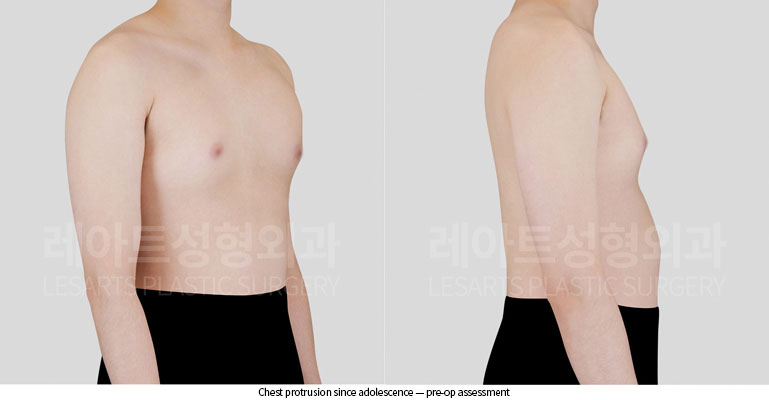
Before gynecomastia surgery,
the patient’s chest showed
noticeable enlargement,
with both the areolae and nipples
projecting outward in a pointed shape.
Based on the size and contour
of the chest,
the condition was clinically assessed as
Simon Grade 2A gynecomastia.
To determine the exact cause
of the patient’s symptoms,
an ultrasound examination was performed.
The evaluation confirmed
the presence of enlarged glandular tissue
beneath both areolae,
which established the diagnosis of
true gynecomastia.
In addition,
surrounding chest fat deposits
were also contributing to
the overall chest size and silhouette.
As a result,
treatment required a combination of
gland excision and chest liposuction
to achieve an optimal outcome.
Furthermore,
to prevent post-operative complications such as
contour depression, irregular adhesions,
or uneven chest shape after removal of the glandular tissue and fat,
the surgical plan also included
tissue repositioning and
anti-adhesion treatment.
The goal was not simply
to reduce chest volume,
but to create a smooth, natural,
and masculine chest contour.
Let’s now take a closer look at
the before-and-after gynecomastia surgery photos
to evaluate the changes in
chest size, areolar contour,
and overall projection.
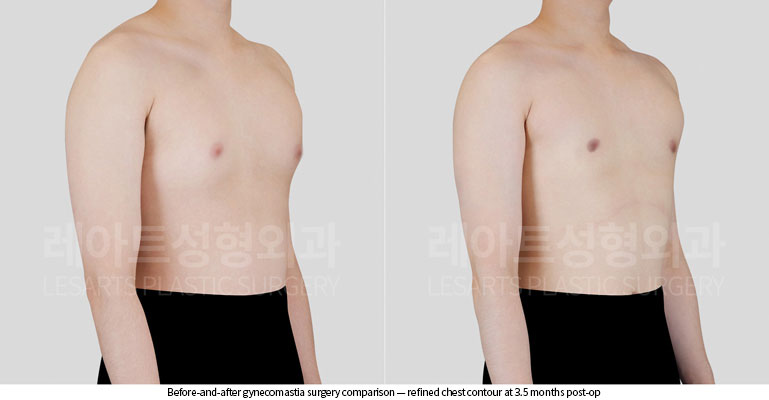
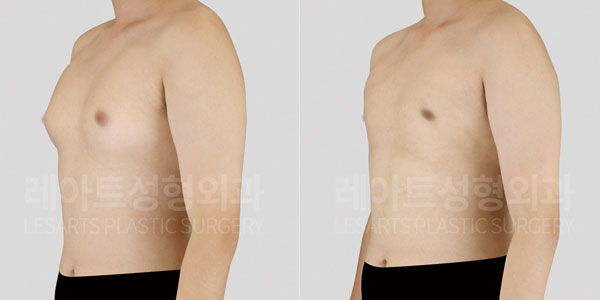
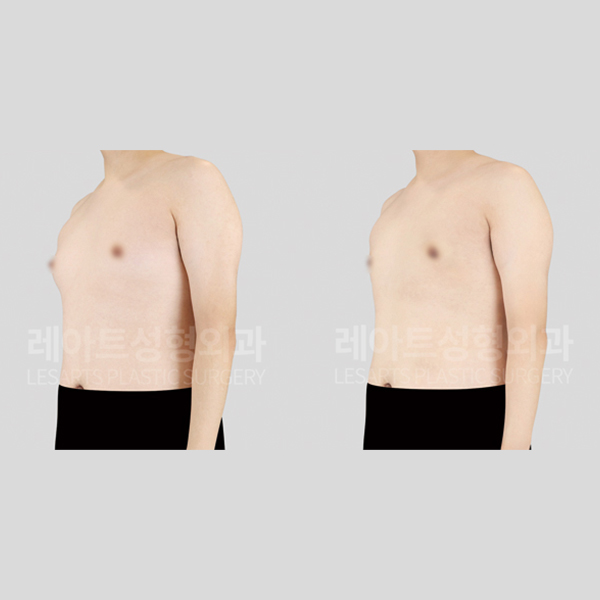
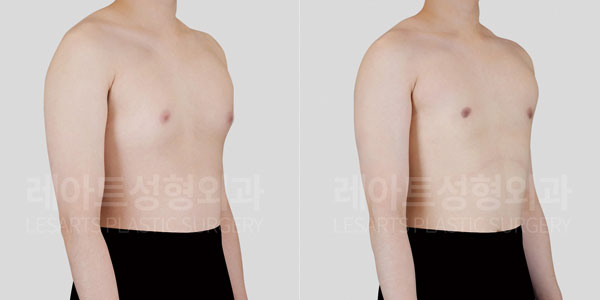
Following gynecomastia surgery,
a noticeable reduction in overall chest size
can be observed.
The previously protruding central chest area
and the enlarged areolar contour
have also been corrected,
resulting in a flatter, more stable,
and masculine chest appearance.
In particular,
the excessive projection that once drew attention
to the center of the chest
has been significantly improved,
creating a smoother transition
across the entire chest wall.
Because the stretched skin
was able to contract naturally
after removal of the enlarged
glandular tissue and surrounding fat,
the areolae also became smaller
and more proportionate in appearance.
As a result,
the chest now appears
more balanced and natural,
without the puffy contour
that previously characterized
the gynecomastia deformity.
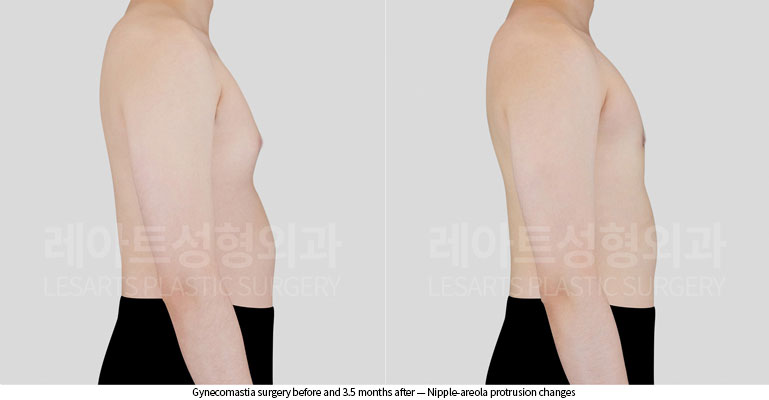
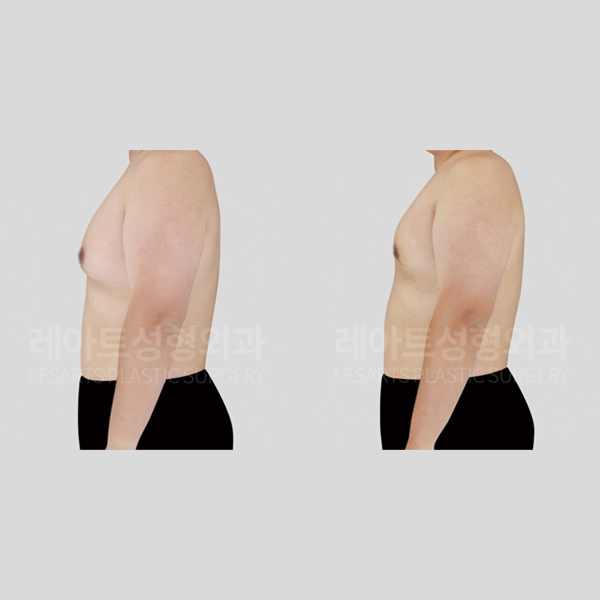
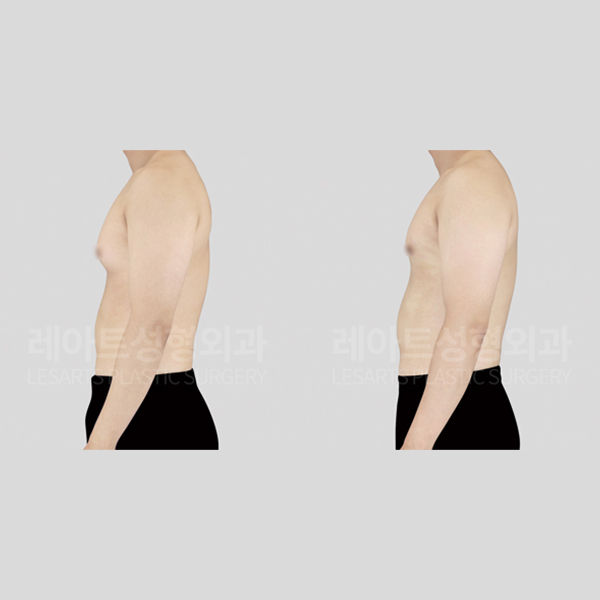
From the side profile,
the degree of improvement in both
chest projection and nipple prominence
following gynecomastia surgery
can be clearly appreciated.
The previously protruding
areolar and nipple complex,
which projected noticeably from
the center of the chest,
has been naturally refined.
As a result,
a smooth and continuous contour
now extends from the upper chest
to the upper abdomen,
creating a much more balanced
and masculine appearance.
Following gland excision and liposuction,
additional tissue repositioning was performed
to prevent contour depression
or abnormal adhesions.
This allowed the chest wall
to heal with a firm and natural shape,
without irregularities or visible deformities.
The final result creates
an athletic-looking upper body contour,
similar to the appearance often associated
with regular strength training.
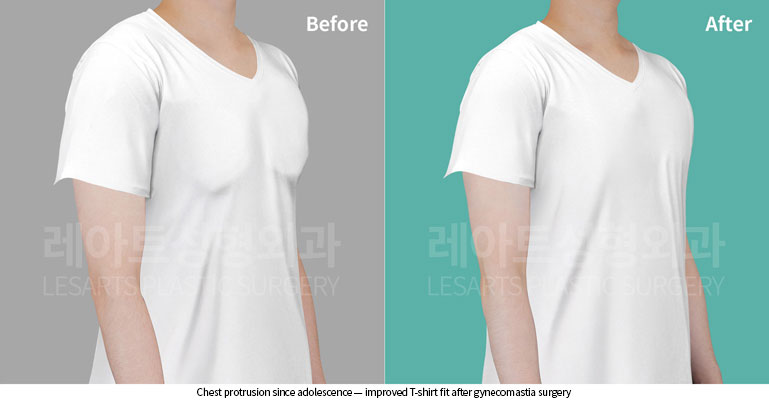
The patient also reported
a significant improvement in confidence.
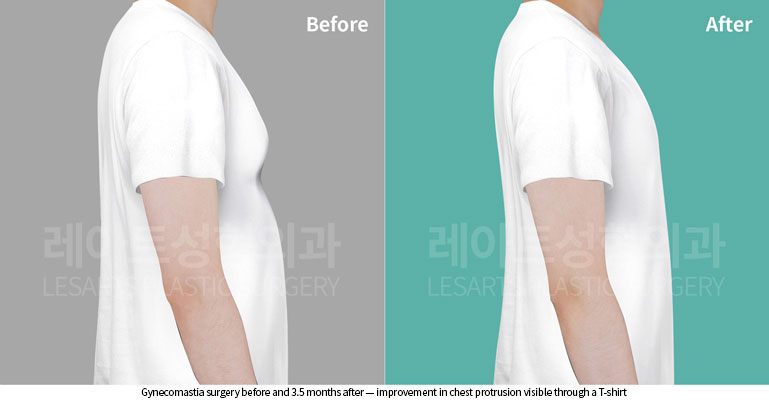
Before surgery,
the protrusion of the central chest area
and the puffiness surrounding
the nipples and areolae
were a constant source of concern
when wearing clothing.
Following surgery,
these features were naturally corrected,
allowing T-shirts and fitted clothing
to sit much more comfortably
and naturally on the body.
The patient further shared that
activities such as exercising
or being in environments
where upper body exposure is unavoidable
no longer cause the same level of discomfort
or self-consciousness.
As the weather becomes warmer,
many patients find themselves
increasingly burdened by the need
to hide gynecomastia symptoms.
For this reason,
obtaining an accurate diagnosis,
receiving appropriate guidance
regarding recovery and post-operative care,
and establishing a proper treatment plan
can be one of the most effective ways
to relieve long-standing stress
caused by gynecomastia.
Let Lesarts Plastic Surgery help you
find a solution to your gynecomastia concerns.
#Gynecomastia
#GynecomastiaSurgery
#GynecomastiaBeforeAfter
#TrueGynecomastia
#SimonGrade2A
#MaleChestReduction
#GlandExcision
#ChestLiposuction
#AreolaReduction
#PuffyNipples
#MaleChestContour
#UpperBodyContouring
#MensPlasticSurgery
#LesartsPlasticSurgery
#BestGynecomastiaClinicInKorea