Abdominoplasty in Korea: 3-month comparison for lower abdominal sagging not improved by abdominal liposuction
Patient Registration Info
| Age | Weight | Height | BMI |
|---|---|---|---|
|
40s |
65kg |
159cm |
26 |
Surgical site
Surgical site : Abdomen, hip area, M-Type, muscle repair, umbilicus correction, c-section scar removal| liposuction aspirate volume : 2,800cc
Hip dip fat transfer: Hip dips (Right: 160 cc / Left: 200 cc)
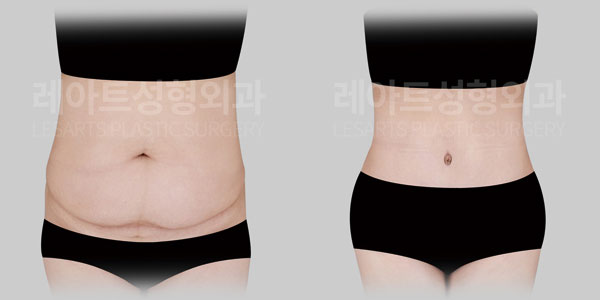
The patient featured in this case
underwent abdominoplasty
to improve lower abdominal skin laxity,
wrinkling around the navel area,
and overall abdominal contour changes
that developed after a previous
C-section delivery.
The patient had previously undergone
abdominal liposuction,
but continued to experience
folding and sagging skin
in the lower abdomen.
Despite the reduction in fat volume,
the stretched skin and altered
abdominal contour remained,
resulting in ongoing dissatisfaction
with the overall appearance.
For this reason,
it was determined that
simply removing any remaining fat
would have limited effectiveness
in improving the abdominal shape.
Instead, correction of the excess skin,
abdominal wall laxity,
and overall contour imbalance
was considered necessary,
leading the patient to choose
abdominoplasty surgery.
During the abdominoplasty consultation,
the patient’s abdominal contour
and degree of skin sagging
were carefully evaluated.
The primary causes were identified as
skin laxity extending from the upper abdomen
and rectus diastasis.
Externally,
the most noticeable finding
was the excess skin that had stretched downward
and folded over the lower abdomen.
In addition,
fine wrinkles and skin laxity
were also present around the navel area,
further contributing to the altered appearance
of the abdomen.
Most importantly,
the transition across the anterior abdomen
was no longer smooth and continuous.
As the skin and abdominal wall lost support,
the weight and volume of the lower abdomen
became more prominent,
creating an imbalanced contour
and a heavier overall appearance.
Considering the extent of
skin sagging,
the degree of abdominal wall laxity,
and the location of the previous
C-section scar,
a full abdominoplasty
was recommended for this patient.
However,
whether the existing C-section scar
could be completely removed
depended on the actual amount of skin
that could be safely advanced
during surgery.
For this reason,
the patient was thoroughly informed
that scar removal would ultimately be determined
based on intraoperative findings,
and the surgical plan was established
after a detailed discussion.
Regarding abdominal liposuction,
the patient had already undergone
a previous liposuction procedure.
Therefore,
rather than performing
aggressive re-liposuction
throughout the entire abdomen,
the treatment focused on
refining only the remaining areas
of localized fat accumulation
where additional contour improvement
could be achieved safely.
If excessive liposuction is performed
in areas where the fat layer
has already become thin
from prior surgery,
the abdominal surface
may appear uneven or irregular.
For that reason,
the patient was advised that
the goal was not maximum fat removal,
but rather achieving a smooth
and balanced abdominal contour
while enhancing the overall results of
abdominoplasty surgery.
The treatment plan therefore focused on
creating a stable, natural-looking contour
within a safe range that would provide
the greatest synergistic benefit
when combined with the abdominoplasty procedure.
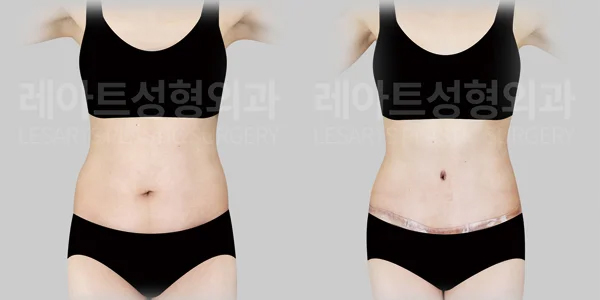
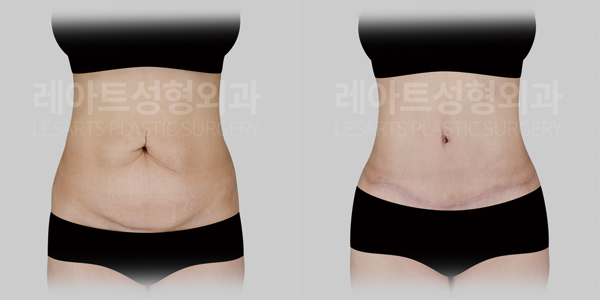
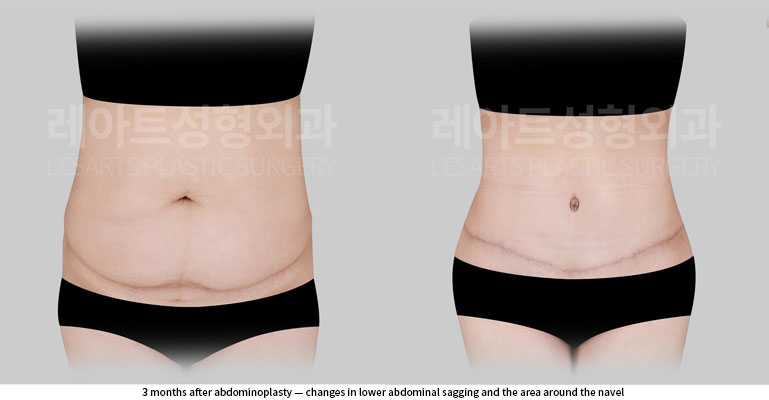
This comparison shows
the changes before and after
abdominoplasty surgery.
The most noticeable improvement
following surgery
is the correction of the excess skin
that previously folded over
the lower abdomen,
eliminating the heavy appearance
of the lower belly.
Before surgery,
significant skin laxity was visible
from below the navel
to the upper underwear line.
The stretched skin folded downward,
creating a bulky appearance
and emphasizing the volume
of the lower abdomen.
At approximately 3 months after abdominoplasty,
the excess skin had been removed,
allowing the abdominal contour
below the navel
to appear flatter and more continuous.
The folds and wrinkles
that had accumulated
throughout the lower abdomen
were also significantly improved.
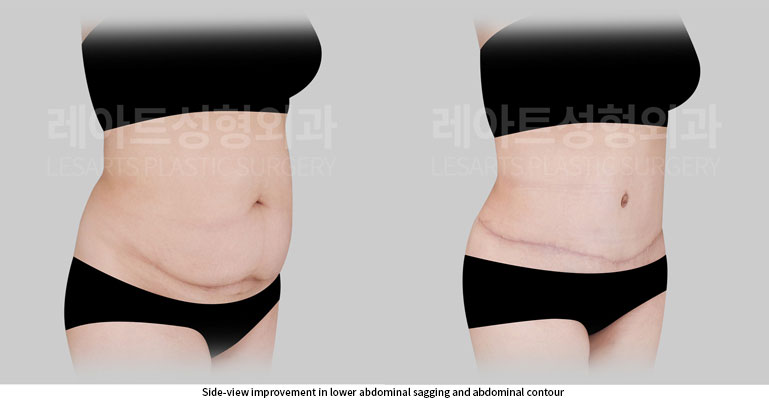
In addition,
the protruding abdominal wall
and the heavy fullness
of the lower abdomen
were effectively corrected,
creating a smoother and firmer transition
from the upper abdomen
to the lower abdomen.
Although this is still considered
an early stage of recovery,
and some redness along the scar line
as well as firmness within the tissues
may still be present,
these findings are part of
the normal healing process
and are expected to gradually improve
as recovery progresses.
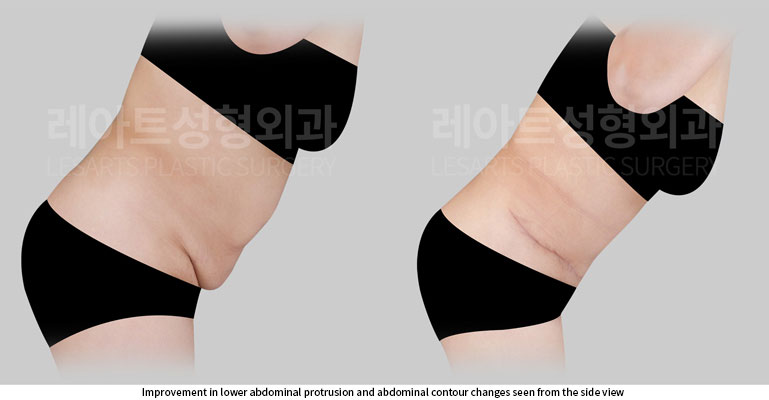
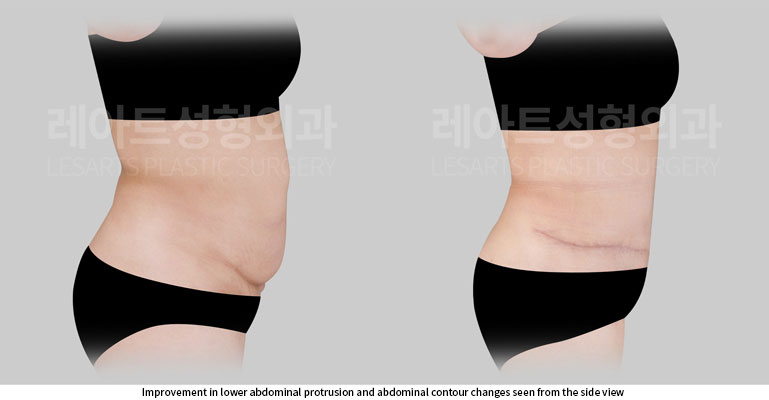
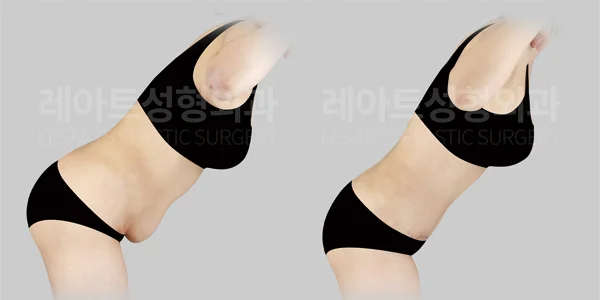
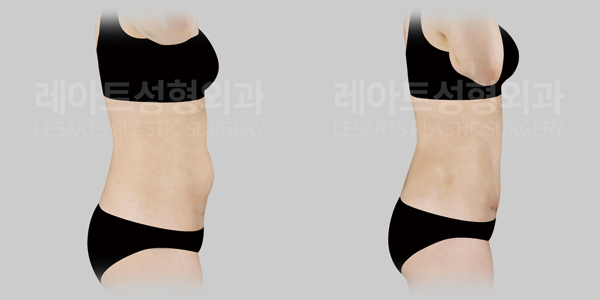
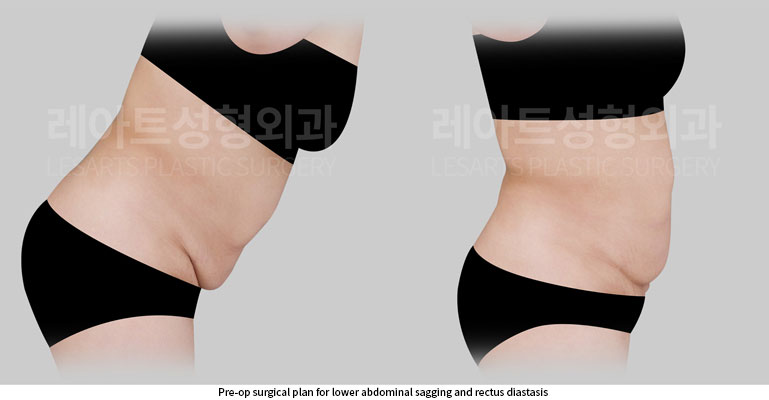
From both the side profile
and the forward-bending position,
the improvement in skin firmness
and recovery of abdominal wall support
can be clearly observed.
The excess skin that previously folded
and accumulated in the lower abdomen
has been removed,
while both the upper and lower abdomen,
which once appeared uneven and protruded,
now display a much smoother
and more natural contour.
In particular,
the improved abdominal wall support
helps maintain a stable shape
even when bending forward,
allowing the abdomen to retain
its firmness and structure
without collapsing or folding.
The heavy appearance
that previously emphasized
the lower abdomen
has also been effectively corrected,
resulting in a lighter,
more balanced abdominal silhouette.
The transition from the upper abdomen
to the lower abdomen
now appears significantly smoother,
creating a firmer and more harmonious
overall abdominal contour.
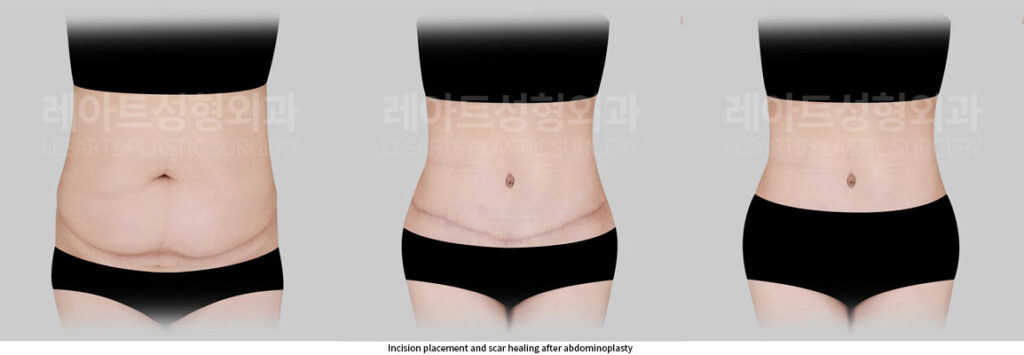
The previous C-section scar
was removed during surgery,
leaving only the abdominoplasty scar,
which was designed to sit low enough
to be naturally concealed
by underwear or swimwear.
The patient was advised
to continue attending
scheduled follow-up visits
for scar management,
while also performing
the recommended self-care routine
to support optimal healing.
This patient initially hoped to improve
the abdominal contour
through liposuction after childbirth,
but did not achieve
the level of improvement expected,
which ultimately led her
to seek consultation at our clinic.
Changes in the abdomen after pregnancy
can certainly be related to
localized fat accumulation.
However, in many cases,
additional factors such as
rectus diastasis,
loss of skin elasticity,
and contour irregularities caused by
a C-section scar
may also play a significant role.
For this reason,
an accurate diagnosis is essential
to determine the true cause of the deformity
and establish the most appropriate
surgical treatment plan.
At Lesarts Plastic Surgery,
every abdominoplasty consultation
is tailored to the patient’s
individual anatomy and concerns.
By carefully evaluating
each patient’s unique characteristics,
we aim to predict realistic outcomes
and recommend the most suitable approach
for achieving a balanced
and natural abdominal contour.
If you feel frustrated by
ongoing body contour concerns
despite continuous efforts at
dieting, exercise, or previous procedures,
we encourage you to visit
Lesarts Plastic Surgery
for a comprehensive consultation.
#Abdominoplasty
#AbdominoplastyBeforeAfter
#FullAbdominoplasty
#PostPregnancyBody
#CSectionScarRevision
#RectusDiastasisRepair
#AbdominalWallRepair
#LowerAbdominalSagging
#AbdominalContour
#AbdominalLiposuction
#LesartsPlasticSurgery
#BestAbdominoplastyClinicInKorea