Patient Registration Info
Surgical site
Unlike pseudogynecomastia caused by fat or obesity,
true gynecomastia from glandular growth
may sometimes involve intermittent chest pain.
However, many men mistake this pain
for simple muscle stiffness, fatigue,
or temporary body changes,
and often delay proper treatment.
If breast size increases along with
a strange pressure around the areola,
short bursts of pain, or sharp twinges,
these may be signs of enlarged gland tissue
caused by hormonal imbalance.
Unlike fatty gynecomastia,
true gynecomastia cannot be reduced
through weight loss alone.
Beyond external discomfort,
the pain and psychological stress
caused by gynecomastia
can also be significant.
That’s why, if treatment is desired,
it is better not to delay too long.
This case features a patient in his mid-40s
who had been overweight since adolescence.
Because of this, his upper body looked large,
and he experienced discomfort from the
prominent chest area.
In his 20s, he lost a significant amount of weight
through consistent exercise and diet control,
but the size of his chest and the swollen shape
around the nipples did not improve.
The most stressful issue was that, when wearing
a thin shirt or cotton T-shirt, the upper body
looked curved like a female breast,
making the chest projection obvious.
In addition, the patient reported intermittent pain
around the nipples and felt a firm lump
beneath the areola.
Because of these symptoms, he decided on a
surgical solution and visited our clinic.
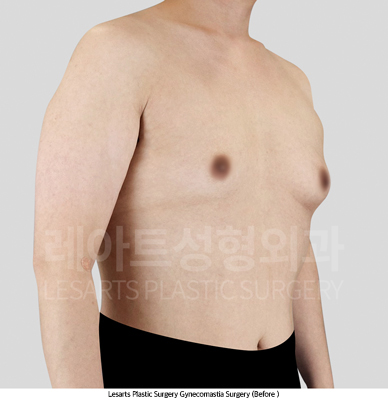
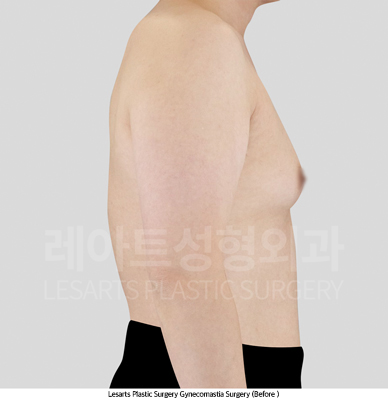
The patient’s chest contour was clearly protruding
even on external examination.
On palpation, firm tissue could be felt
beneath both areolas.
He also reported intermittent pain and discomfort
around this area, especially when moving his arms
or holding certain postures.
For accurate diagnosis, a detailed ultrasound scan
was performed. It confirmed a wide distribution
of glandular tissue beneath both nipples,
with fibrotic tissue extending deeply—
clear evidence of glandular overgrowth.
Based on these findings, the patient was diagnosed
with true gynecomastia, corresponding to
between Simon Grade 2A and 2B.
To achieve precise correction and treatment,
the following surgical methods were planned:
1.Gland Excision
Through an areolar incision, the enlarged gland tissue
causing chest protrusion was directly removed.
This reduced chest size and corrected nipple projection.
2.Chest Liposuction
Fat in the lower and lateral chest areas was suctioned
to complement gland removal, further reducing chest size
and refining the overall contour for a smooth result.
3.Adhesion & Depression Prevention
To prevent skin adhesion or nipple depression
after gland removal, deep tissue repositioning
was performed for a balanced, natural chest shape.
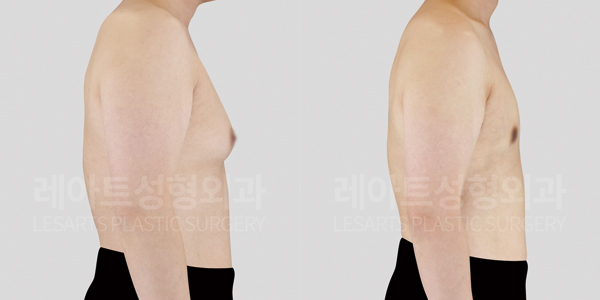
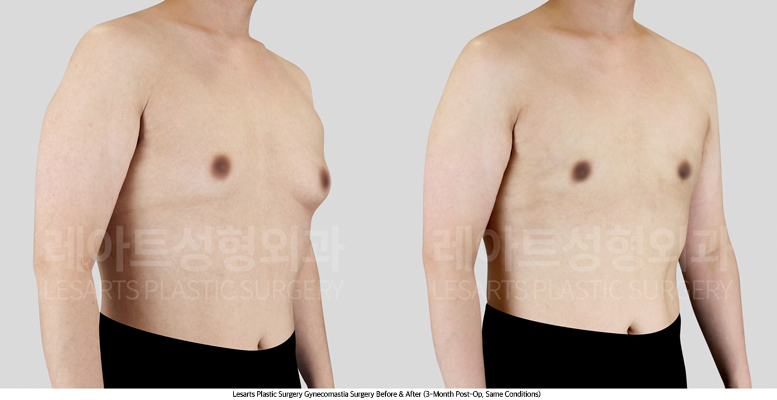
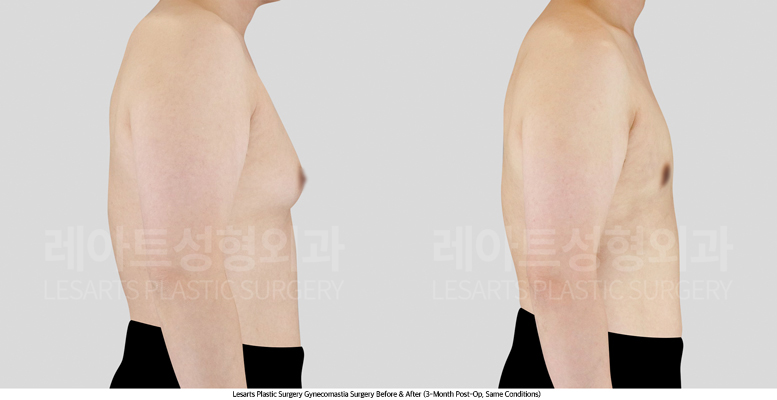
At 3 months post gynecomastia surgery,
we will now review how much the patient’s
chest volume was reduced and how much
his pain symptoms were alleviated.
Before gynecomastia surgery,
a firm glandular tissue was located
beneath the nipples, pushing the chest
forward into a protruding shape.
This added volume extended to the lower chest,
making the entire upper body look bulky.
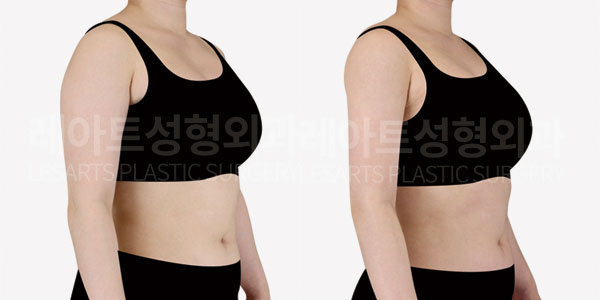
At 3 months post gynecomastia surgery,
the once prominent chest contour
was corrected into a flat, natural chest line,
similar to that of a typical male chest.
The nipple projection was also refined,
creating a smooth, balanced connection
throughout the upper body silhouette.
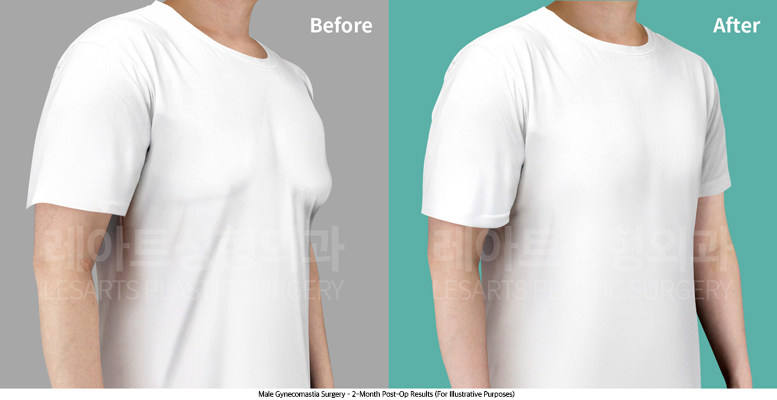
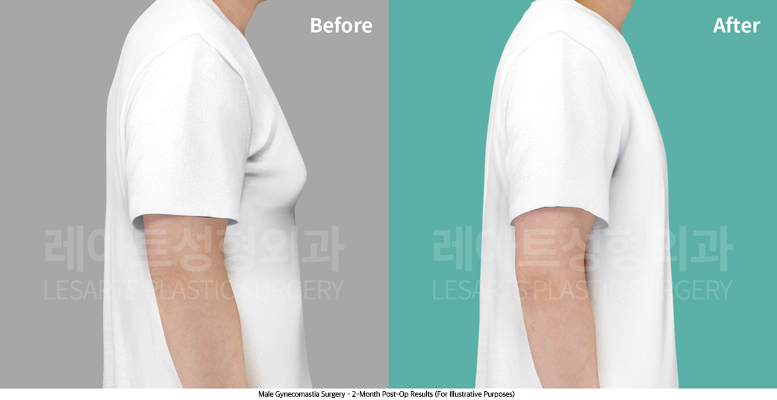
When comparing gynecomastia before-and-after photos
with a T-shirt on, the protruding bulge
beneath the nipples seen before surgery
was smoothed out, creating a natural male chest shape.
The fit of the shirt also improved,
no longer looking uncomfortable or bulky.
In this patient’s case, the enlarged gland tissue
had developed excessively, even causing pain.
Additional fat in the lower and lateral chest
contributed to an unbalanced upper body silhouette
and loss of confidence.
Through gynecomastia surgery, not only was
the chest size reduced and nipple projection corrected,
but chest pain was also resolved at the same time.
By removing unnecessary fat, the chest contour
was refined into a masculine and smooth shape,
transforming the previously heavy-looking upper body
into a lighter, more confident appearance.
#GynecomastiaSurgery
#MaleChestReduction
#TrueGynecomastia
#ChestLiposuction
#GlandRemovalSurgery
#BeforeAndAfterGynecomastia
#MaleChestContour
#FlatChestResults
#ConfidenceRestored
#BestLiposuctionClinicInKorea