Patient Registration Info
Surgical site
Gynecomastia is a condition that can cause
significant psychological discomfort in daily life.
The protruding chest volume around the nipples
not only affects how clothing fits,
creating an awkward appearance,
but also causes discomfort in social environments
such as school, military service, gyms, swimming,
and leisure activities like golf or saunas.
Although it may seem like a weight-related issue,
in reality, it often results from hormonal imbalance
that leads to enlargement of the mammary glands,
known as true gynecomastia.
As explained in several Lesarts Plastic Surgery posts,
true gynecomastia cannot be improved
through self-care or exercise alone —
thus, surgical treatment is often the only solution.
If you also experience chest tightness
or a foreign sensation in addition to visible swelling,
a precise diagnosis and corrective surgery
may be necessary for full recovery and comfort.
This patient in his 20s had gradually experienced
psychological stress caused by chest protrusion
since his teenage years.
At the time, he believed that the condition
would naturally improve with age
as part of normal growth,
so he didn’t pay much attention to it.
However, after reaching adulthood,
he began to feel a firm lump beneath the nipple,
and the protrusion in that area became more visible,
causing increasing discomfort in daily life.
To identify the underlying cause
and receive surgical treatment,
he visited Lesarts Plastic Surgery
for a detailed gynecomastia consultation.
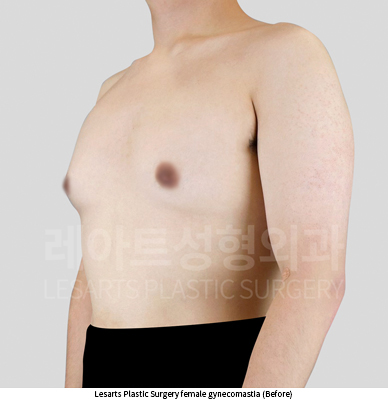
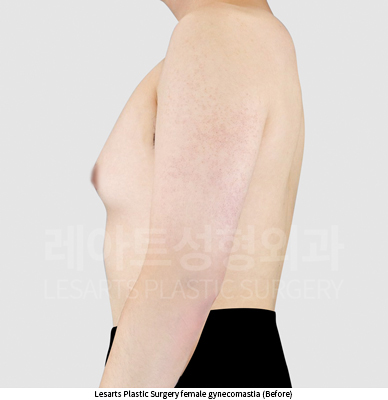
At a glance, the patient’s chest appeared enlarged,
with a noticeable protrusion around the nipple area.
Through palpation, firm tissue was detected
directly beneath both nipples,
and fat accumulation was also observed
in the accessory breast and front armpit region,
further increasing the overall chest volume.
An ultrasound examination was performed
to assess the degree of glandular tissue development,
and the results showed bilateral glandular hypertrophy
clearly visible in both breasts.
Based on these combined findings,
the patient was diagnosed with true gynecomastia,
classified as Simon Grade 2A.
Taking into account the fat distribution
around the lower and outer chest areas,
the following surgical plan was established.
1.Glandular tissue excision
Through a periareolar incision,
the enlarged glandular tissue —
the primary cause of the chest volume — was removed.
This reduced the breast size and corrected
the nipple protrusion, creating a smooth chest contour.
2.Liposuction
To balance the upper body silhouette,
liposuction was performed on the lower and outer chest,
removing excess fat volume and enhancing symmetry.
3.Adhesion and depression prevention
After gland removal, the deep tissue was repositioned
to prevent irregular adhesion or depression
beneath the nipple–areola complex,
allowing a natural and stable chest contour to form.
At the 2-month postoperative mark,
we will examine how the chest contour improved
and how the patient’s previous discomfort
has been successfully resolved.
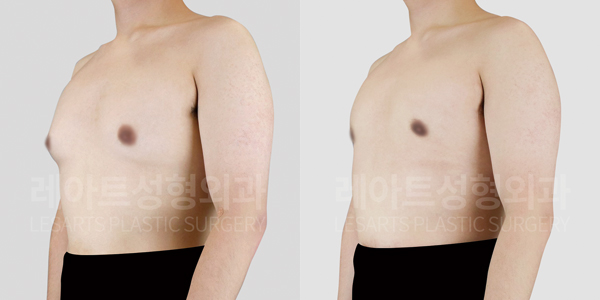
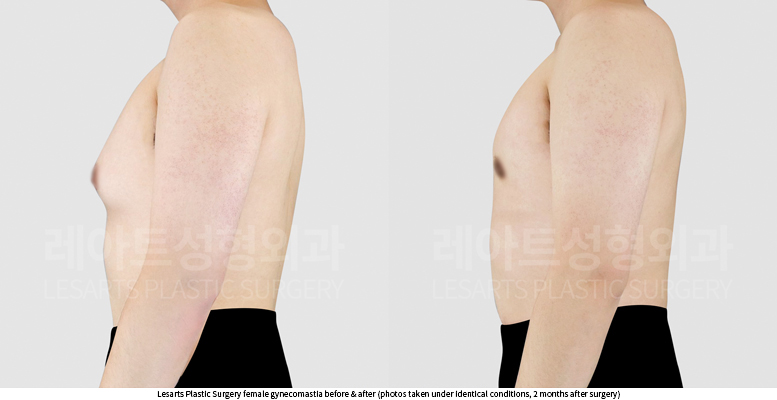
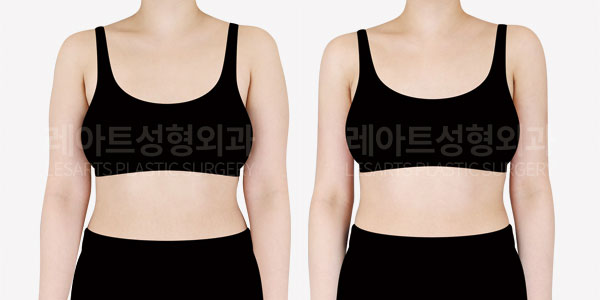
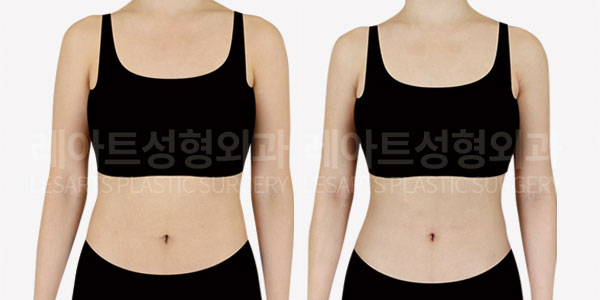
Before the gynecomastia surgery,
a wide distribution of firm glandular tissue
was present beneath both nipples,
causing the entire chest to appear large and protruded.
The volume extending from the chest center
toward the outer chest and front armpit
further emphasized the heaviness of the chest,
making the upper body look full and bulky.
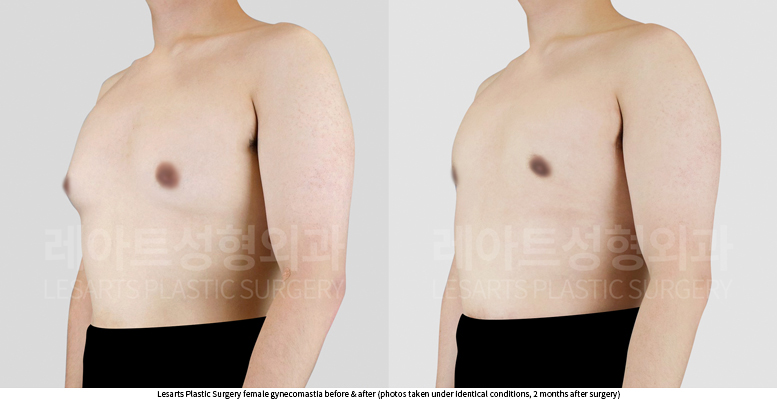
At two months after surgery,
the nipple protrusion was corrected,
and the chest contour became smaller, firmer,
and smoothly defined overall.
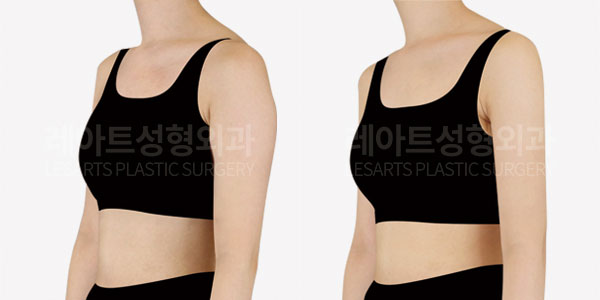
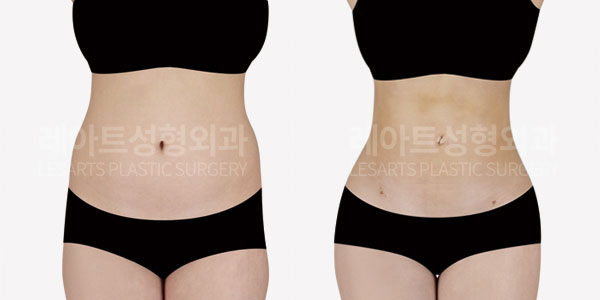
Before surgery, the protruding chest
made the upper torso stand out disproportionately,
but after correction of the lower and outer chest lines,
the entire silhouette became neater,
showing a more balanced and masculine contour.
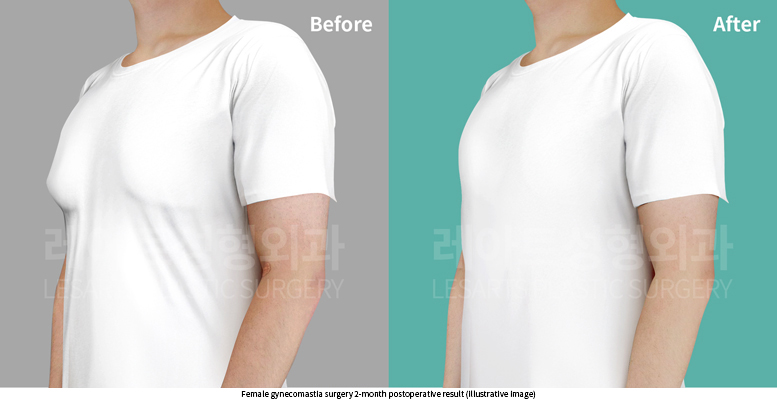
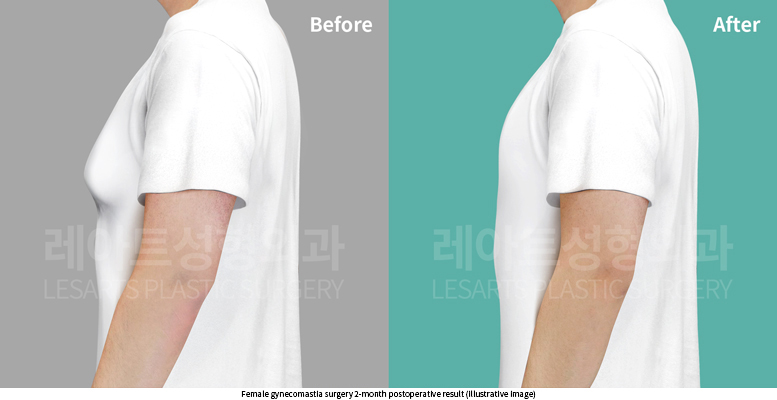
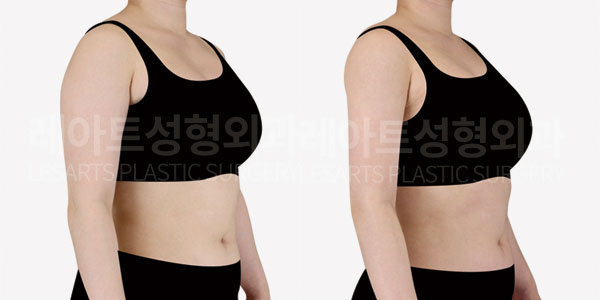
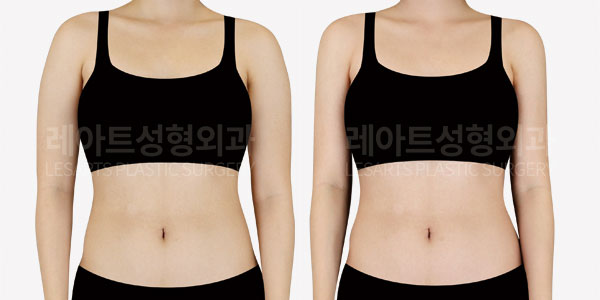
When comparing the appearance in a T-shirt,
the pre-surgery chest shape caused the fabric
to cling awkwardly around the chest,
and the nipple protrusion was easily noticeable.
At two months post-surgery,
the protruding chest volume had been corrected,
and even in a simple T-shirt,
the chest looked flat, toned, and natural,
as if shaped through regular workouts.
The patient reported feeling satisfied
not only with the visual reduction in chest size,
but also with the elimination of discomfort —
such as chest tightness and pain
that used to occur during daily activities.
He mentioned that the stress of wearing thin clothes
had completely disappeared,
and that he now feels lighter and more confident,
with a noticeable improvement in quality of life.
In cases of true gynecomastia caused by glandular hypertrophy,
it’s not just about changes in chest size or nipple shape —
patients may also experience pain, posture imbalance,
and emotional discomfort.
For these reasons, accurate diagnosis
and surgical treatment can be an effective solution.
If you’ve been struggling with similar concerns,
it’s recommended to seek a professional consultation
to find a realistic and lasting solution without delay.
#GynecomastiaSurgery
#MaleBreastReduction
#TrueGynecomastia
#HormonalImbalanceTreatment
#ChestContourCorrection
#BeforeAndAfterGynecomastia
#LesartsPlasticSurgery
#SimonGrade2AGynecomastia
#UpperBodyRefinement
#TonedChestAppearance
#MaleConfidenceRestoration
#BestGynecomastiaClinicInKorea