
Gynecomastia surgery in Gangnam: what if one side of the chest looks larger? 2-week before and after
Patient Registration Info
| Age | Weight | Height | BMI |
|---|---|---|---|
|
20s |
76kg |
174cm |
18 |
Surgical site
Surgical site : Gynecomastia | Grade 2-A
Can Gynecomastia Affect Only One Side If One Side of the Chest Looks Larger?
Even if one side of the chest appears larger,
the glandular tissue may actually be developed
to a similar degree on both sides.
Differences in subcutaneous fat distribution
and muscle volume can also affect chest asymmetry,
so an ultrasound examination is important
to accurately identify the cause.
Among men who visit the clinic because of increased chest size
or projection in the center of the chest,
some have similar enlargement on both sides,
while others are concerned because one side
appears noticeably larger than the other.
If a firm lump is more noticeable on one side
or accompanied by occasional pain,
it may raise concerns that gynecomastia
has developed on only one side.
This patient also felt that his right chest
was larger than the left and experienced discomfort
from a lump on the inner chest
along with intermittent pain.
His gynecomastia symptoms began after entering his 20s.
Although he continued exercising and managing his weight,
he noticed little improvement in the overall chest size
or projection.

[Before Gynecomastia Surgery – Lesarts Plastic Surgery]
Preoperative Condition Before Male Gynecomastia Surgery
[Patient Information and Ultrasound Findings]
Age: 20s
Height / Weight: 174 cm / 76.5 kg
Gynecomastia diagnosis: Simon Grade 2A, bilateral true gynecomastia
Skin elasticity: Moderate
[Preoperative Central Chest Projection and Left-Right Size Difference]
Before surgery, the central area of both sides
of the chest projected forward, and the overall
chest size was enlarged.
From the side view, the contour between
the lower chest and upper abdomen formed
a rounded angle, making the chest appear even thicker.
The patient felt that his right chest was larger,
but the ultrasound examination showed no significant
difference in the size of the glandular tissue
between the two sides.
Both sides showed excessive and widely distributed
glandular tissue, confirming bilateral true gynecomastia.
[Why the Chest Can Appear Asymmetrical]
Enlarged glandular tissue can be a major factor
contributing to increased chest size in gynecomastia.
However, visible differences in size and shape
between the two sides are not necessarily caused
by differences in glandular tissue alone.
Even when the glandular tissue is similar in size,
differences in the distribution and thickness
of subcutaneous fat and the development of the chest muscles
can make one side appear larger or more prominent.
Therefore, rather than assuming unilateral gynecomastia
based only on visible asymmetry or a palpable lump,
it is important to evaluate the glandular tissue
and surrounding fat on both sides through ultrasound.
[Why Gland Removal and Liposuction Were Planned Together]
The surgical plan included removal of the enlarged
glandular tissue, liposuction of the surrounding chest fat,
and tissue rearrangement.
In addition to glandular tissue, the patient had
subcutaneous fat extending from the lateral chest
to the lower chest area.
If only the glandular tissue were removed
while the surrounding fat remained, the central chest
could become flatter while thickness persisted
along the outer and lower chest.
As a result, the overall chest size might not
be reduced sufficiently.
For this reason, the glandular tissue on both sides
was removed while fat along the lateral
and lower chest was also reduced to decrease
the overall thickness of the front chest.
The remaining tissue was then evenly rearranged
to prevent the area where the glandular tissue
was removed from appearing excessively hollow
and to create a smooth transition between
the center of the chest and the surrounding contour.
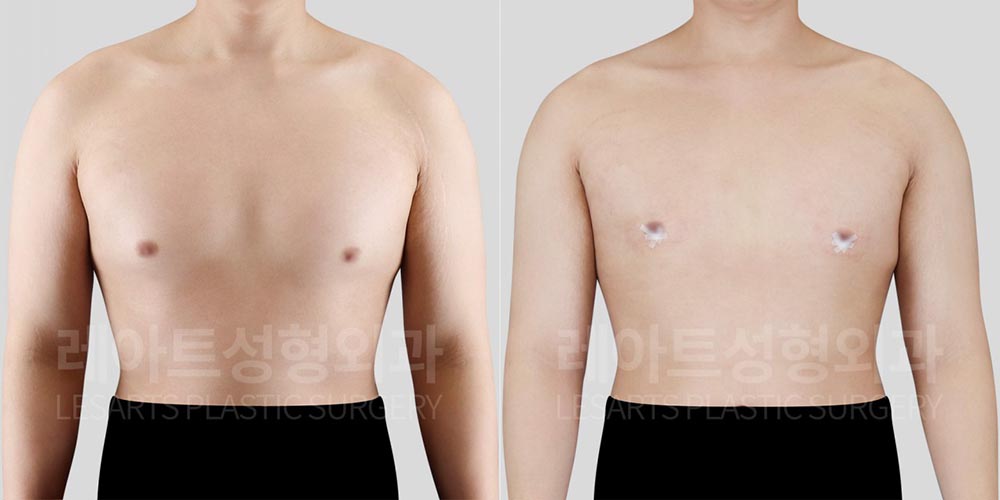
[Changes in Front Chest Thickness from the Front 2 Weeks After Male Gynecomastia Surgery]
This photo was taken 2 weeks after surgery.
Although this is still an early stage of recovery
when considerable swelling may remain,
the central chest projection that was prominent
before surgery has already decreased.
From the front, the overall size of both sides
of the chest has been reduced, and the previously
rounded and heavy-looking chest contour
appears flatter and more balanced.

[Changes in Front Chest Thickness from an Oblique View 2 Weeks After Male Gynecomastia Surgery]
From the oblique view, the change in thickness
from the center of the chest toward the lateral chest
can be seen more clearly.
Before surgery, the central chest projection
and fat distributed along the lateral chest
created a rounded and thicker upper body appearance.
After surgery, the glandular tissue and surrounding fat
were reduced together, creating a lighter and smoother
contour from the front chest toward the torso.

[Changes in Chest Projection and Lower Chest Contour from the Side 2 Weeks After Male Gynecomastia Surgery]
From the side view, the previously prominent
central chest appears flatter, with a noticeable reduction
in forward chest projection.
The angle from the lower chest to the upper abdomen
has also become more gradual than before surgery.
The area where the glandular tissue was removed
was smoothly connected with the surrounding tissue
through tissue rearrangement, preventing the center
of the chest from appearing abruptly hollow
and creating a smoother overall chest contour.

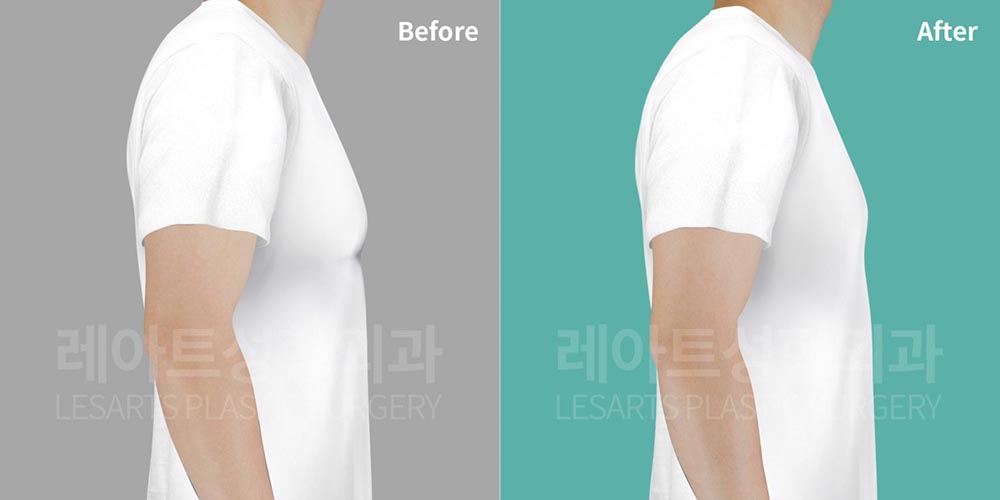
[Changes in T-Shirt Fit 2 Weeks After Gynecomastia Surgery for Chest Asymmetry]
[Changes in T-Shirt Fit 2 Weeks After Gynecomastia Surgery for Chest Asymmetry]
One of the situations in which men with gynecomastia
often feel the most self-conscious is when wearing
a thin T-shirt.
Before surgery, the fullness in the center of the chest
was visible through the T-shirt, causing the fabric
to lift away from the torso and making the difference
between the two sides more noticeable.
At 2 weeks after surgery, the forward projection
of the chest had decreased, allowing the T-shirt
to fall more naturally along the torso.
Although swelling remains and the surgical areas
are still in the early stages of recovery,
the chest contour visible through clothing
already appears more even than before.
This patient felt that his right chest was larger
and was concerned about unilateral gynecomastia
because he also experienced a palpable lump
and intermittent pain.
However, ultrasound examination showed no significant
difference in the size of the glandular tissue
between the two sides.
Instead, both sides showed widely developed glandular tissue,
confirming bilateral true gynecomastia.
Visible chest asymmetry can be influenced not only
by glandular tissue but also by factors such as
subcutaneous fat distribution and muscle volume.
After gland removal, liposuction of the lateral
and lower chest, and tissue rearrangement,
the central chest projection and overall thickness
were reduced at 2 weeks after surgery.
The contour from the lower chest to the upper abdomen
also appeared smoother than before.
The patient was satisfied that the chest size
and asymmetry that had caused stress for many years
were improved and that the front chest appeared
less prominent when wearing a thin T-shirt.
If one side of the chest appears larger,
it does not necessarily mean that gynecomastia
is present on only one side.
The symptoms you notice may not always correspond
directly to the actual degree of glandular tissue development.
Rather than relying on self-diagnosis alone,
an ultrasound examination can help determine
the condition of both sides of the chest
and identify the underlying cause more accurately.
Asymmetrical Gynecomastia FAQ
Q1. If one side of the chest looks larger, does that mean gynecomastia is only present on one side?
Even if one side appears larger, the glandular tissue
may actually be developed to a similar degree on both sides.
An ultrasound examination is needed to evaluate
the distribution of both glandular tissue and fat.
Q2. Can gynecomastia cause a lump in the chest?
Developed glandular tissue may feel like
a firm lump in the center of the chest.
However, touch alone cannot accurately determine
the size or extent of the glandular tissue.
Q3. Can gynecomastia cause chest pain?
Some patients may experience intermittent pain
or discomfort along with the development
of glandular tissue.
If the pain continues or recurs, an examination
is recommended to identify the cause.
Q4. Can exercise improve asymmetrical gynecomastia?
Weight loss may reduce fat around the chest,
but developed glandular tissue may not decrease
sufficiently through exercise alone.
Q5. Is 2 weeks after gynecomastia surgery the final result?
Two weeks after surgery is still an early stage
of recovery, when swelling and tissue firmness
may remain.
As recovery continues, the chest contour
will gradually settle and stabilize.
▼ Visit Lesarts Plastic Surgery in Gangnam, Seoul, Korea ▼