Facial fat transfer in Gangnam: how did prominent cheekbones and hollow temples change after 1 week?
Patient Registration Info
| Age | Weight | Height | BMI |
|---|---|---|---|
|
30s |
– |
– |
– |
Surgical site
Surgical site : Face| liposuction volume : -|Fat Transfer: –
Can facial fat grafting make prominent cheekbones appear less noticeable?
Yes. Facial fat grafting does not reduce the size of the cheekbones themselves.
However, by restoring volume to hollow areas such as the temples and the region beneath the cheekbones,
it reduces the contrast between adjacent facial contours. As a result, the cheekbones can appear less prominent,
creating a softer and more balanced facial profile.
Compared with Western facial structures,
Asian faces often appear wider
and flatter in overall contour.
When the cheekbones are prominent
and the temples or areas beneath
the cheekbones are hollow,
the face may look even wider
and the overall impression
can appear stronger.
However, these facial contour concerns
do not always require surgery
to reduce the facial bones.
By restoring appropriate volume
to hollow areas around the cheekbones
and the central face,
the differences in facial height
and projection can be balanced.
This can help create
a smoother and softer facial contour
while preserving the patient’s
natural facial structure.
In this post,
we will review the preoperative condition
of a patient whose facial contour
appeared uneven due to hollow temples
and prominent cheekbones,
along with the changes observed
one week after facial fat grafting.

[Preoperative Analysis of Prominent Cheekbones Before Facial Fat Grafting]
In the preoperative frontal view,
the temples appeared hollow,
creating shadowing in the area,
while the cheekbones beneath them
appeared relatively more prominent.
Volume loss below the cheekbones
also created noticeable hollowing,
preventing a smooth transition
along the outer facial contour.
As a result,
the face appeared stronger
and more tired overall.
The patient wanted
to soften the appearance
of the prominent cheekbones
and achieve a smoother transition
from the forehead to the temples,
creating a more balanced
upper facial contour.

[Facial Fat Grafting Surgical Plan]
For this procedure,
the goal was not to add excessive volume
directly over the cheekbones.
Instead, the treatment focused
on restoring volume
to hollow areas such as the temples
and beneath the cheekbones
to create a smoother,
more balanced facial contour.
Additional volume was placed
along the temples
to create a seamless transition
from the forehead,
while the hollow areas
beneath the cheekbones
and in the anterior cheeks
were filled to enhance
three-dimensional facial definition.
The nasolabial folds
and chin were also refined
with conservative volume enhancement,
maintaining overall facial harmony
without allowing any single area
to appear overfilled or overly prominent.

[Changes in Temple, Under-Cheekbone, and Anterior Cheek Volume One Week After Facial Fat Grafting]
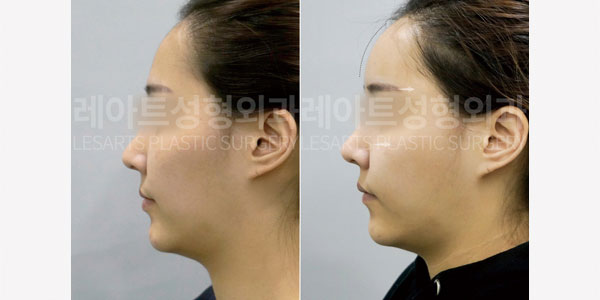
[Forehead and Chin Volume Changes Seen from the Side One Week After Facial Fat Grafting]
The photographs above were taken under the same conditions before surgery and one week after facial fat grafting.
One week after surgery,
volume had been restored
to the previously flat temples
and lateral forehead,
creating a smoother,
more rounded upper facial contour.
The hollow transition
from the temples
to the lateral cheekbones
and beneath the cheekbones
had also been softened,
making the previously prominent
cheekbone contour appear
more balanced and less pronounced.
The anterior cheeks
and the areas around
the nasolabial folds
were enhanced with
a natural amount of volume,
adding greater facial definition
without looking overfilled.
As a result,
the central face appeared
more three-dimensional,
giving the patient
a brighter, healthier,
and more refreshed appearance
compared with before surgery.

[Changes in Forehead Contour and Chin Profile One Week After Facial Fat Grafting]

[Changes in Forehead Contour and Chin Profile One Week After Facial Fat Grafting]
From the side view,
the forehead developed
a natural, rounded contour,
giving the previously flat upper face
greater definition.
Volume was also added
to the chin in proportion
to the overall facial structure,
creating a more balanced profile
from the forehead
to the nose and chin.
Rather than dramatically changing
the shape of the face
with excessive volume,
the procedure focused on restoring
volume only where it was lacking.
This helped soften
the less balanced areas
while naturally preserving
the patient’s original appearance.
At one week after surgery,
some swelling is still present,
and the transferred fat
is only beginning to settle.
The current volume
does not represent the final result.
As the swelling gradually subsides
and the fat continues to stabilize,
the facial contour will become
more refined and natural.
The patient was also satisfied
that the face did not appear
excessively full,
while the hollow temples
and uneven contours
around the cheekbones
had been naturally improved.
When hollow temples
or shadows beneath the cheekbones
make the face appear wider
or create a stronger impression,
or when volume loss
in the anterior cheeks
and around the nasolabial folds
creates a tired appearance,
it is important to evaluate
the overall facial contour
rather than treating
only one isolated area.
At Lesarts Plastic Surgery,
facial fat grafting consultations
include a detailed assessment
of the patient’s fat distribution,
facial bone structure,
and skin condition.
Based on the factors
that make the cheekbones
appear more prominent
and the patient’s desired appearance,
the appropriate treatment areas
and grafting volume
are carefully planned.
For patients who feel hesitant
about bone reduction surgery
but want to soften
uneven contours around the cheekbones
and improve hollow temples,
we recommend
a personalized consultation
at Lesarts Plastic Surgery
to evaluate your facial structure
and determine
the most suitable
facial fat grafting plan.
#facialfatgrafting
#facialrejuvenation
#templefatgrafting
#cheekbonecontouring
#facialcontouring
#fattransfer
#lesartsplasticsurgery
Facial Fat Grafting FAQ
Q1. Can facial fat grafting reduce the size of the cheekbones?
No. Facial fat grafting does not reduce the cheekbones themselves.
Instead, it restores volume to hollow areas such as the temples and beneath the cheekbones,
helping the cheekbones appear less prominent by improving overall facial balance.
Q2. Are the results one week after facial fat grafting the final outcome?
No.
At one week after surgery, some swelling is still present,
and the transferred fat is continuing to settle. Both the facial volume
and contour gradually become more stable over time.
Q3. Why are the temples and anterior cheeks often treated together?
Treating only one area can create an unnatural transition.
For a smoother and more balanced contour, the forehead, temples, beneath the cheekbones,
and anterior cheeks are evaluated and treated together when appropriate.
Q4. Does all of the transferred fat survive permanently?
No. A portion of the transferred fat may be naturally absorbed,
and the amount of long-term fat survival varies from patient to patient.
Follow-up evaluations help determine whether additional grafting is needed.
Q5. How long does swelling last after facial fat grafting?
The rate at which swelling subsides varies between individuals.
Following the recommended postoperative care instructions and
attending scheduled follow-up visits help support a smooth recovery.
▼ Visit Lesarts Plastic Surgery in Gangnam, Seoul, Korea ▼