
M-Type Full Abdominoplasty – 7-Month Results for Abdominal Skin Laxity and Wrinkles Around the Belly Button
Can an M-type full abdominoplasty improve abdominal skin laxity and wrinkles around the belly button?
An M-type full abdominoplasty can remove excess abdominal skin, repair rectus diastasis,
and tighten the skin around the belly button. When needed, abdominal liposuction can also be combined
to improve localized fat and create a smoother overall abdominal contour.
[ Learn More About Abdominoplasty at Lesarts Plastic Surgery ]
Written by Dr.Kukhan Lee, Lesarts Plastic Surgery
This article was written directly by the attending surgeon.
※Unauthorized reproduction, editing, or redistribution is prohibited.※
As the seemingly endless summer heat gradually fades,
the season for getting back into exercise is returning.
Many people may be restarting workouts that were temporarily put on hold because of the heat,
hoping to see positive changes in their body shape.
However, even after losing weight and exercising consistently,
the abdomen may not change as much as expected, leading to a different set of concerns.
This is especially common in people who have experienced significant weight fluctuations
or have gone through pregnancy and childbirth.
Even after successfully losing weight, sagging abdominal skin, wrinkles, and stretch marks may remain,
making it difficult to achieve the abdominal appearance they had hoped for.
This is because exercise and dietary control alone have limitations
when it comes to correcting already stretched skin or rectus diastasis.
These concerns may become even more noticeable when loose skin folds or sags while bending forward during exercise or daily activities,
or when wearing crop tops, swimsuits, or other clothing that exposes part of the abdomen
and draws attention to wrinkles and laxity around the belly button.
In this case, we will look at the 7-month postoperative results of a patient
who continued exercising and managing her weight for many years
but still had abdominal skin laxity and wrinkles around the belly button.
To address these concerns, she underwent abdominal liposuction
combined with an M-type full abdominoplasty.
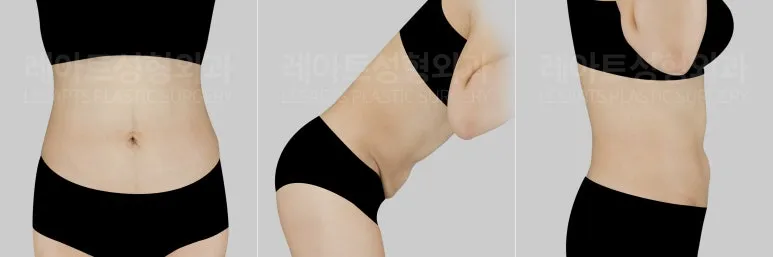
Preoperative Condition Before Abdominoplasty – Lesarts Plastic Surgery
The patient was a woman in her 40s
who was 166 cm tall and weighed 55 kg.
She had experienced severe obesity during her teenage years,
with her weight reaching nearly 90 kg.
She later lost weight through exercise and dietary management
and had consistently maintained a weight of approximately 55–60 kg.
She had also given birth to one child through vaginal delivery,
and her weight had increased to approximately 70 kg during pregnancy.
Due to these significant weight fluctuations over the years,
she was concerned about skin laxity throughout the abdomen.
Because she often wore clothing that exposed the area around the belly button and upper abdomen,
she was particularly concerned about wrinkles and sagging skin around the belly button.
Physical examination showed that she did not have a large amount of overall subcutaneous fat.
Having exercised consistently and managed her weight for many years,
she maintained relatively good overall body proportions and contour.
However, localized fat deposits remained in the upper abdomen and waistline,
which could be further improved with liposuction.
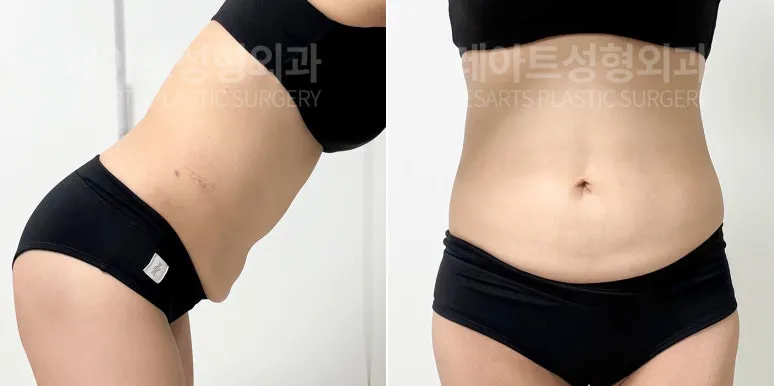
Preoperative Condition Before Abdominoplasty (Photo Provided by the Patient) – Lesarts Plastic Surgery
Skin laxity was present in both the upper and lower abdomen.
Although the skin around the belly button itself was not severely stretched,
the combination of mild skin laxity, stretch marks, fine wrinkles, and rectus diastasis
made the area around the belly button appear more saggy than it actually was.
In the lower abdomen, loose skin remained above the underwear line.
Rectus diastasis was also confirmed through physical examination,
and we determined that it should be corrected together with the skin laxity.
One of the most important considerations when planning the surgery
was the location of the final scar.
Considering both the patient’s abdominal condition and her concerns
about the upper abdomen and the area around the belly button,
an M-type full abdominoplasty appeared to be the appropriate approach.
However, when evaluating the actual degree of skin laxity
apart from the stretch marks and fine wrinkles,
the upper abdominal skin was not severely sagging.
When there is limited excess skin in the upper abdomen,
there is also a limit to how far the skin can be pulled downward during surgery.
This can restrict how low the final scar can be positioned.
We therefore explained the expected incision location and its limitations in detail
and advised the patient to consider her usual styles of underwear and swimwear
when deciding whether to proceed with surgery.
After careful consideration, she decided to undergo surgery,
and abdominal liposuction combined with an M-type full abdominoplasty was planned and performed.
Now, let’s look at the results 7 months after abdominal liposuction and abdominoplasty.
Because the appearance around the belly button was one of the patient’s main concerns,
creating a natural belly button shape and tightening the surrounding skin
were important considerations during surgery.
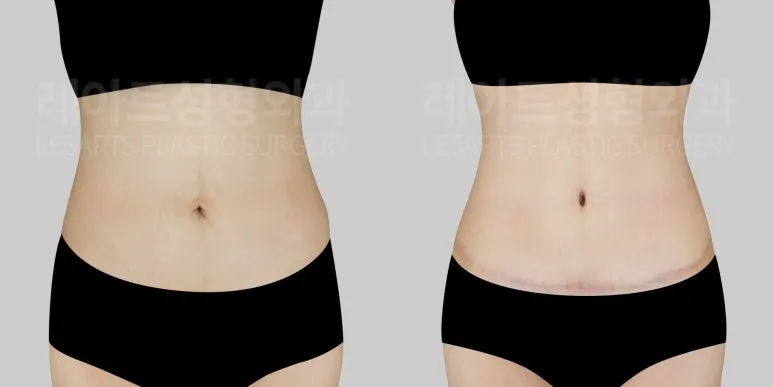
Comparison Before and After Abdominoplasty – Dr. Kukhan Lee, Lesarts Plastic Surgery
After removing localized fat from the upper abdomen,
the rectus diastasis was repaired and the loose skin was pulled downward sufficiently
to create a firmer, smoother appearance around the belly button.
The belly button was reshaped into the vertical form preferred by the patient.
At follow-up, it had settled into a natural shape
that blended harmoniously with the overall abdominal contour.
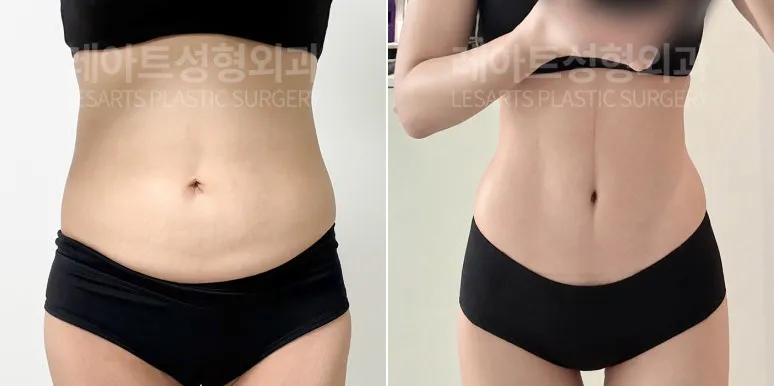
Everyday Photos Before and After Abdominoplasty – Dr. Kukhan Lee, Lesarts Plastic Surgery
The skin laxity in the lower abdomen was also corrected and showed stable improvement.
In particular, the incision area was carefully contoured to minimize any noticeable step-off,
allowing the overall lower abdominal line to transition smoothly and naturally.

Everyday Photos After Abdominoplasty – Dr. Kukhan Lee, Lesarts Plastic Surgery
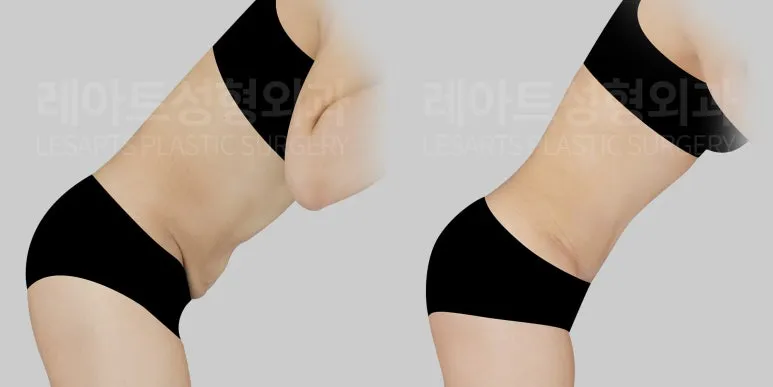
Changes in Lower Abdominal Skin Laxity Before and After Abdominoplasty – Lesarts Plastic Surgery
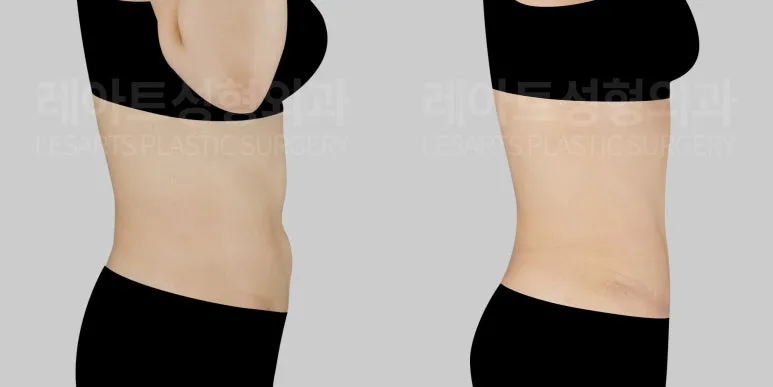
Lifting Surgery for Sagging Abdominal Skin and Wrinkles Above the Belly Button – Lesarts Plastic Surgery
When the patient bends forward, the improvement in skin laxity becomes even more noticeable
from the side and oblique views compared with before surgery.
One of her concerns was that the loose abdominal skin would fold and sag
when bending forward during exercise.
The significant improvement in skin laxity even in this position
was therefore one of the meaningful changes observed after surgery.
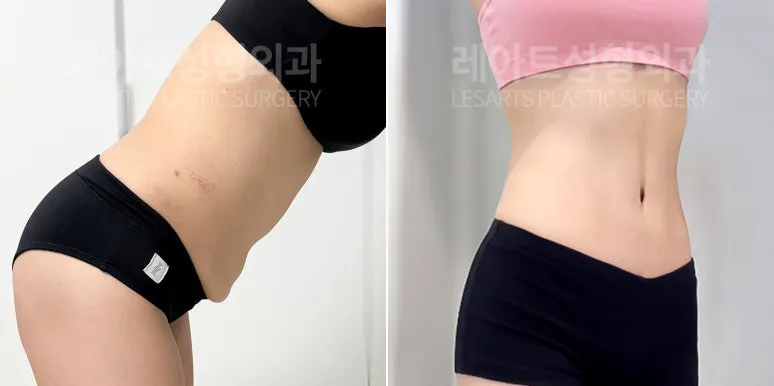
Changes in the Lower Abdominal Contour Before and After Abdominoplasty – Lesarts Plastic Surgery
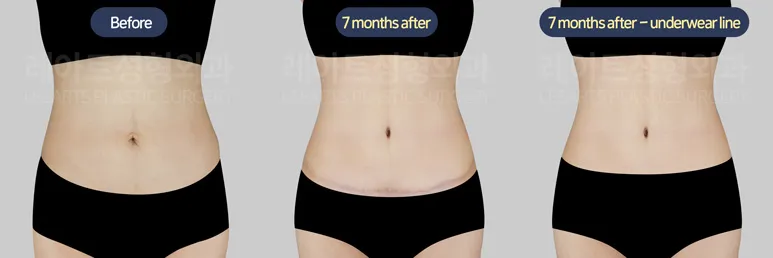
Abdominoplasty Scar Location, Length, and Recovery Process – Lesarts Plastic Surgery
The incision was positioned as low as reasonably possible within the limits of the procedure.
Because both the amount of available skin and surgical safety must be considered,
there are limitations to how low the scar can be placed.
In this case, the incision could be positioned slightly lower than initially expected,
and it is now located where it can be sufficiently covered by the patient’s usual underwear.
At 7 months after surgery, the scar is also progressing through the expected maturation process.
It has remained relatively stable without any significant widening or raised areas,
and it is expected to gradually become softer and lighter over time.
Abdominoplasty is not simply a procedure that removes excess, sagging skin.
Achieving an overall balanced result requires consideration of multiple factors,
including the degree of skin laxity, fat distribution, rectus diastasis,
the position and shape of the belly button, and the location of the postoperative scar.

Everyday Photos After Abdominoplasty – Dr. Kukhan Lee, Lesarts Plastic Surgery
Although this patient had maintained her weight and body shape well for many years,
she still had abdominal skin laxity and wrinkles around the belly button
that were difficult to improve through exercise or dietary management alone.
These concerns were addressed together through abdominal liposuction
and an M-type full abdominoplasty.
At 7 months after abdominoplasty, most of the discomfort experienced in daily life
has typically improved considerably.
However, complete stabilization of the surgical tissues
and scar maturation continue for much longer.
Changes in the scar and surrounding tissues may continue for approximately 1–2 years after surgery.
As more time passes, the tissues in the treated area are expected to gradually soften,
while the scar continues to fade and develop a more natural appearance.
Considering both the current results and the remaining recovery process,
further stabilization and a more natural abdominal appearance can be expected over time.
Even with consistent exercise and long-term weight management,
there may be limitations to improving stretched skin, rectus diastasis,
and wrinkles around the belly button through exercise alone.
For patients who frequently wear clothing that exposes part of the abdomen
or remain concerned about sagging skin during exercise,
an appropriate treatment approach may be considered based on their individual condition.
Abdominoplasty involves more than simply removing excess skin.
Fat distribution, the abdominal muscles, the shape of the belly button,
and the location of the final scar all need to be considered together.
For this reason, a thorough consultation is important
when developing a surgical plan suited to each patient’s individual condition.
FAQ
Q1. Why can abdominal skin laxity remain even after weight loss and exercise?
Significant weight changes, pregnancy, and childbirth can leave stretched abdominal skin, wrinkles, and rectus diastasis.
These structural changes may be difficult to improve through exercise and weight management alone.
Q2. Why was an M-type full abdominoplasty selected in this case?
The patient had skin laxity in both the upper and lower abdomen, wrinkles around the belly button, and rectus diastasis.
Considering these concerns together, an M-type full abdominoplasty was selected to address the overall abdominal contour.
Q3. Why was abdominal liposuction combined with the abdominoplasty?
Although the patient did not have a large amount of overall subcutaneous fat,
localized fat remained in the upper abdomen and waist.
Liposuction was therefore combined with the abdominoplasty to further refine these areas.
Q4. Can the abdominoplasty scar be completely hidden below underwear?
The incision can be positioned as low as reasonably possible, but its final location depends on the amount of available skin and surgical safety.
In this case, the scar was positioned low enough to be covered by the patient’s usual underwear.
Q5. Is recovery complete 7 months after an abdominoplasty?
By 7 months, many of the discomforts experienced in daily life may have substantially improved,
but tissue stabilization and scar maturation continue for much longer.
Changes in the scar and surgical tissues may continue for approximately 1–2 years.
▼ Visit Lesarts Plastic Surgery in Gangnam, Seoul, Korea ▼