
Adolescent gynecomastia in Korea: when is surgery appropriate for minors? 2-week results after 6 months of observation

Patient Registration Info
| Age | Weight | Height | BMI |
|---|---|---|---|
|
10s |
93kg |
181cm |
28 |
Surgical site
Surgical site : Gynecomastia | Grade 2-B
Should Minors Undergo Gynecomastia Surgery Immediately After Diagnosis?

[Changes in School Uniform Fit 2 Weeks After Gynecomastia Surgery in a Minor]
Even when adolescents are diagnosed
with true gynecomastia, it may be necessary
to monitor changes in chest size and shape
for a certain period during their growth years.
This is because hormonal changes during puberty
may allow gynecomastia to improve naturally over time.
However, if surgery is being considered,
a follow-up observation period may be necessary
from the initial consultation.
For this reason, it is important to have
the current condition evaluated early enough
to allow time for proper monitoring.
As adolescents enter puberty, some may experience
sudden breast enlargement or forward chest projection,
which can become a source of stress.
This concern may become even greater when wearing
school uniforms or thin T-shirts that easily reveal
the chest shape, making them more conscious
of how their peers perceive them.
However, a diagnosis of gynecomastia
does not necessarily mean that surgery
should be performed immediately
while the patient is still growing.
Hormonal changes are active during puberty,
and breast enlargement may naturally decrease over time.
For this reason, even adolescents diagnosed
with true gynecomastia may undergo approximately
6 months of follow-up observation to monitor
changes in chest size and shape.
In this case, the patient first visited the clinic
in his late teens. Rather than proceeding directly
with surgery, his condition was monitored for 6 months.
[Patient Information]
Age: Late teens
Height: 181 cm
Weight: 92.8 kg
BMI: 28.3
Gynecomastia Classification: Simon Grade 2B
At his initial consultation, the patient was diagnosed
with mixed-type gynecomastia, in which both fat
and glandular tissue contributed to chest enlargement.
However, because he was still in his growth years,
the decision was made to monitor changes in his chest
for 6 months while he also worked on weight loss,
rather than proceeding with surgery immediately.
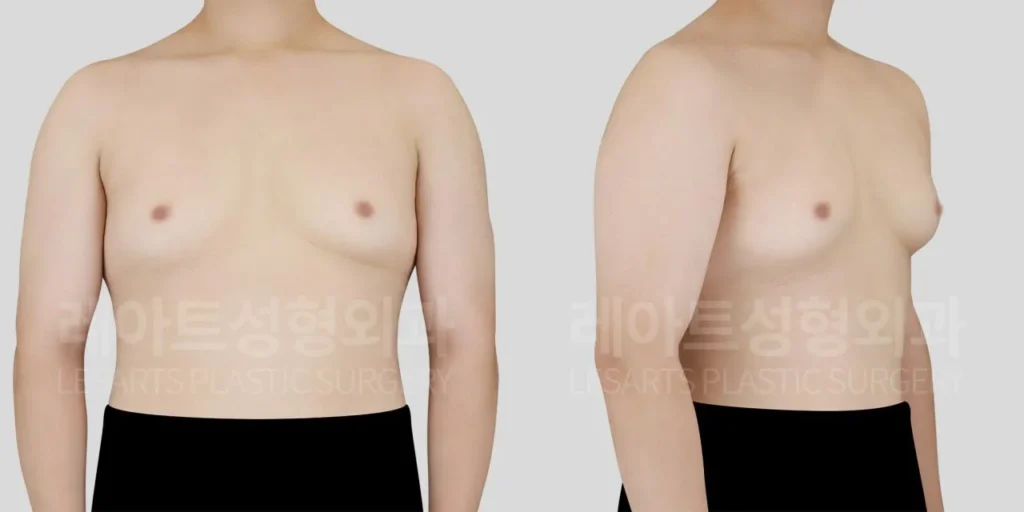
[Persistent Chest Projection After 6 Months of Follow-Up for Adolescent Gynecomastia]
When the patient returned to the clinic 6 months later,
his body fat had decreased through weight management.
However, there was little change in the size
or forward projection of both sides of his chest.
The enlarged glandular tissue also showed
no significant reduction compared with
the initial examination.
After evaluating the chest size and degree
of skin sagging, the patient was diagnosed
with Simon Grade 2B true gynecomastia.
Because the patient was still in his teens,
his skin elasticity remained relatively good.
We determined that, with proper postoperative care
and adherence to recovery precautions,
the skin could gradually adapt and settle
into the reduced chest contour.

[Changes in Anterior Chest Projection 2 Weeks After Gynecomastia Surgery in a Minor]
The procedure included glandular tissue removal,
chest liposuction, and tissue rearrangement.
Photos taken 2 weeks after surgery show
a noticeable difference from the front view,
even though swelling, bruising, and tissue firmness
were still present during this early recovery stage.
Before surgery, shadowing beneath the breasts
made the size and projection of both sides
of the chest appear more pronounced.
After surgery, the volume in the lower chest
had decreased, making the shadowing less noticeable.
The previously prominent anterior chest
also appeared significantly flatter.
The long, horizontal shadow across the central chest
had also diminished, creating an overall contour
closer to a masculine chest shape.
Because only 2 weeks had passed since surgery,
it was still too early to evaluate the final chest shape.
However, the chest size and forward projection
that had been the patient’s main concerns
already showed visible improvement.

[Changes in Chest Thickness from the Oblique View 2 Weeks After Adolescent Gynecomastia Surgery]
From the oblique view, the reduction
in the height of the previously prominent chest
is even more noticeable.
Before surgery, the anterior chest projected forward
around the areolas, with rounded volume extending
downward toward the lower chest.
This made the upper body appear heavier overall.
At 2 weeks after surgery, the thickness
of the anterior chest had decreased,
and the rounded contour extending toward
the lower chest had also been reduced.
As a result, the chest appeared less prominent
from the side, creating a smoother and more natural
transition into the torso.

[Changes in Chest Projection Through a School Uniform 2 Weeks After Adolescent Gynecomastia Surgery]
Gynecomastia during adolescence often causes
more stress through everyday clothing than
in situations where the chest is directly exposed.
When wearing school uniforms or thin cotton T-shirts,
the forward-projecting chest may remain noticeable.
This can become an even greater concern at school,
where adolescents spend time with many peers.
In this case, the patient shared that one of
the most satisfying changes after surgery was
no longer having to worry about his chest
when wearing everyday clothes.
In the before-and-after photos, the rounded chest volume
was clearly visible through his school uniform before surgery.
At 2 weeks after surgery, the anterior chest projection
had decreased, allowing the uniform to fall more naturally
along the contour of his torso.
The patient also expressed satisfaction
with feeling more confident in his daily life.
Gynecomastia that develops during adolescence
does not necessarily require immediate surgery.
Because gynecomastia that appears during puberty
may naturally decrease over time, a period of observation
may be necessary while the patient is still growing.
In this case, mixed-type gynecomastia was confirmed
at the initial consultation, but surgery was not
performed immediately.
Instead, the patient underwent 6 months
of follow-up observation.
During this period, his body fat decreased through dieting,
but there was little change in the glandular tissue,
chest size, or forward projection on either side.
He was subsequently diagnosed with Simon Grade 2B
true gynecomastia, and surgery was decided upon.
At 2 weeks after surgery, the volume and shadowing
beneath the chest had decreased, creating
a flatter anterior chest contour.
In particular, the chest projection that had previously
been noticeable through his school uniform was reduced,
and the patient was satisfied with the changes
he experienced in everyday life.
However, an important consideration is that
the timing of the initial consultation may also
affect the overall treatment schedule.
Because adolescent gynecomastia may require
a certain period of follow-up observation,
continuing to delay the initial examination
could also delay the time when a decision
about surgery can be made.
If chest projection continues to cause discomfort
when wearing school uniforms or thin clothing,
it is important not to decide on surgery immediately.
Instead, an accurate examination should first be performed
to evaluate the current condition of the glandular tissue
and surrounding fat.
The necessary observation period and appropriate
timing of treatment should then be discussed
thoroughly with a medical professional.
Adolescent Gynecomastia FAQ
Q1. Should minors undergo gynecomastia surgery immediately after diagnosis?
Gynecomastia may naturally decrease during adolescence,
so a period of follow-up observation may be recommended first.
The decision about surgery is then made based on
changes in chest size and shape and examination results.
Q2. How long should adolescent gynecomastia be monitored?
In this case, changes in chest size and shape
were monitored for approximately 6 months
after the initial diagnosis.
The actual follow-up period may vary
depending on the patient’s condition.
Q3. Can adolescent gynecomastia go away with weight loss?
Weight loss may help reduce chest enlargement
caused by excess fat.
However, as shown in this case, if enlarged glandular tissue
remains despite a reduction in body fat,
chest projection may not improve sufficiently.
Q4. What is Simon Grade 2B gynecomastia?
Simon Grade 2B gynecomastia involves
noticeable chest enlargement accompanied by skin sagging.
When planning surgery, it is important to consider
not only chest volume but also skin elasticity
and the recovery process.
Q5. Can adolescents return to school 2 weeks after gynecomastia surgery?
In this case, the patient still had swelling, bruising,
and tissue firmness 2 weeks after surgery.
However, he was able to perform everyday activities
without significant difficulty.
The actual recovery process may vary
from person to person.
▼ Visit Lesarts Plastic Surgery in Gangnam, Seoul, Korea ▼