
Abdominoplasty in Gangnam: 3-month results for abdominal skin sagging starting from the upper abdomen
Patient Registration Info
| Age | Weight | Height | BMI |
|---|---|---|---|
|
40s |
73kg |
157cm |
30 |
Surgical site
Surgical site : Abdomen, M-Type, Rectus Muscle Repair, Umbilicoplasty| liposuction aspirate volume : 1,600cc
Can Lower Abdominal Sagging Actually Start from the Upper Abdomen?
Even when wrinkles and folds appear concentrated
in the lower abdomen, abdominal skin laxity
may actually begin in the upper abdomen.
As loose skin shifts downward due to gravity,
it can accumulate in the lower abdomen.
Therefore, when planning a tummy tuck, it is important
to evaluate not only the lower abdomen but also
the extent of skin laxity from the upper to lower abdomen,
along with the condition of the abdominal wall.
When abdominal skin begins to sag, visible wrinkles
and folds tend to appear mainly around
the belly button and lower abdomen.
This can make it easy to assume
that only the lower abdominal skin has become loose.
However, skin that has lost elasticity in the upper abdomen
may gradually shift downward, creating wrinkles
around the belly button.
Excess skin can then gather in the lower abdomen
and form visible folds.
In this patient, skin laxity beginning in the upper abdomen
extended around the belly button
and down into the lower abdomen.
Preoperative Skin Laxity Extending from the Upper Abdomen
[Preoperative Upper Abdominal Skin Laxity and Wrinkles Around the Belly Button]
The patient had previously undergone
abdominal liposuction at another clinic,
but the skin laxity remained, making the abdomen
appear thick and heavy.
Her main concern was the wrinkles
around the upper abdomen and belly button.
Before surgery, skin elasticity had decreased
from the upper abdomen, and the excess skin
had shifted downward, creating wrinkles
and folds around the belly button.
The belly button itself had also become distorted
due to the surrounding loose skin.
When bending forward, the excess skin
folded even more noticeably, while the protruding
abdominal wall became more visible, making
the front abdomen appear uneven.
Surgical Plan Considering Adhesions Remaining from Previous Abdominal Liposuction

[Preoperative Surgical Plan Considering Upper Abdominal Skin Laxity and Adhesions from Previous Liposuction]
In addition to skin laxity, the patient also had
adhesions remaining in the areas where abdominal
liposuction had previously been performed.
These adhesions made the abdominal surface appear uneven
and further emphasized the irregular contour.
During the tummy tuck, the existing adhesions needed
to be released as the skin was dissected.
The loose skin extending from the upper abdomen
was planned to be sufficiently pulled downward and tightened.
The separated rectus muscles were also repaired to correct
the abdominal wall that had been protruding forward.
In addition, the belly button, which had become distorted
into a shape resembling an inverted “V” due to skin laxity,
was planned to be reshaped during the tummy tuck.
View Abdominal Liposuction Cases
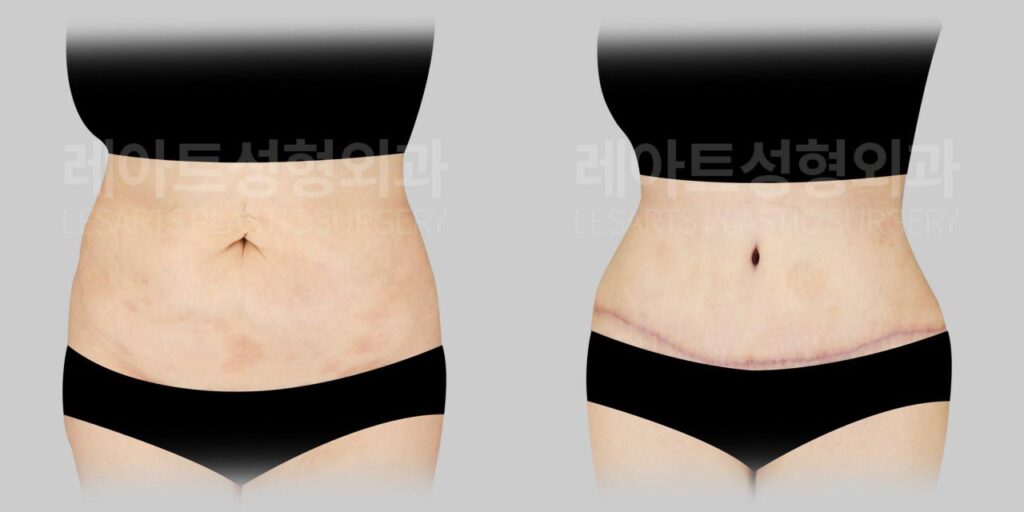
Abdominal Changes from the Front 3 Months After Tummy Tuck
[Changes in Upper Abdominal Skin Laxity and Wrinkles Around the Belly Button from the Front 3 Months After Tummy Tuck]
The patient underwent an M-type full tummy tuck
to correct skin laxity extending from the upper abdomen.
At 3 months after surgery, the wrinkles and folds
extending from the upper abdomen to the belly button area
appeared noticeably smoother.
By releasing the adhesions remaining from the previous liposuction,
the irregular appearance of the abdominal surface
was also improved.
By correcting both the stretched skin and the abdominal wall
that had been protruding forward, the entire front abdomen
appeared firmer than before surgery.
The previously distorted belly button
was also reconstructed into a vertical shape.
How Did the Front Abdominal Projection and Waistline Change?
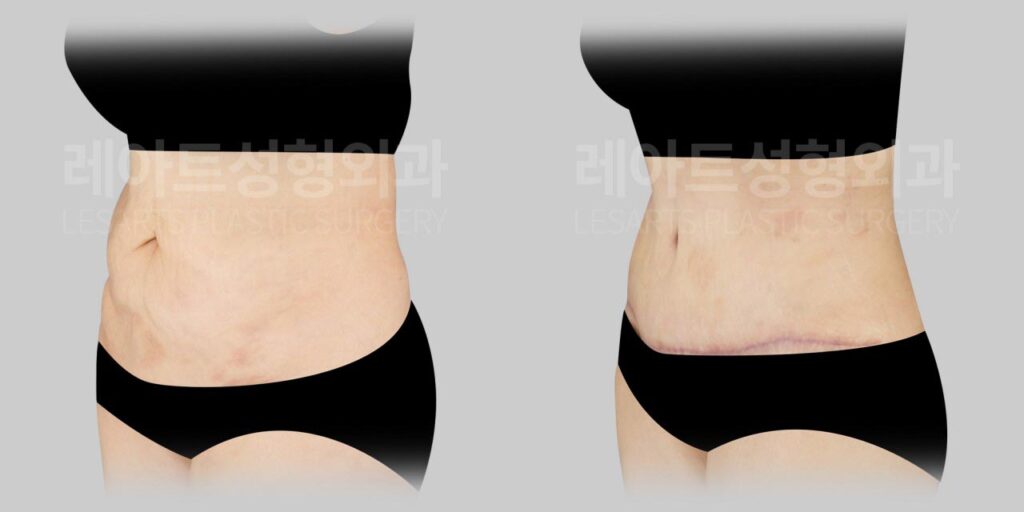
[Changes in Front Abdominal Projection and Waistline 3 Months After Tummy Tuck]
Before surgery, the upper abdominal skin sagged downward,
making the center of the abdomen appear thicker.
The irregular contours around the belly button
also made the waistline appear less defined.
After surgery, the skin from the upper to lower abdomen
was tightened and the abdominal wall was corrected,
reducing the overall volume of the front abdomen.
The uneven contour around the belly button became smoother,
and the vertically reconstructed belly button was positioned
naturally in the center of the abdomen.
As a result, the waistline also appeared
more naturally defined than before surgery.
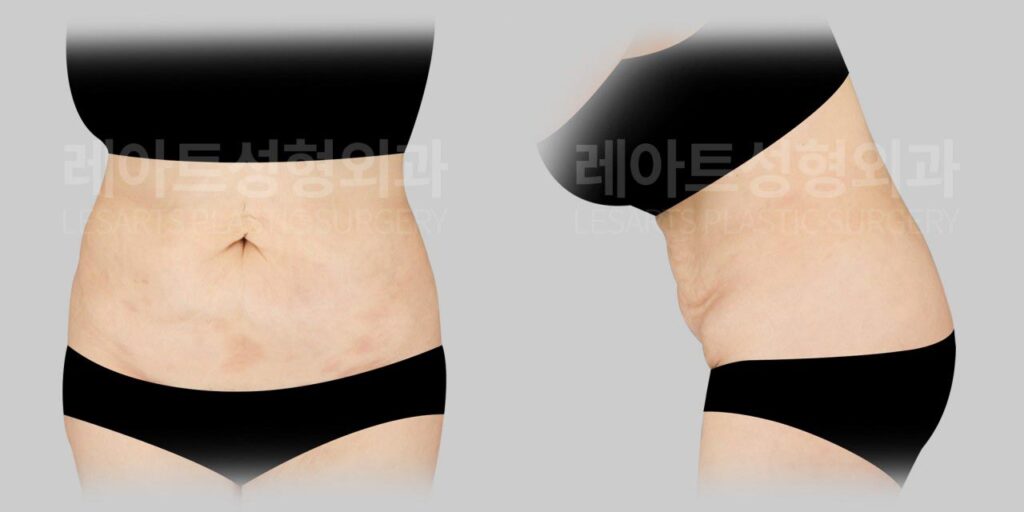
Changes in Upper and Lower Abdominal Contours from the Side View
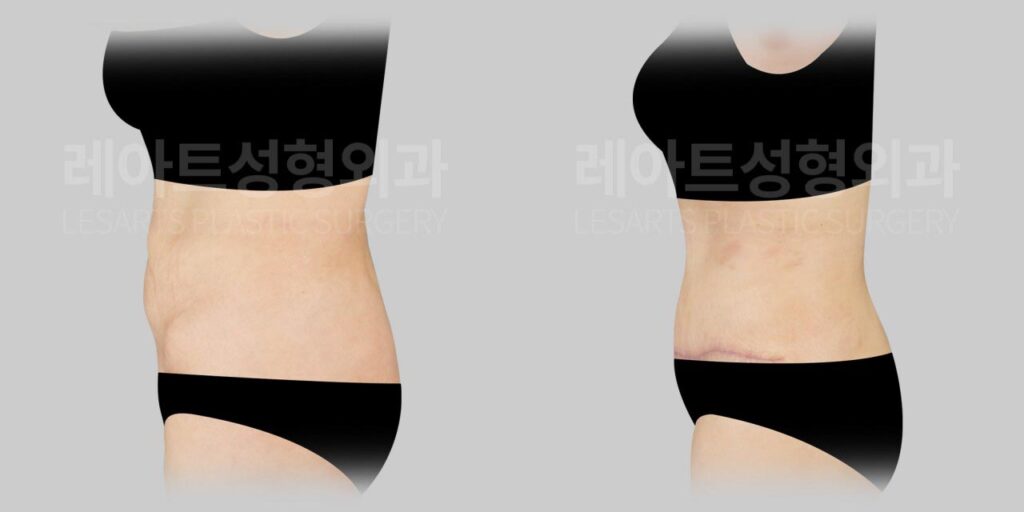
[Changes in Front Abdominal Projection and Upper and Lower Abdominal Contours from the Side 3 Months After Tummy Tuck]
From the side view, the change in front abdominal thickness
after correcting the skin laxity and abdominal wall
can be clearly seen.
Before surgery, the abdomen projected forward
from the upper to lower abdomen,
creating an overall loose and heavy appearance.
After surgery, the front abdominal projection was reduced,
creating a smoother contour from the upper
to the lower abdomen.
In particular, the irregular contours caused by skin laxity
were smoothed out, making the overall abdomen
appear lighter than before surgery.
Changes in Skin Folds When Bending Forward

[Changes in Upper Abdominal Skin Laxity and Folds Around the Belly Button When Bending Forward 3 Months After Tummy Tuck]
In this patient, the skin laxity became
more noticeable when bending forward.
Before surgery, when the upper body was bent forward,
the loose skin shifted downward, creating multiple wrinkles
and folds around the belly button.
At 3 months after surgery, even when bending forward,
the skin no longer sagged downward as heavily as before,
and the folds around the belly button were noticeably reduced.
The front abdomen, which had appeared loose before surgery,
also maintained a firmer appearance.
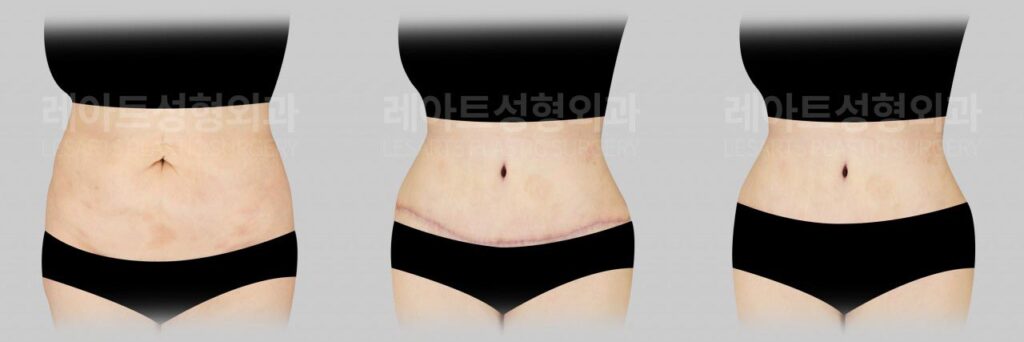
At 3 months after surgery, the tummy tuck scar
has not yet fully matured.
As seen in the photo, some redness still remains
along the lower abdominal incision.
The patient was informed that this is part
of the normal healing process and that the color
may gradually fade with continued scar care.
The incision is positioned relatively low
on the lower abdomen, allowing it to be naturally
covered when wearing underwear.

[Selfie Comparison Before and 3 Months After Tummy Tuck]
The changes in the center of the abdomen can also be seen
in the photos taken and provided by the patient.
The patient was especially satisfied with the reduction
in wrinkles around the upper abdomen and belly button,
which had been her main concern before surgery.
In the selfies, the center of the abdomen appears firmer and smoother,
with the waistline becoming more naturally defined.
The irregular abdominal contour caused by adhesions
from previous liposuction was also improved, along with
the fullness around the flanks.
As a result, the contour from the waist to the hips
appears smoother and more naturally connected.
As seen in this patient, even when excess skin appears
to gather in the lower abdomen, the skin laxity
does not necessarily begin there.
Skin that has lost elasticity in the upper abdomen
can shift downward, creating wrinkles around the belly button
and eventually forming folds in the lower abdomen.
In this case, an M-type full tummy tuck was planned
after evaluating the skin laxity extending from the upper abdomen,
adhesions from previous liposuction, separated rectus muscles,
and the distorted belly button.
At 3 months after surgery, the wrinkles around the upper abdomen
and belly button had improved, while the skin folds
that became prominent when bending forward were also reduced.
The patient was satisfied that the upper abdomen
and belly button area, which had been her main concerns,
appeared smoother than before surgery.
She was also pleased with the more natural contour
extending from the waist to the hips.
Therefore, when considering a tummy tuck, the surgical range
should not be determined simply by looking at or pinching
the loose skin in the lower abdomen.
It is important to evaluate how the skin laxity extends
from the upper abdomen, along with the condition
of the abdominal wall, belly button, and previously treated areas.
Tummy Tuck FAQ
Q1. If only the lower abdomen is sagging, is a mini tummy tuck enough?
Even if excess skin appears concentrated in the lower abdomen,
the actual skin laxity may begin in the upper abdomen.
The condition of the upper abdominal skin and the presence
of rectus diastasis should be evaluated before determining
the appropriate surgical range.
Q2. Can skin laxity remaining after abdominal liposuction be improved with another liposuction procedure?
Liposuction is designed to reduce subcutaneous fat,
so it has limitations in removing skin that has already stretched.
If skin laxity extends across a wide area,
a tummy tuck may be necessary.
Q3. Can I have a tummy tuck if I have adhesions from previous abdominal liposuction?
If adhesions remain from previous abdominal liposuction,
they need to be considered during the tummy tuck procedure.
Because adhesions can affect skin movement,
their extent and severity should be evaluated before surgery.
Q4. Can the shape of the belly button change after a tummy tuck?
With an M-type full tummy tuck, the loose skin is repositioned,
and the belly button may need to be reconstructed
into a new shape and position.
Q5. Is the scar still red 3 months after a tummy tuck?
At 3 months after surgery, the scar is still
in the process of maturing, so some redness may remain.
As recovery and scar care continue,
the color and appearance may gradually change.
▼ Visit Lesarts Plastic Surgery in Gangnam, Seoul, Korea ▼