
Abdominoplasty in Seoul: 1-year scar and abdominal contour changes after twin pregnancy
Patient Registration Info
| Age | Weight | Height | BMI |
|---|---|---|---|
|
30s |
58kg |
164cm |
22 |
Surgical site
Surgical site : Abdomen, Hip Dips, M-Type, Rectus Muscle Repair, Umbilicoplasty | Liposuction : 3,500cc
Fat Grafting: Hip Dips (Right: 130 cc / Left: 190 cc)
Sagging Lower Abdominal Skin After Twin Pregnancy: Is a Full Tummy Tuck Worth a Longer Scar?
A tummy tuck requires an incision of a certain length
to adequately remove excess, sagging skin.
However, rather than determining the surgical approach
based solely on scar length, it is important to evaluate
how extensively the skin has stretched,
how much the abdominal wall has loosened,
and the degree of improvement desired.
Even when two abdomens appear similar,
the extent of correction and incision length required
may differ depending on the condition
of the skin, fat, and underlying muscles.
When considering a tummy tuck, one of the biggest
concerns, besides how much sagging skin can improve,
is the scar that remains after surgery.
Because a tummy tuck involves directly removing
excess skin, a relatively long incision is often necessary.
On the other hand, for patients who have struggled
with persistent lower abdominal folds and sagging skin
for years after childbirth, adequately removing
the excess skin may be more important
than simply minimizing scar length.
This patient was also a woman in her 30s
whose primary concern was the sagging abdominal skin
that remained after giving birth to twins.
We will examine her preoperative abdominal condition,
the surgical plan, and the changes in skin laxity
and scarring more than one year after her tummy tuck.

[Preoperative Abdominal Sagging After Twin Pregnancy]
The patient did not have a particularly large
amount of abdominal fat overall.
However, the skin around the navel
and lower abdomen had become loose and stretched.
Toward the lower abdomen, the excess skin
gathered and formed noticeable folds.
In particular, the lower abdominal bulge
was not caused by fat alone.
The excess stretched skin had also accumulated
in this area, creating an overall heavy
and sagging appearance.
The abdominal wall had also been significantly
stretched during pregnancy.
Even when the patient tightened her abdominal muscles,
the central abdomen did not feel firm or well-supported.
Instead, the abdomen protruded forward
and appeared wider and more spread out.
[Preoperative Surgical Plan Considering the High Navel Position and Abdominal Wall Condition]
The patient considered adequately correcting
the abdominal sagging that remained after childbirth
more important than simply minimizing
the length of the incision scar.
Therefore, rather than limiting the surgical area,
we planned a full tummy tuck to sufficiently remove
the loose, sagging skin that had lost its elasticity.
The procedure was not intended
to tighten the skin alone.
We also planned rectus muscle plication
to tighten and reinforce the abdominal wall,
which had become stretched during pregnancy.
In addition, because the original navel was affected
by the area of skin being removed during
the extensive skin repositioning process,
umbilicoplasty was planned to create a navel
suited to the new abdominal position.
Finally, abdominal liposuction was also included
to create a smooth transition between
the upper and lower abdomen after the tummy tuck
and a more naturally defined waistline.
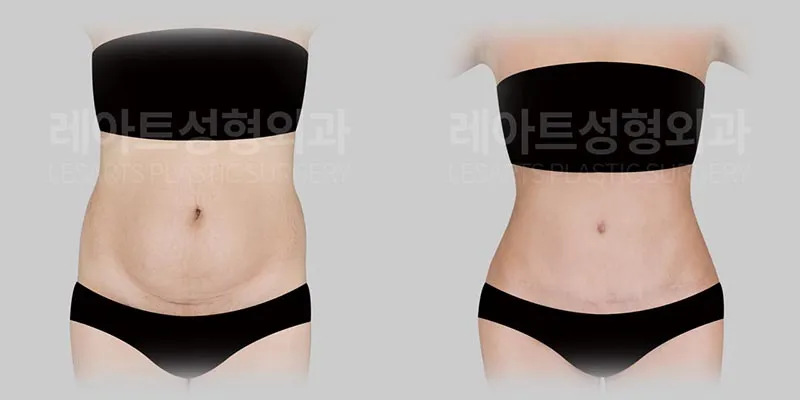
[Changes in Lower Abdominal Skin Sagging and the Navel Area 1 Year After a Tummy Tuck]
Let’s compare the front-view photos
taken before surgery and 1 year after the tummy tuck.
Before surgery, the skin around the navel
and lower abdomen was loose and sagging,
creating a noticeable forward bulge.
At 1 year after surgery, the excess skin
had been removed, creating a smoother contour
from the navel to the lower abdomen.
The deep folds caused by overlapping skin
in the lower abdomen had also been eliminated.
Some of the stretch marks on the lower abdomen
were also removed along with the sagging skin
within the surgical excision area.
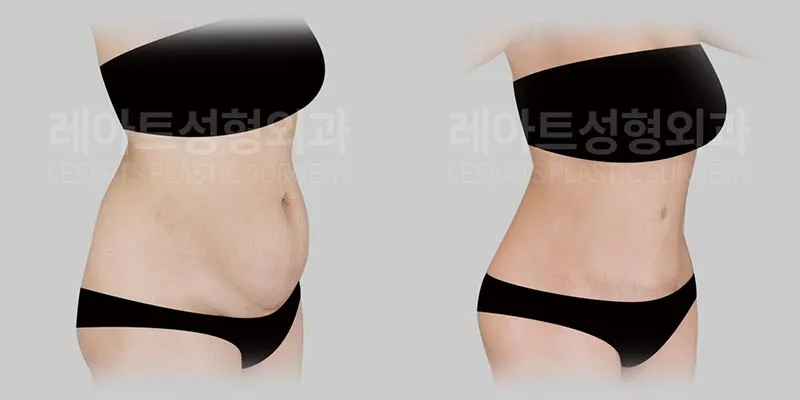
[Changes in Lower Abdominal Protrusion and Waistline 1 Year After a Tummy Tuck]
From the side view, the changes resulting
from abdominal wall correction are even more noticeable.
Before surgery, the stretched abdominal wall
protruded forward, making the central abdomen
appear loose and spread out.
After rectus muscle plication restored support
to the abdominal wall, the front of the abdomen
appeared firmer and more defined than before.
In addition, abdominal liposuction helped reduce
excess volume not only in the front of the abdomen
but also around the waist.
As a result, the contour extending from
the upper abdomen to the lower abdomen
appeared smoother and more natural.

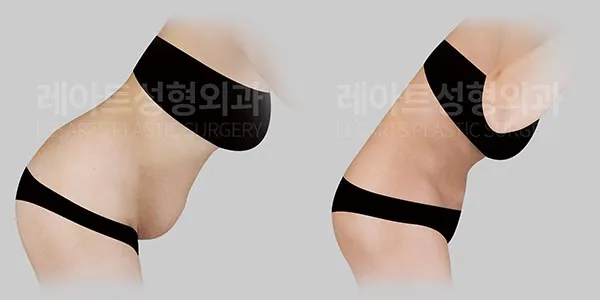
[Changes in Lower Abdominal Skin Sagging and Folds When Bending Forward 1 Year and 1 Month After a Tummy Tuck]
Sagging skin remaining after childbirth
often becomes more noticeable when bending forward
than when standing upright.
Before surgery, when this patient bent forward,
the excess skin gathered significantly downward
due to gravity, creating pronounced folds
in the lower abdomen.
At 1 year and 1 month after surgery,
the amount of excess skin had decreased considerably.
Even when bending forward, the skin no longer
sagged downward as noticeably as before.
The front of the abdomen also appeared firmer
and more stable, even when changing positions.
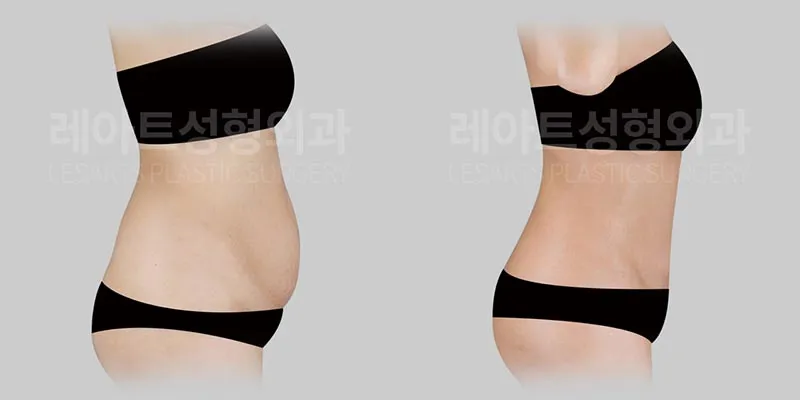
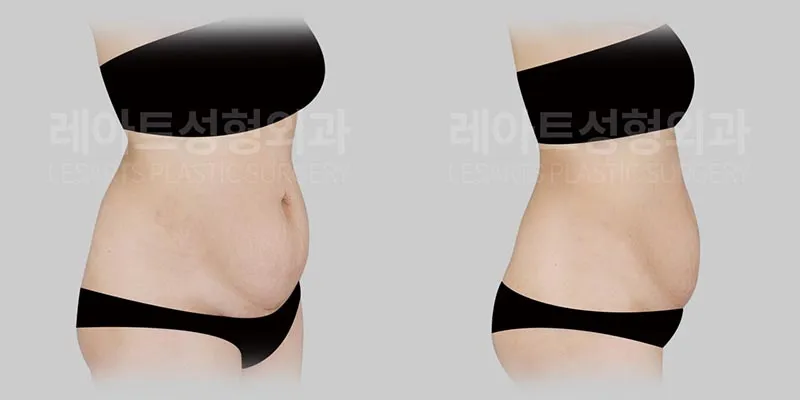
[Changes in Lower Abdominal Protrusion and Front Abdominal Contour from the Side View 1 Year and 1 Month After a Tummy Tuck]
From the side view, the front of the abdomen,
which previously protruded forward,
appeared flatter and smoother than before surgery.
In addition to removing excess skin
and tightening the abdominal wall through
a tummy tuck, liposuction was also performed.
This helped create a more natural transition
in thickness from the upper abdomen
to the lower abdomen.
Excess volume around the flanks
and love handles had also decreased,
creating a slimmer and smoother curve
from the waist to the hips.
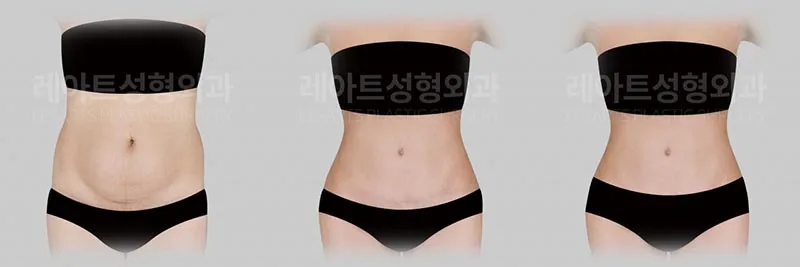
[Lower Abdominal Incision Scar Healing 1 Year After a Tummy Tuck]
One of the biggest concerns patients have
about tummy tuck surgery is the long incision scar.
Because sufficient excess skin must be removed,
a horizontal incision scar remains
along the lower abdomen.
In this case, the patient attended regular
follow-up appointments after surgery
and continued receiving necessary treatments
and postoperative care.
At 1 year after surgery, the scar had faded
significantly compared to the early recovery period,
and the incision line appeared to be healing
and settling well.
Since postoperative scar care is just as important
as the surgery itself, it is recommended
to continue appropriate scar management
based on the scar’s condition and long-term healing progress.

[Selfie Comparison After Childbirth, Before Surgery, and 1 Month After a Tummy Tuck]
The changes are also clearly visible
in the everyday photos taken by the patient herself.
Before surgery, excess sagging skin and volume
remained in the lower abdomen, making the contour
from the waist to the lower abdomen
appear somewhat less defined.
At 1 month after surgery, the waistline
appeared more defined, curving inward
and transitioning smoothly into the lower abdomen.
Even when wearing fitted clothing,
the natural curves of the waist
became more noticeable.
The patient also expressed satisfaction
with being able to see and feel
her slimmer, firmer waistline
when wearing everyday clothing.
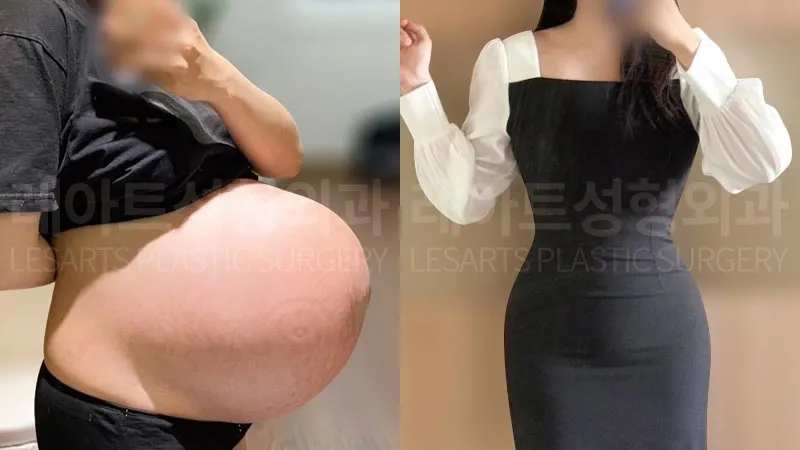
[Selfie Comparison During Pregnancy and 1 Month After a Tummy Tuck]
The final photos compare the significantly
stretched abdomen during pregnancy
with the patient’s body contour after tummy tuck surgery.
Because the abdominal skin and abdominal wall
had stretched considerably during her twin pregnancy,
sagging skin and abdominal protrusion remained
even after her weight stabilized following childbirth.
After surgery, the excess skin was removed
and the abdominal wall was tightened,
creating a noticeably different contour
from the waist to the lower abdomen.
When the abdominal skin becomes stretched
and folds downward after giving birth to twins,
weight loss alone may not provide
the desired improvement.
In this patient’s case, although she did not have
a particularly large amount of abdominal fat,
the skin around the navel and lower abdomen
had become significantly loose and stretched.
The abdominal wall was also considerably weakened,
causing the front of the abdomen to protrude forward
without sufficient support.
Above all, the patient considered adequately
correcting the abdominal sagging that had persisted
for years after childbirth more important
than minimizing the length of the surgical scar.
Therefore, a full tummy tuck was performed
to remove the excess sagging skin,
along with rectus muscle plication,
umbilicoplasty, and abdominal liposuction.
More than 1 year after surgery,
the loose skin and folds extending
from the navel to the lower abdomen
had noticeably decreased.
Even when bending forward, the skin
no longer gathered and sagged downward
as significantly as before surgery.
With the abdominal wall tightened,
the previously protruding front abdomen
also appeared flatter.
A smoother waistline was created,
with a natural transition through
the flanks and love handles.
In addition, the lower abdominal incision scar,
which had been the patient’s biggest concern
before surgery, gradually faded and stabilized
over the course of 1 year with regular
follow-up examinations and scar care.
As this case demonstrates, the decision
to undergo a tummy tuck should not be based
solely on the length of the surgical scar.
It is important to evaluate the extent
of remaining skin laxity, the condition
of the abdominal wall, and the degree
of improvement desired.
If sufficient time has passed after childbirth
and your weight has stabilized,
but lower abdominal sagging or protrusion remains,
it is important to determine whether
the concern is caused by excess fat alone
or whether changes in the skin
and abdominal wall are also contributing factors.
Tummy Tuck FAQ
Q1. Can sagging skin after twin pregnancy improve with weight loss?
Body fat can be reduced through weight loss, but skin that has stretched and lost elasticity during pregnancy may not recover to the desired extent.
If abdominal wall laxity is also present, exercise alone may have limitations in improving the abdominal contour.
Q2. Does a tummy tuck leave a long scar?
The length of the incision depends on how much sagging skin needs to be removed.
Rather than simply minimizing scar length, it is important to determine the appropriate surgical extent to adequately correct the sagging skin while creating a natural abdominal contour.
Q3. Why is rectus muscle plication performed during a tummy tuck?
If the abdominal wall has stretched after pregnancy and childbirth, causing the front abdomen to protrude, removing excess skin alone may leave some abdominal bulging.
Depending on the condition of the abdominal wall, rectus muscle plication may also be performed.
Q4. Is umbilicoplasty necessary during a full tummy tuck?
During a full tummy tuck, extensive skin repositioning and removal may change the position and appearance of the original navel.
Therefore, umbilicoplasty may be performed to reposition and reshape the navel to suit the new abdominal contour.
Q5. Will a tummy tuck scar still be visible after 1 year?
The incision scar itself remains, but its color and thickness may change over time.
In this case, regular follow-up examinations and postoperative scar care were continued throughout the first year.
The scar gradually faded and became more stable during the healing process.
▼ Visit Lesarts Plastic Surgery in Gangnam, Seoul, Korea ▼