
Abdominoplasty in Seoul: why a full abdominoplasty was needed for lower abdominal sagging after childbirth
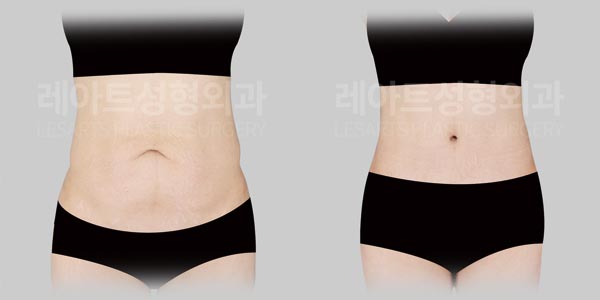
Patient Registration Info
| Age | Weight | Height | BMI |
|---|---|---|---|
|
40s |
59kg |
165cm |
21 |
Surgical site
Surgical site : Abdomen, M-Type, Rectus Muscle Repair, Umbilicoplasty
Can a Full Tummy Tuck Be Necessary Even If Sagging Appears Limited to the Lower Abdomen After Childbirth?
Even if sagging skin appears concentrated in the lower abdomen,
the actual skin laxity may extend from the upper abdomen.
If the rectus muscles and abdominal wall have also stretched
after childbirth, treating only the lower abdomen may not provide
sufficient improvement. Therefore, both the extent of skin laxity
and the condition of the abdominal wall should be evaluated.
Pregnancy and childbirth can cause
a variety of changes in the abdomen.
If the skin that stretched significantly during pregnancy
does not fully return to its previous state after childbirth,
excess skin may remain around the lower abdomen,
leading to sagging or wrinkles.
If the rectus muscles and fascia that support the abdomen
have also stretched, the front abdomen may continue to protrude
even after body weight returns to normal.
These changes are different from simply having excess body fat.
Even with stable weight management and regular exercise,
stretched skin and the abdominal wall may not return
to their previous condition as much as desired.
A tummy tuck may be considered when correcting
both post-pregnancy skin laxity and changes
in the abdominal wall.
This patient planned surgery to improve abdominal skin laxity
that had persisted for approximately 20 years
after giving birth naturally.
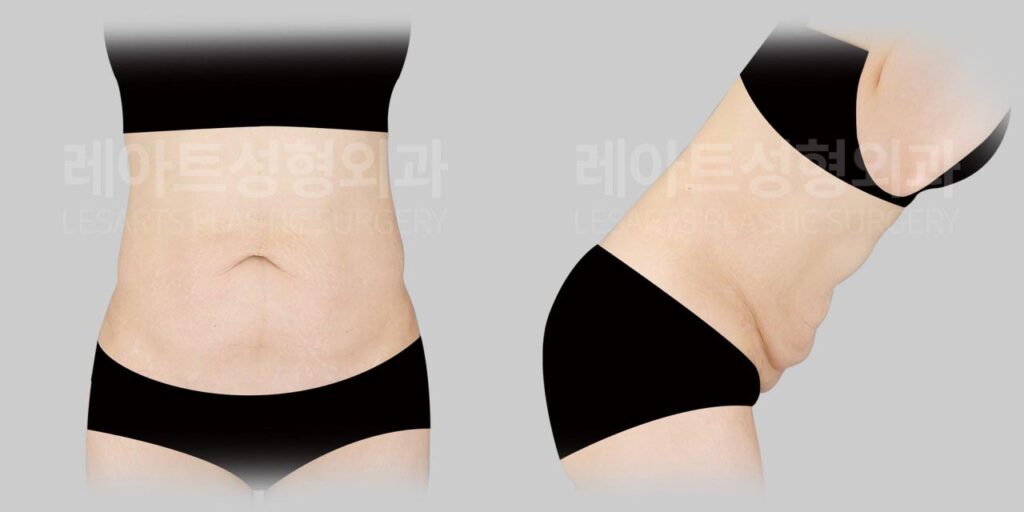
[Preoperative Evaluation of Skin Laxity Around the Belly Button and Abdominal Wall Condition]
Before surgery, the overall amount of abdominal fat
was not particularly high.
However, skin elasticity had decreased from the upper abdomen,
and the loose skin extended downward toward
the belly button and lower abdomen.
The belly button had widened horizontally due to tension from the skin,
while loose skin had accumulated in the lower abdomen,
creating an uneven appearance on the abdominal surface.
The skin laxity became more noticeable
toward the lower abdomen.
The changes were not limited to the skin.
The rectus muscles had also become lax
and were no longer providing sufficient support to the abdominal wall,
causing the front abdomen to appear widened and pushed forward.
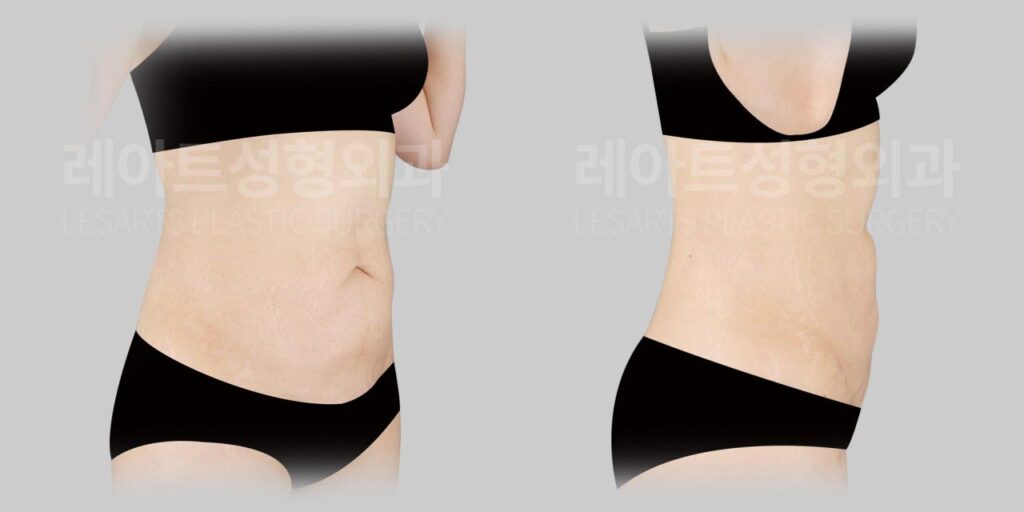
[Preoperative Surgical Plan Based on Lower Abdominal Skin Laxity and Abdominal Wall Condition]
Before the consultation, the patient believed
that the skin laxity was mainly limited to the lower abdomen.
This was because the most noticeable folds and loose skin
appeared to be concentrated in the lower abdomen.
However, the evaluation showed that the skin laxity
was not limited to the lower abdomen.
Skin elasticity had decreased from the upper abdomen,
and the loose skin had shifted downward,
making the lower abdominal sagging appear more pronounced.
Therefore, rather than treating only the skin below the belly button,
an M-type full tummy tuck was considered more appropriate
to pull the entire abdominal skin downward from the upper abdomen
while also correcting the stretched abdominal wall and distorted belly button.
The patient was informed about the extent of the skin laxity
and the areas requiring correction, and after a thorough consultation,
she decided to proceed with a full tummy tuck.
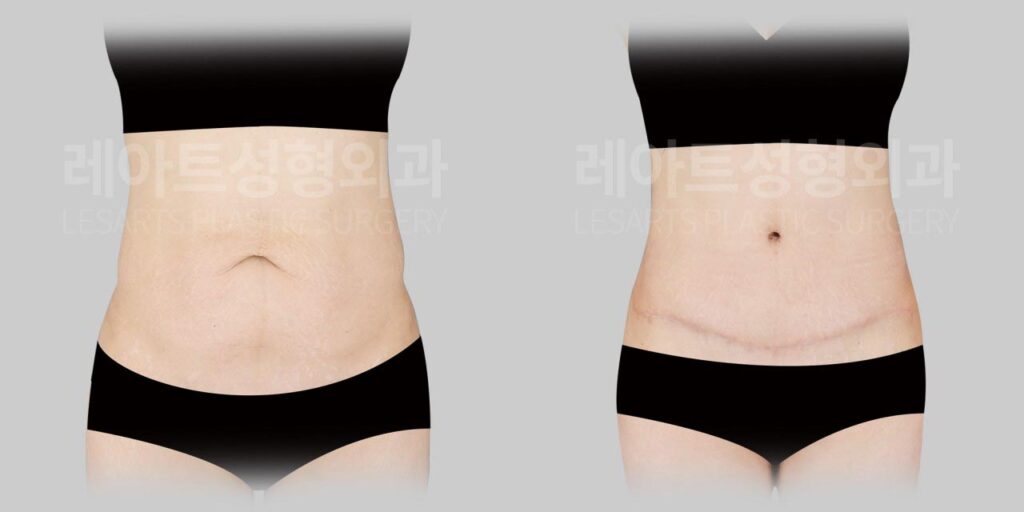
[Changes in Lower Abdominal Projection and Waistline 1 Year After Tummy Tuck]
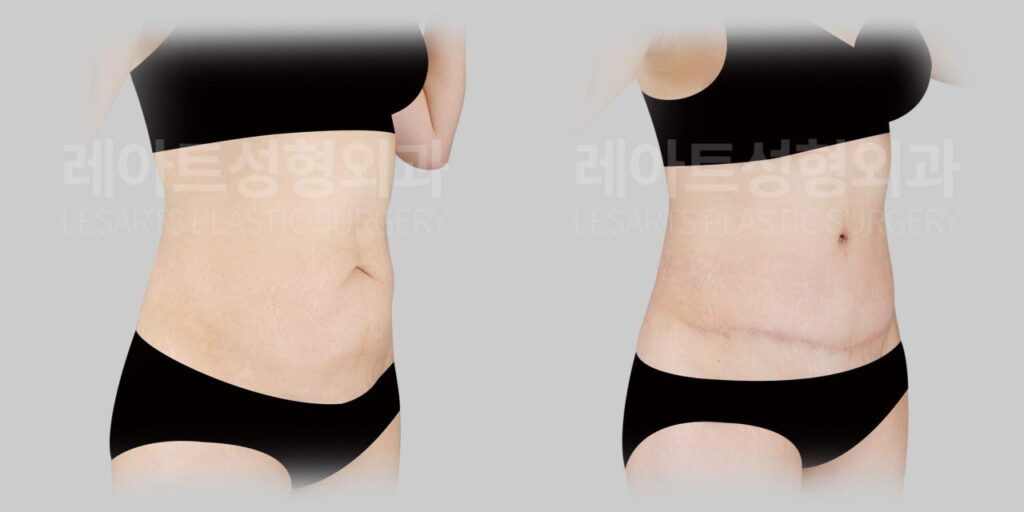
[Changes in Loose Lower Abdominal Skin and Belly Button Shape 1 Year After Tummy Tuck]
Let’s compare the before-and-after photos
1 year after surgery.
Before surgery, the skin was irregularly wrinkled and sagging
from the upper abdomen above the belly button
down to the lower abdomen.
After surgery, the loose skin was removed,
creating a firmer and smoother front abdominal contour.
The rectus muscles were also repaired to correct
the abdominal wall that had projected forward,
while the horizontally widened belly button was reconstructed
and repositioned into a new shape.
From the front view, the heavy appearance of the lower abdomen
has decreased, making the waistline appear
more clearly defined than before.
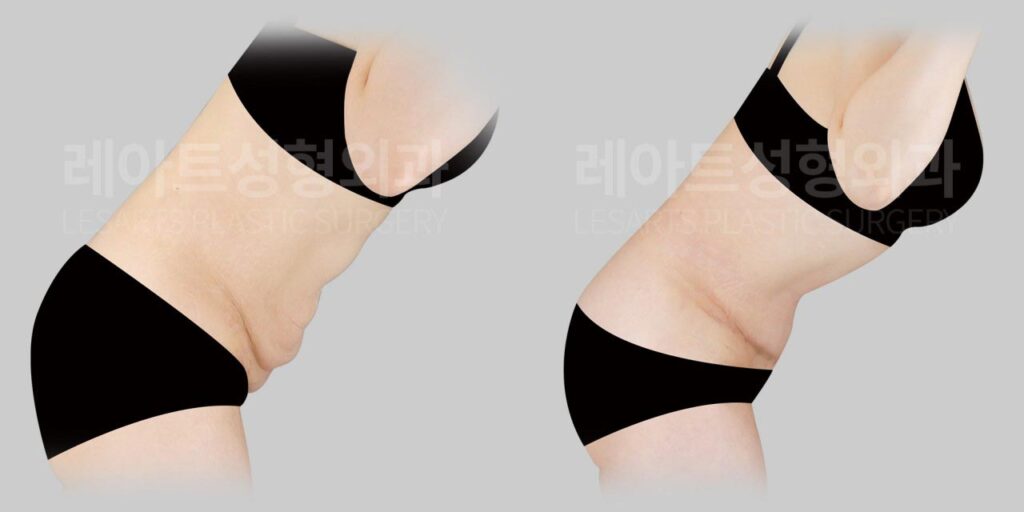
[Changes in Lower Abdominal Skin Laxity and Folds When Bending Forward 1 Year After Tummy Tuck]
Abdominal skin laxity often becomes more noticeable
when bending forward than when standing upright.
Before surgery, bending the upper body forward caused
the remaining loose skin to shift downward,
creating multiple folds in the lower abdomen.
At 1 year after surgery, the excess skin had been removed,
so even when bending forward, the skin no longer forms
multiple overlapping folds as before, maintaining a firmer appearance.
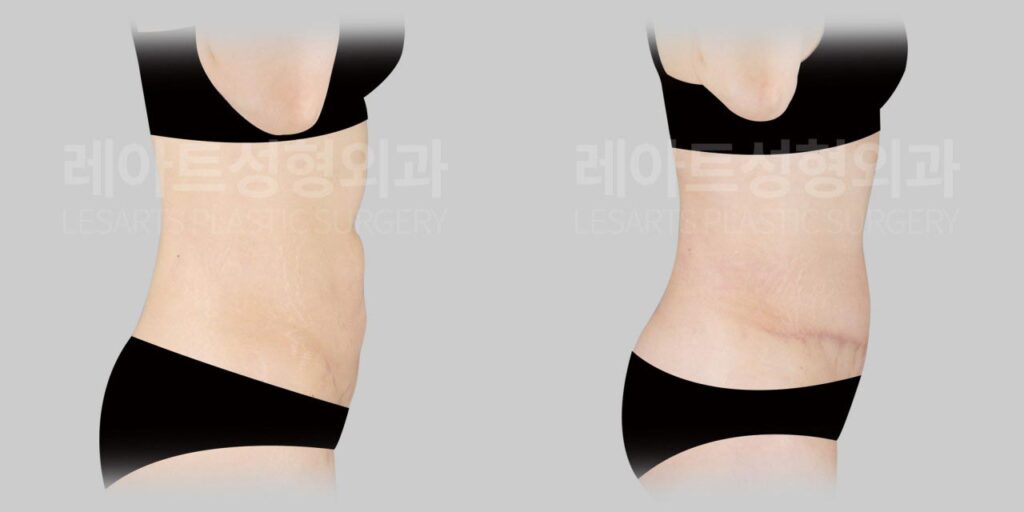
[Changes in Lower Abdominal Projection and Front Abdominal Contour from the Side 1 Year After Tummy Tuck]
From the side view, the front abdomen, which appeared
uneven and projected forward before surgery,
shows a noticeably smoother contour.
By repairing the rectus muscles, the abdominal wall
that had previously pushed forward was corrected,
while the loose skin was also removed, creating a smoother transition
from the upper to the lower abdomen.
Although this patient did not undergo additional abdominal liposuction,
correcting the skin and abdominal wall alone resulted
in a lighter and slimmer overall abdominal contour.
[Lower Abdominal Incision Scar Recovery 1 Year After Tummy Tuck]
Because a tummy tuck involves directly removing excess skin,
a relatively long incision scar remains along the lower abdomen.
Therefore, postoperative care involves not only monitoring
changes in abdominal shape but also regularly checking
how the incision site is healing.
This patient also continued laser toning treatments
for the lower abdominal scar after surgery.
The photo taken 1 year after surgery shows
the ongoing scar recovery process, and the color and thickness
will continue to be monitored as the scar further matures.
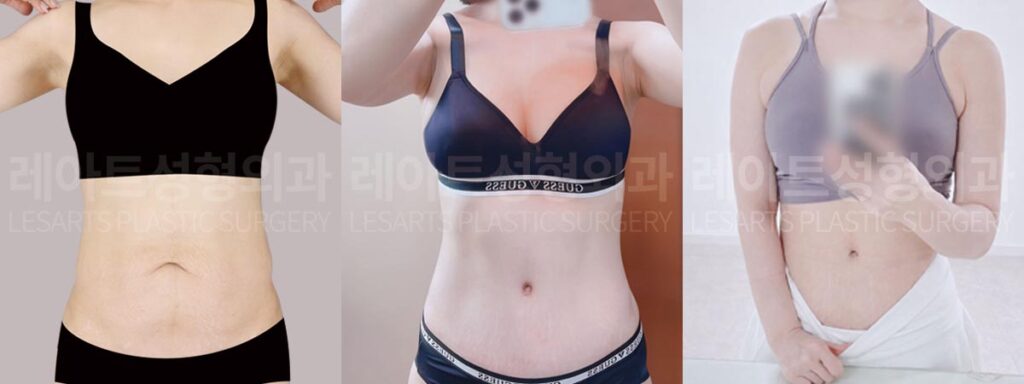
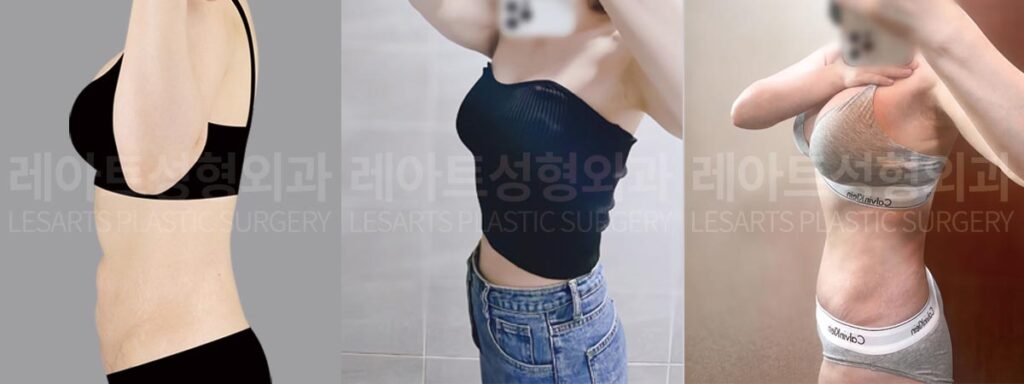
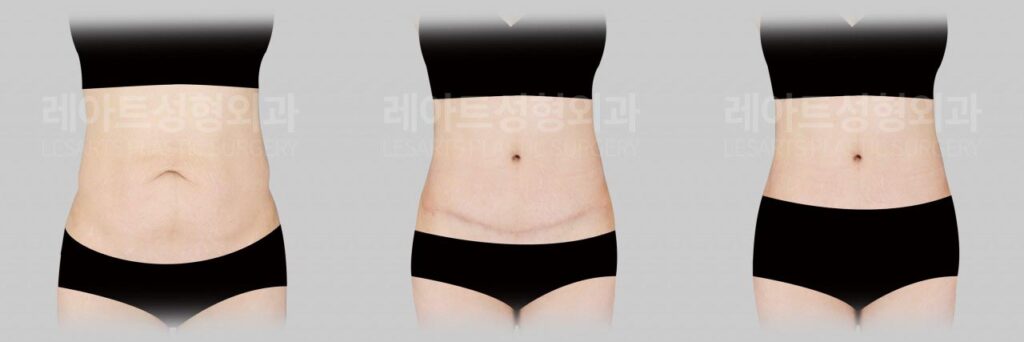
[Selfie Comparison Before, 3 Months After, and 1 Year After Tummy Tuck]
Changes in the abdomen can also be seen
in the patient’s own photos taken before surgery,
at 3 months, and at 1 year after surgery.
Before surgery, loose skin below the belly button formed folds,
making the lower abdomen appear heavy, while wrinkles
on the abdominal surface became more noticeable with movement.
At 3 months, the loose skin had been removed,
giving the front abdomen a lighter appearance.
By 1 year, the belly button and lower abdominal contour
had settled into a more natural shape.
This patient had been concerned about lower abdominal skin laxity
for approximately 20 years after childbirth.
Although she initially believed the sagging was limited
to the lower abdomen, the evaluation showed that skin laxity
extended from the upper abdomen, while the stretched rectus muscles
were no longer providing sufficient support to the front abdominal wall.
Therefore, an M-type full tummy tuck was performed
to pull and remove the loose skin extending from the upper abdomen,
along with rectus muscle repair and belly button reconstruction.
At 1 year after surgery, the irregular wrinkles and sagging skin
extending from above the belly button to the lower abdomen
had been reduced, creating a firmer front abdominal contour.
The multiple skin folds that had appeared
when bending forward were also noticeably reduced.
Although no additional abdominal liposuction was performed,
correcting both the skin and abdominal wall reduced
the uneven projection seen from the side
and created a more naturally defined waistline.
If lower abdominal skin laxity or a protruding abdomen
continues to be a concern long after childbirth, even after
body weight has stabilized, it is important to evaluate
both the skin and abdominal wall rather than assuming
that residual fat is the only cause.
Even when visible sagging appears concentrated in the lower abdomen,
the actual area of skin laxity may extend farther upward.
An accurate evaluation can help determine whether
a mini tummy tuck or a full tummy tuck
is more appropriate for the current abdominal condition.
Tummy Tuck FAQ
Q1. Is a full tummy tuck necessary even if only the lower abdomen appears saggy?
Even if sagging appears concentrated in the lower abdomen,
the actual skin laxity may extend from the upper abdomen.
The surgical method should be determined after evaluating
where the skin laxity begins and how far it extends.
Q2. Can stretched rectus muscles after childbirth come back together with exercise?
It depends on the degree of laxity in the rectus muscles and fascia.
If there is significant structural change causing
the abdominal wall to project forward, exercise alone
may not provide sufficient correction.
Q3. Can the belly button shape change after a tummy tuck?
During a full tummy tuck, the abdominal skin is moved downward,
and the belly button may need to be reconstructed
and repositioned as part of the procedure.
Q4. Can the waistline change without abdominal liposuction?
As in this case, if there is not much excess fat
and the main concerns are skin laxity and abdominal wall weakness,
correcting the skin and abdominal wall alone
may create a lighter and more defined abdominal contour.
Q5. How does a tummy tuck scar change over time?
A tummy tuck leaves a relatively long incision scar along the lower abdomen.
The scar is monitored throughout recovery, and appropriate scar care
may be continued while observing how its color and thickness gradually stabilize.
▼ Visit Lesarts Plastic Surgery in Gangnam, Seoul, Korea ▼