
Arm Liposuction – What Is Important for Patients with High Muscle Mass?
What is most important when performing arm liposuction in patients with high muscle mass?
In patients with well-developed arm muscles, the goal is not simply to remove as much fat as possible.
It is important to adjust how much fat is removed or preserved in each area so that the muscle contours do not become
overly prominent and the overall arm line remains smooth and balanced.
Written by Dr. Yongseung Seo, Lesarts Plastic Surgery
This article was written directly by the attending surgeon.
※ Unauthorized reproduction, editing, or redistribution is prohibited. ※
Some patients visit a clinic for liposuction because they have long been concerned about thick upper arms,
only to be surprised when they are told that they have more muscle mass than expected
and that achieving extremely thin, so-called “skinny arms” may be difficult.
They may have assumed that excess fat was the only reason their arms looked thick.
So it is understandable to feel disappointed when they learn that even after fat removal,
the underlying muscle remains and the arms may not become as thin as they had expected.
This is particularly common in patients who exercise regularly
or naturally have well-developed muscles.
However, this does not mean that liposuction cannot be performed
or that it will not produce a noticeable improvement.
Rather, the location and thickness of the fat that should be preserved
need to be carefully planned according to the shape and size of the underlying muscles.
Simply removing as much fat as possible can sometimes create an undesirable contour.
For patients with greater muscle mass, the more important goal is not simply to achieve extremely thin arms,
but to create an arm contour that blends naturally with the underlying muscles.
Even when two patients have arms of similar thickness,
the surgical approach may differ significantly depending on the proportion of muscle and fat.
For this reason, a detailed assessment tailored to each patient’s individual body structure
is essential when planning arm liposuction.
The patient we are introducing today visited Lesarts Plastic Surgery
because she was concerned that the outer contour of her arms did not appear smooth when viewed from the front.
She wanted a detailed evaluation to determine the cause
and identify an appropriate treatment approach.
[Patient Information]
Age: Early 20s
Height: 159 cm
Weight: 56.1 kg
BMI: 22.2 kg/m²
Body Fat Percentage: 35.5%
※ Liposuction results may vary between individuals,
even among patients with similar body measurements.
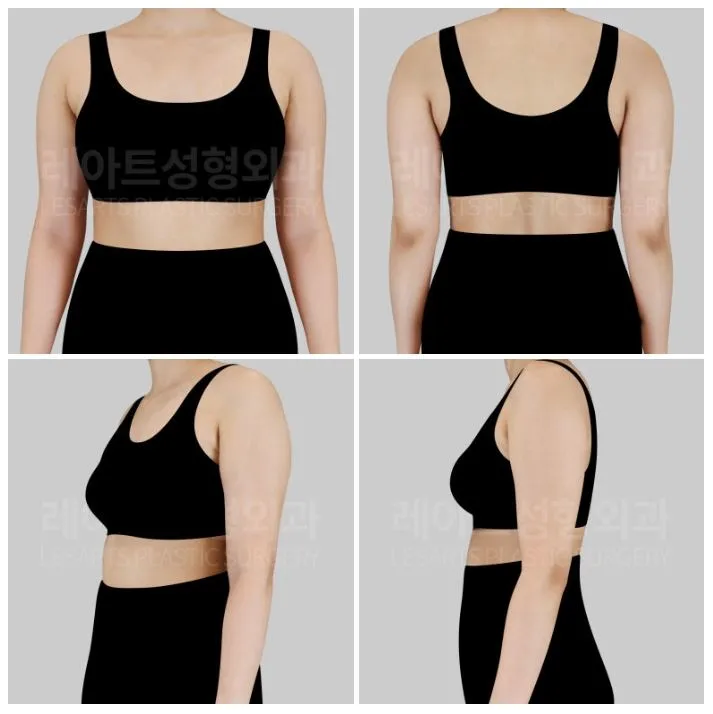
Arm Shape Before Arm Liposuction
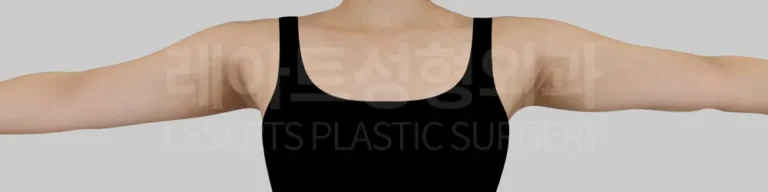
Physical Examination Before Arm Liposuction
[Consultation and Diagnosis]
“I’m concerned about the outer contour of my arms when viewed from the front.
I would like them to have a straighter, smoother line.”
The patient had previously undergone mini liposuction several years ago,
but remained dissatisfied with the thickness and overall contour of her arms.
Her main concern was the outer arm contour,
which appeared noticeably rounded when her arms were resting naturally at her sides.
She wanted a straighter and smoother line
when viewed from the front.
The outward bulging contour made her arms appear thicker
and gave her upper body a broader appearance.
In particular, her deltoid muscles around the shoulders were relatively well developed.
Because liposuction cannot reduce the muscle itself, we first explained that there were limitations
to creating an almost completely vertical, so-called “90-degree arm” contour.
[Ultrasound Examination]
Posterior: 12/12 mm
Anterior: 10/10 mm
Deltoid: 22/19 mm
The ultrasound examination showed that there was enough fat
for the patient to expect a noticeable improvement from liposuction.
However, she also had relatively well-developed muscle mass
compared with the amount of fat present.

A difference in deltoid thickness was also identified between the left and right sides.
Because this asymmetry was caused by the muscles themselves rather than fat,
it could not be completely corrected through liposuction.
Although this type of asymmetry is a common and natural difference in the body,
we explained in advance that it could become more noticeable after liposuction
as the overall volume of the arms decreased.
[Arm Liposuction Design Considering Muscle Mass and a Straighter Arm Contour]
For this patient, the key was to minimize the prominence of the deltoid contour
and improve the overall silhouette of the arms when viewed from the front.
Therefore, we planned to adjust the amount of fat preserved
according to each area of the upper arm.
The deltoid itself is a muscle and cannot be reduced through liposuction.
However, the thickness of the fat preserved along the lower border of the muscle
can affect how the outer arm contour appears from the front.
If the muscle contour becomes too prominent, the arms may appear thicker and broader.
For this reason, a small amount of fat was carefully preserved and adjusted
to create a straighter line without emphasizing the underlying muscle.
In contrast, the rounded outer area that was most prominent from the front
was treated more thoroughly to reduce the bulging contour
from both the front and side views.
There was also a 3 mm difference in deltoid thickness between the left and right sides.
Because this difference originated from the muscles themselves,
it could not be eliminated through liposuction.
We discussed two possible approaches with the patient: removing as much fat as possible
while accepting some remaining asymmetry, or preserving more fat on one side
to make the overall appearance as symmetrical as possible.
The patient felt that leaving additional fat would be more concerning
than having a slight degree of asymmetry.
Therefore, we decided to remove as much fat as possible
without intentionally preserving additional fat to compensate for the muscle difference.
[Before and After Arm Liposuction]
(Photos were taken 1.5 months after surgery
under the same lighting and environmental conditions.)

Before and After Arm Liposuction in a Patient with High Muscle Mass – Dr. Yongseung Seo, Lesarts
The prominence of the deltoid contour was slightly reduced,
while the outer arm line below it became smoother and closer to a straight contour.
As a result, the arms also appeared noticeably slimmer
when resting naturally at the sides and viewed from the front.
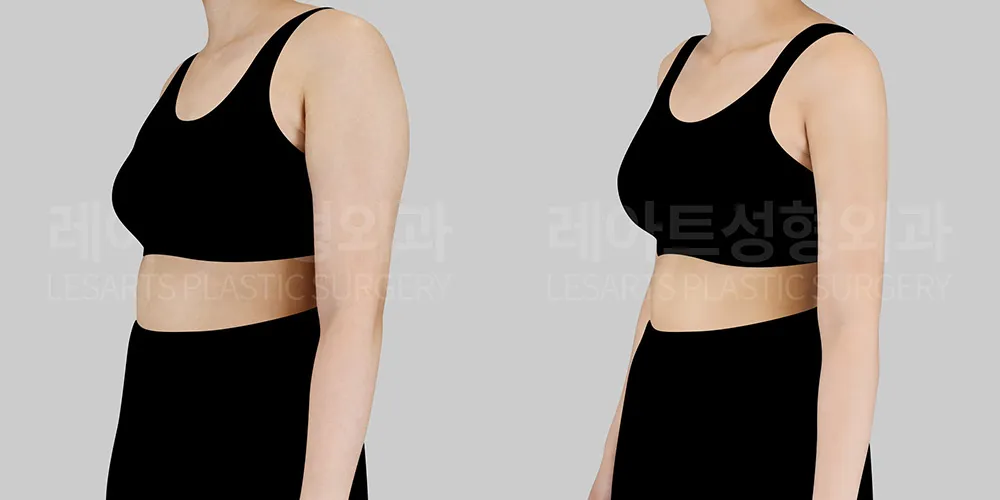
Before and After Arm Liposuction in a Patient with Well-Developed Muscles – Dr. Yongseung Seo, Lesarts
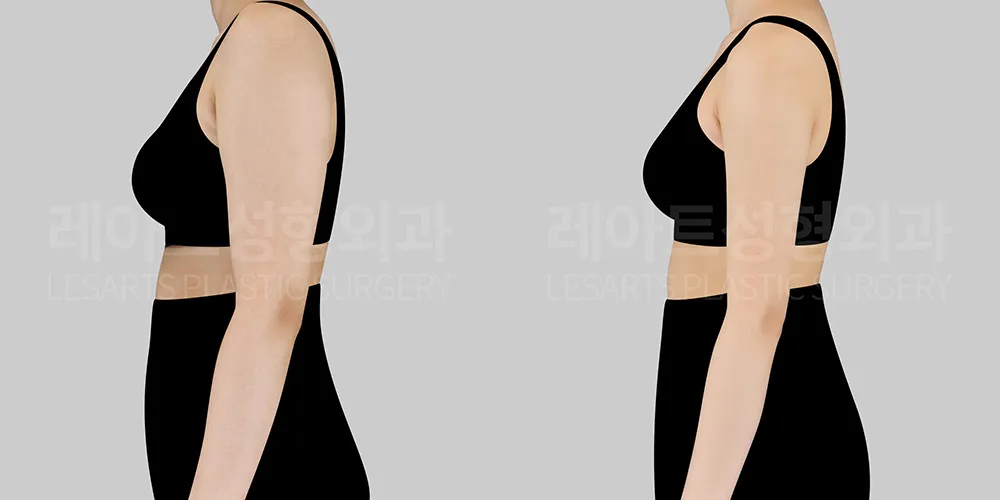
Changes in Arm Contour Before and After Liposuction – Dr. Yongseung Seo, Lesarts Plastic Surgery
When viewed from the side, the fullness in the upper arm was also reduced,
creating a noticeably slimmer and more refined contour.

Arm Liposuction for a Muscular Body Type – Dr. Yongseung Seo, Lesarts Plastic Surgery
As explained before surgery, a slight difference between the left and right arms
may still be noticeable upon close examination.
However, the remaining asymmetry was not significant enough
to noticeably affect the overall appearance of the arms.

Before and After Upper Arm Liposuction – Dr. Yongseung Seo, Lesarts
Before arm liposuction, when the arms were extended out to the sides,
the contour from the armpit to the elbow appeared relatively full and rounded.
After surgery, the same area became slimmer and smoother,
creating a noticeably more refined silhouette when the arms were extended.
View More Arm Liposuction Before-and-After Cases
In patients with greater muscle mass, removing too much fat
can make the underlying muscle contours more prominent
and may negatively affect the overall arm line.
Therefore, even when fat is removed as much as possible from areas that require reduction,
it is important to identify where fat should be preserved
and carefully determine how much should remain.
Without a detailed assessment of factors such as the muscle-to-fat ratio
and differences between the left and right arms, as in this case,
the final contour may not fully match the patient’s expectations.
This type of careful evaluation is important for every patient,
but an even more detailed consultation may be necessary for those with well-developed muscles
or those who were dissatisfied with the results of a previous procedure.
If you have been concerned about the shape of your arms for a long time
or are considering another consultation because you were dissatisfied with the results of a previous procedure,
please feel free to contact Lesarts Plastic Surgery.
We will help you determine an appropriate approach
through a detailed evaluation and carefully planned treatment design.
FAQ
Q1. Can arm liposuction make muscular arms extremely thin?
Not always. Liposuction can reduce subcutaneous fat, but it cannot reduce the size of the muscles themselves.
Therefore, the achievable arm thickness depends on both fat volume and underlying muscle development.
Q2. Why should some fat be preserved in patients with well-developed arm muscles?
Removing too much fat may make the underlying muscle contours more prominent.
Carefully preserving an appropriate amount of fat in selected areas
can help create a smoother transition and a more balanced arm silhouette.
Q3. Can arm liposuction correct asymmetry caused by muscle size?
Not completely. If left-right asymmetry is caused by differences in muscle size rather than fat thickness,
liposuction cannot directly correct the muscle itself.
In some cases, the difference may become more noticeable after overall arm volume is reduced.
Q4. Why is ultrasound examination useful before arm liposuction?
Ultrasound can help evaluate fat thickness in different areas of the arm. Combined with a physical examination,
this information can help determine which areas require greater fat reduction and where some fat may need to be preserved.
Q5. What determines the design of arm liposuction in a muscular body type?
The design should consider the ratio of muscle to fat, the shape of the deltoid and upper arm,
fat thickness in each area, left-right differences, and the patient’s desired contour.
These factors help determine how much fat should be removed or preserved in each area.
▼ Visit Lesarts Plastic Surgery in Gangnam, Seoul, Korea ▼