Mini tummy tuck in Seoul: 3-month results after umbilical floating for lower abdominal sagging
Patient Registration Info
| Age | Weight | Height | BMI |
|---|---|---|---|
|
40s |
56kg |
160cm |
22 |
Surgical site
Surgical site : Abdomen, S-Type, Rectus Muscle Repair, Umbilical Floating| liposuction aspirate volume : 2,400cc
Can a Mini Abdominoplasty Only Correct the Lower Abdomen with a Short Incision?
It is difficult to determine the incision length
or the extent of correction based solely on the term “mini.”
The appropriate surgical approach is decided after evaluating
the degree of upper abdominal skin laxity, rectus diastasis,
umbilical position, and the amount of excess skin that needs to be removed.
For patients considering abdominoplasty,
the incision length, scar location, and expected treatment area
are often the biggest concerns.
However, abdominal skin laxity varies significantly
in both location and severity from one patient to another.
For this reason, the surgical technique or results seen online
may not reflect your own condition. Choosing a procedure
based solely on someone else’s case is generally not recommended.
In particular, the S-Type procedure is often referred to
as a mini abdominoplasty, leading many people to assume
that it always involves a short incision.
In reality, the incision length may vary depending on
the extent of upper abdominal skin laxity, the severity of
rectus diastasis, and the amount of skin that must be removed.
In this case, we will review the three-month results of a patient
who underwent an S-Type mini abdominoplasty with umbilical floating,
combined with rectus muscle repair and abdominal liposuction
to address lower abdominal skin laxity.

[Preoperative Lower Abdominal Skin Condition Before Umbilical Floating Mini Abdominoplasty]
At the initial consultation, skin laxity in the upper abdomen
was relatively mild. However, the skin below the navel
had lost elasticity and was noticeably sagging.
The excess lower abdominal skin folded over the underwear line,
preventing a smooth transition of the lower abdominal contour
and creating an uneven appearance.
Although rectus diastasis was clearly identified in both
the upper and lower abdomen, the patient’s natural umbilical position
was not excessively low. This made the patient a suitable candidate
for an umbilical floating technique.

[Surgical Plan for Abdominoplasty Based on Rectus Diastasis and Lower Abdominal Skin Laxity]
The patient wanted to focus primarily on improving
the lower abdomen and also expressed concerns
about having a long surgical incision.
For this reason, we planned an S-Type mini abdominoplasty
using the umbilical floating technique. This approach allowed us
to repair the rectus diastasis extending into the upper abdomen
while removing the excess skin concentrated below the navel.
Abdominal liposuction was performed at the same time
to reduce fullness along the flanks and lower back,
creating a smoother and more defined waistline.
However, we also explained before surgery that
the incision length is determined by the vertical amount
of skin that must be advanced and removed. As a result,
the incision could be somewhat longer than in a typical S-Type case.
With this surgical plan, the procedure was completed successfully.
The following photographs demonstrate how the abdominal contour
changed from before surgery to three months postoperatively.


[Changes in the Lower Abdomen from the Front and Oblique Views Three Months After Abdominoplasty]
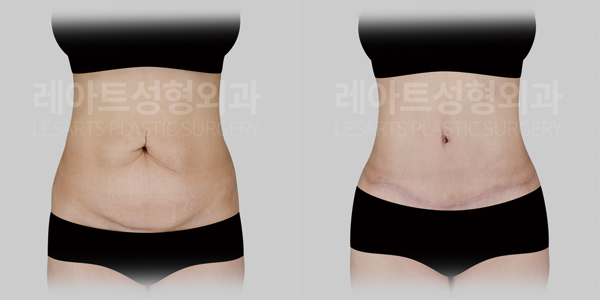
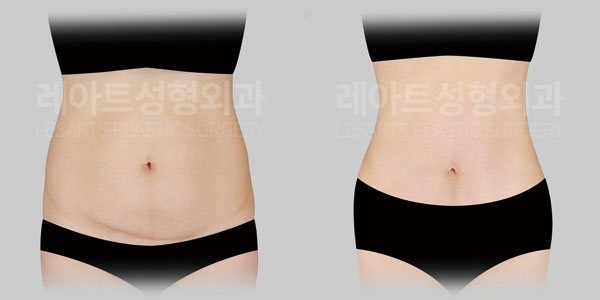
Comparing the preoperative and three-month postoperative photographs,
the excess skin and folds that had accumulated below the navel
have been effectively removed, resulting in a smoother lower abdomen.
Repairing the rectus diastasis in both the upper and lower abdomen
also improved the rounded abdominal protrusion, creating
a firmer and flatter abdominal contour.
In addition, abdominal liposuction reduced the fullness
of the flanks and lower back, making the waistline more defined.
The transition from the upper abdomen to the lower abdomen
now appears slimmer and more balanced.


[Incision Hidden Inside the Underwear Line Three Months After Abdominoplasty]
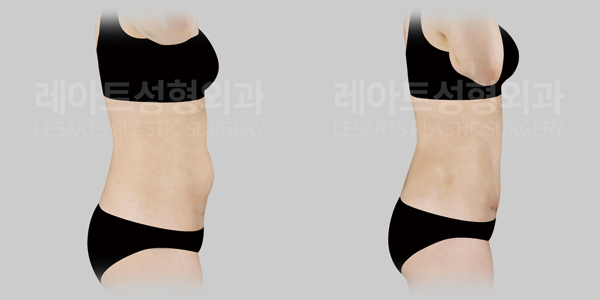
The side-view comparison shows that correcting the abdominal wall
significantly reduced the lower abdominal protrusion
that had previously projected forward.
The abdomen also became noticeably better supported.
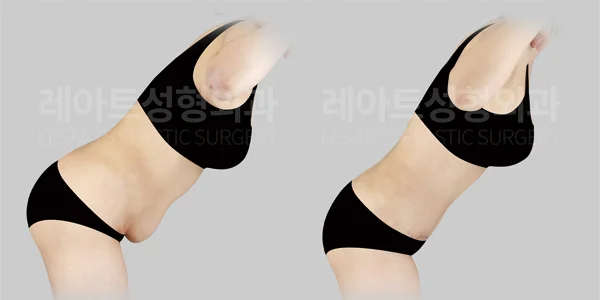
Before surgery, bending at the waist caused the skin
and lower abdomen to sag downward. Three months after surgery,
the abdominal contour remains firmer and maintains its shape more effectively.

[Removal of a C-Section Scar and Incision Placement After Mini Abdominoplasty]
The existing C-section scar had become more noticeable
because excess skin folded over the underwear line.
It was removed during surgery, and the new incision
was positioned where it could remain hidden inside underwear.
At three months after surgery, redness around the scar
may still be visible, as this is a normal stage of healing.
Overall recovery was progressing well, and the patient was advised
that the scar’s color and firmness would gradually improve
with continued postoperative scar management.
The umbilical floating technique slightly lowers
the patient’s original navel together with the surrounding skin.
Because the patient’s natural navel position was relatively high,
its postoperative position remained well balanced
and continued to heal with a natural appearance.
Maintaining a stable body weight and regular exercise
after abdominoplasty also plays an important role
in preserving the improved abdominal contour.
Once sufficient healing has occurred,
consistent healthy habits and ongoing body management
are recommended to maintain long-term results.
If you are concerned about lower abdominal skin folding
over the underwear line, contour irregularities around
a previous C-section scar, or lower abdominal protrusion
caused by abdominal wall laxity, it is important to undergo
a thorough evaluation before deciding on a surgical technique.
Rather than choosing a procedure based solely
on another patient’s results, we recommend an individualized
assessment of skin laxity, rectus diastasis,
and umbilical position.
At Lesarts Plastic Surgery, a personalized consultation
can help determine the most appropriate abdominoplasty approach
for your specific condition.
#miniabdominoplasty
#abdominoplasty
#umbilicalfloating
#rectusdiastasis
#abdominoplastyrecovery
#csectionscar
#lesartsplasticsurgery
Mini Abdominoplasty FAQ
Q1. Is the incision always short in a mini abdominoplasty?
No. The length of the incision depends on
the amount of excess skin that needs to be removed
and the extent of skin laxity.
Q2. Does umbilical floating create a new belly button?
No. The original belly button is preserved
and moved slightly downward together
with the surrounding abdominal skin.
Q3. Can upper abdominal rectus diastasis also be repaired?
Yes. In this case, rectus diastasis in both
the upper and lower abdomen was repaired.
The extent of correction depends on the patient’s condition.
Q4. Is it normal for the scar to remain red three months after surgery?
Yes. Some redness may still be present
at three months after surgery.
Regular follow-up and appropriate scar care
are important during this stage of healing.
Q5. When can I exercise after abdominoplasty?
The appropriate timing depends on
the extent of surgery and your recovery progress.
Exercise should be resumed gradually
after your surgeon confirms adequate healing.
▼ Visit Lesarts Plastic Surgery in Gangnam, Seoul, Korea ▼