Patient Registration Info
Surgical site
Surgical site : Abdomen, Bra line, Scapular area, M-type, Umbilical correction, Rectus muscle repair| liposuction aspirate volume : 2,800cc
Previous procedures or surgeries inevitably
leave structural changes
within the subcutaneous tissue,
and those traces
can remain in various forms.
For example, among patients
who visit for abdominoplasty,
many have a history of
Cesarean section or
liposuction surgery.
In such cases,
adhesions may form beneath the skin,
preventing smooth tissue layering.
As a result, the abdomen
may appear pulled to one side,
uneven, or irregular to the touch.
Additionally, patients
who delivered via C-section
often experience poor scar healing,
leading them to inquire about
scar revision surgery
or scar treatment at the same time.
In this post,
we will review a similar case
and explain the abdominoplasty outcome
of a patient who visited for consultation.
[Patient Information]
Age: Mid-40s
Height: 157 cm
Weight: 60 kg
BMI: 24
Even with similar body specifications,
surgical results may vary by individual.
After delivering via Cesarean section,
the patient gradually developed
significant overall abdominal sagging.
Wrinkling around the C-section scar line
also became more noticeable over time.
Due to substantial weight fluctuations
during pregnancy and childbirth,
the abdominal skin had been
stretched extensively.
The thinned skin and lax tissue
did not fully recover afterward,
which became a persistent concern.
Following childbirth,
she previously underwent
abdominal liposuction
to reduce lower abdominal
and flank fat.
However, as time passed,
the effect of the surgery diminished,
and instead, adhesion-related pulling
around the umbilicus developed.
The abdomen appeared uneven
and irregular in contour,
causing ongoing stress.
The patient’s abdomen showed
particularly thinned skin
below the C-section scar,
and overall reduced elasticity
with significant sagging
across the entire abdomen.
Due to adhesions,
the skin surface around the umbilicus
appeared uneven
and irregularly pulled.
As a result,
the umbilicus appeared
slightly deviated
to the right side.
Overall,
both sagging and surface irregularities
required structural correction.
To address these concerns,
the following surgical plan
was established:
Surgical plan
1. Abdominoplasty (M-type + Umbilical Correction)
– Improvement of sagging skin
from upper to lower abdomen
– Removal of the previous C-section scar
– Reconstruction of the deviated umbilicus
closer to the abdominal midline
2. Abdominal Wall Repair
– Correction of rectus diastasis
– Restoration of abdominal wall support
– Muscle tightening to refine
the inward waist contour
3. Adhesiolysis
– Careful release of adhesions
to smooth the uneven
abdominal surface
4. Combined Liposuction
(Abdomen, Bra Line, Scapular Area)
– Reduction of waist volume
to enhance contour definition
– Back fat removal
to improve overall upper body balance
Through abdominoplasty,
we will evaluate the degree of
sagging improvement,
adhesion correction,
and complete removal
of the previous C-section scar.
[Procedures performed]
M-type abdominoplasty, umbilical correction,
adhesion release, abdominal liposuction,
bra line liposuction, and scapular liposuction
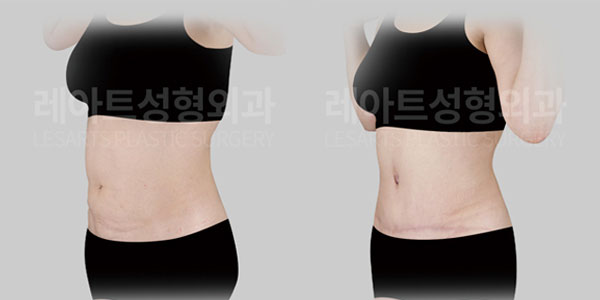
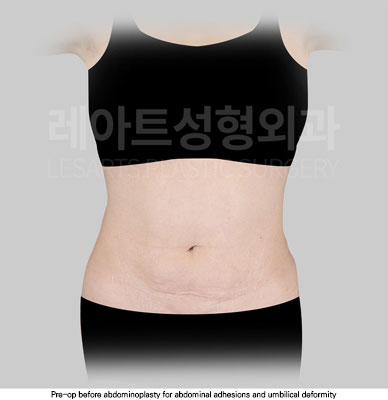
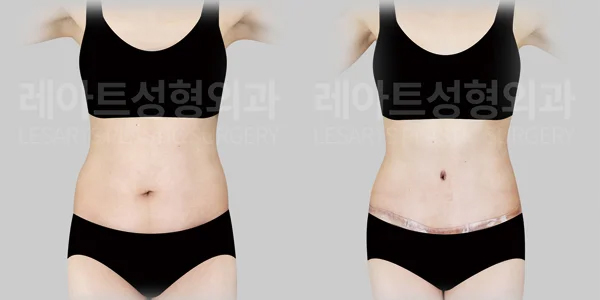
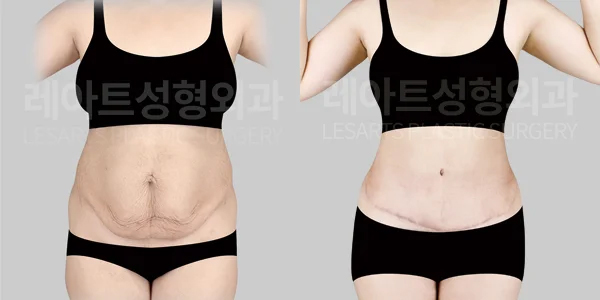
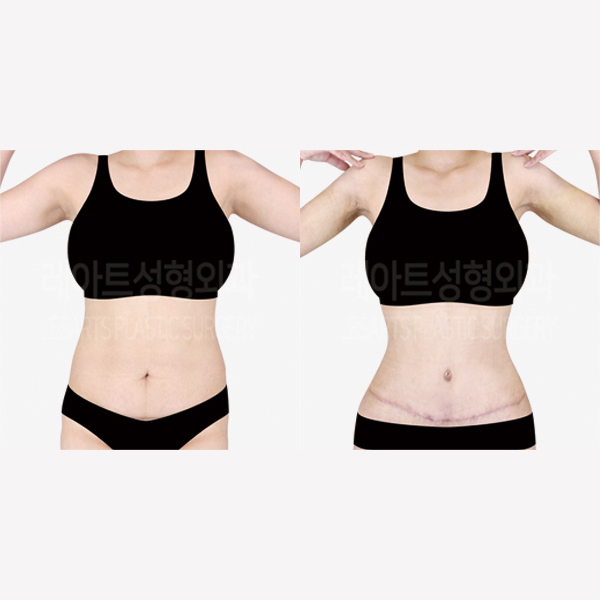
Before abdominoplasty,
the abdomen appeared asymmetric,
with visible wrinkling and sagging
around the previous C-section scar.
In particular,
the skin around the umbilicus
looked pulled to one side,
further emphasizing
the imbalance.
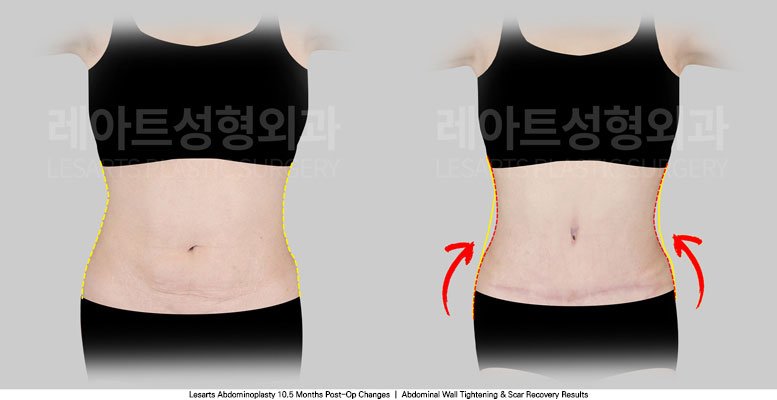
During surgery,
adhesions were carefully released,
and liposuction refined
the waistline,
allowing transformation
into a smoother, firmer contour.
The umbilicus was repositioned
closer to the midline,
restoring stable abdominal symmetry.
The previous C-section scar
was completely removed,
and surrounding wrinkles
were lifted,
revealing a flatter,
more even lower abdomen.
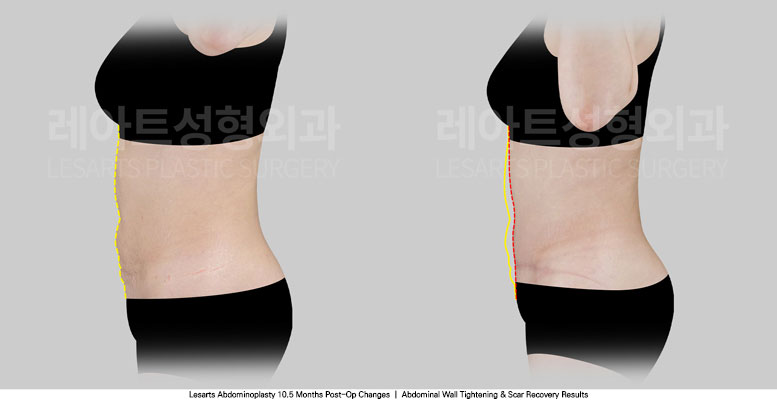
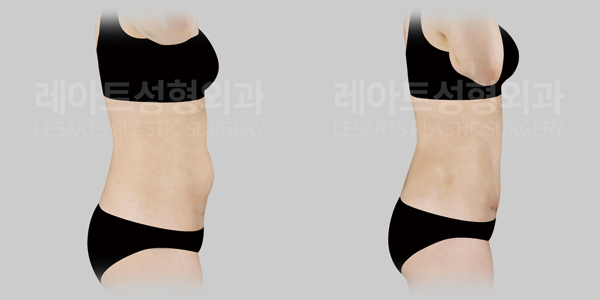
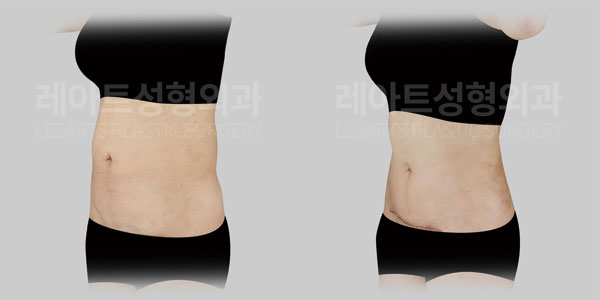
From the side view,
the uneven abdominal contour
caused by adhesions
and rectus diastasis
has been smoothly corrected.
In particular,
the pronounced sagging
and irregular folds
below the umbilicus
have completely resolved.
Without forward bulging
or drooping,
a firm and well-supported
anterior abdominal line
has been restored.
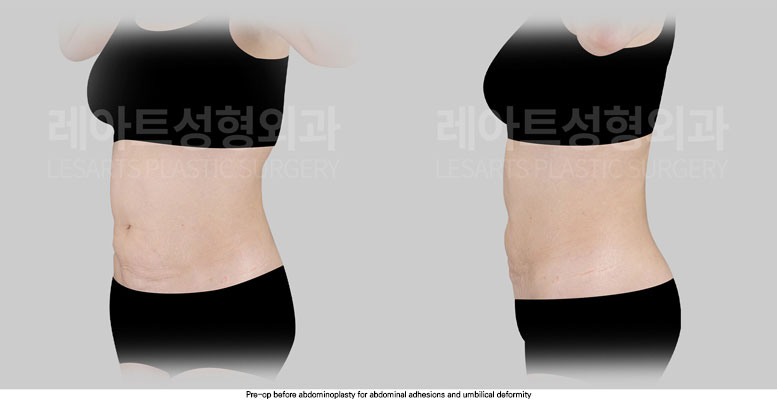
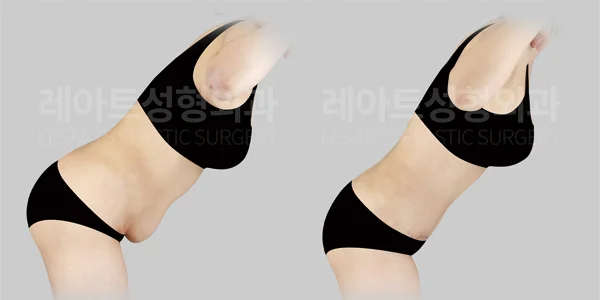
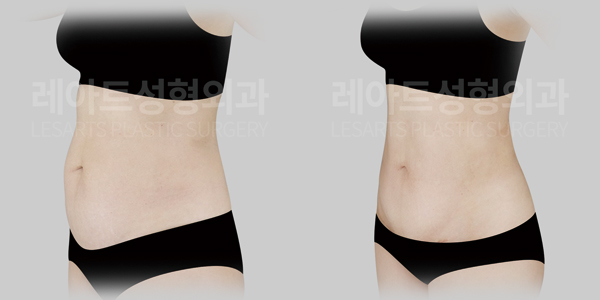
From the oblique view as well,
abdominoplasty corrected
lower abdominal sagging,
and the forward bulging
of the abdominal wall
has resolved,
revealing a smoother
and more contoured waistline.
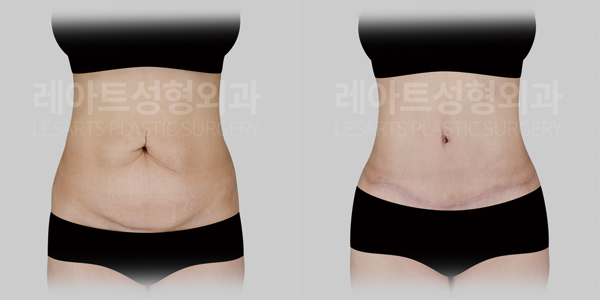
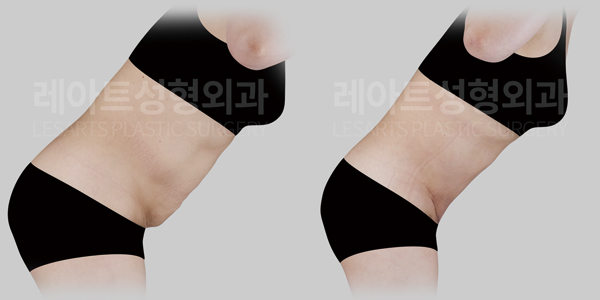
Before surgery,
the drooping lower abdominal skin
pressed the umbilicus downward,
and surrounding adhesions
pulled the skin unevenly,
creating noticeable asymmetry.
Through abdominoplasty,
these concerns were improved.
The umbilicus was repositioned
in alignment with the waistline,
and the lower abdomen
appears lifted and refined,
resulting in a younger-looking
body contour.
The previous Cesarean section scar
was completely removed,
and the new scar
is being carefully managed
through follow-up visits
and laser scar treatment,
showing stable recovery.
At approximately
10 and a half months post-op,
the patient expressed
high satisfaction
with the correction of sagging,
asymmetry,
and the overall abdominal contour change.
We emphasized
the importance of continued
scar care and body management
to maintain optimal results.