Thigh liposuction in Korea – How to improve satisfaction and maximize results | Lesarts Plastic Surgery
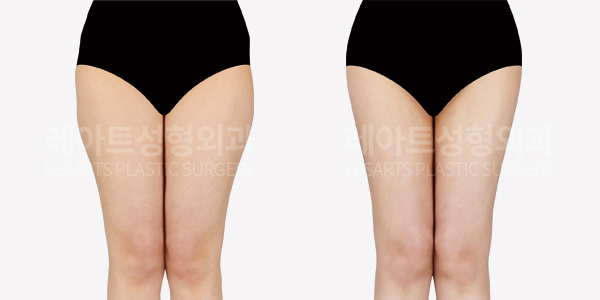
Patient Registration Info
| Age | Weight | Height | BMI |
|---|---|---|---|
|
30s |
70kg |
165cm |
26 |
Surgical site
Surgical site : Thigh, hip line| liposuction volume : 5,300cc
Satisfaction after liposuction surgery
is not judged only by
how much fat was removed.
Even when the same amount
of fat is extracted,
if skin elasticity is sufficient,
a smooth and slim line
can settle naturally.
But when elasticity is low,
the skin may sag
or leave uneven texture,
lowering overall satisfaction.
The thighs, in particular,
accumulate fat across multiple areas,
contain large muscle groups,
and are prone to wrinkles.
So stable results require
careful evaluation of elasticity
before surgery
and thorough postoperative care.
In this post, we will review
the change of a patient
who was concerned about
fat buildup in the front and back thighs,
inner knees, and saddlebags,
along with reduced skin elasticity,
and underwent
full thigh liposuction
and hip-line liposuction.
[Patient Information]
Age: Early 30s
Height: 165 cm
Weight: 70 kg
BMI: 26
Even with similar body characteristics,
results from liposuction may vary.
The patient experienced
a noticeable increase
in overall thigh volume
as weight was gained.
She shared that as the thighs
became more prominent,
the hip line also appeared larger,
which caused significant stress.
She had previously lost weight
through exercise
and diet control,
but the leg line did not refine
as much as she wanted,
and marks remained
on the inner-thigh skin,
showing clear limitations.
As a result, she felt that
dieting or simple treatments alone
would not fully improve
the thighs and hip line,
and decided to proceed with
thigh liposuction
along with hip-line contouring.

When examining the body shape
before surgery,
fat was concentrated in the thighs
and hip line,
showing clear concern
about line refinement.
The volume of the front and back thighs
was especially prominent,
and fat also needed to be removed
from the inner knees
and saddlebags,
adding to a heavy leg appearance.
In this patient’s case,
the leg shape was basically
close to a straight line,
so the inner-thigh spacing
was naturally limited.
Even if circumference is reduced
as much as possible
through liposuction,
there is a structural limit
to creating a wide thigh gap.
Because of sudden weight gain,
stretch marks and skin laxity
were also confirmed
on the inner thighs
and inner buttock area.
We explained that while
liposuction could make the surface
smoother than before,
there is a limitation
in fully restoring it
to a completely flat state.
In particular, the skin
on the left buttock
had reduced elasticity,
so even with
hip-line liposuction,
clear tightening improvement
would be difficult.
This needed to be considered
before surgery.
In other words,
if thigh fat were removed excessively,
skin sagging and irregularities
could worsen.
So the thigh liposuction plan
was designed to keep enough fat
on both the inner and outer thighs
to maintain elasticity
and balance.
Because her buttock weight
was naturally present,
a portion of the fat
under the buttocks
needed to be preserved
to prevent sagging.
This was an important
design point.
Ultimately, thigh liposuction
and hip-line liposuction
were performed together.
Unnecessary fat was removed,
but areas with weaker elasticity
were refined without overcorrection.
This minimized uneven texture
and asymmetry,
while creating
a soft, smooth curved line.
At 2 months after surgery,
we will now review
how circumference changes
and body-balance improvements
appeared from the front, back,
and side views.

Through thigh liposuction
and hip-line liposuction,
the thick, rounded thighs
have been reshaped
into a more feminine,
smoothly curved contour.
Before surgery,
thick fat layers
were formed on both
the inner and outer thighs,
making the legs look
wide from the front.
In particular,
the pelvis and saddlebags
were noticeably thick,
causing the outer line
to drop straight down,
creating a cylindrical
leg shape.
To correct this,
thigh liposuction
was performed,
reducing overall thigh circumference.
The outward-protruding
saddlebags were refined
into a soft curve,
creating a slimmer line
overall.
With this change,
the legs appear longer
in proportion,
and the feminine curves
stand out more clearly,
which gave the patient
a high level
of satisfaction.

A clear change
can also be seen
from the back view.
Before surgery,
excess fat had accumulated
on the back thighs
and buttocks,
making the boundary
between the legs
and hips unclear.
However, at 2 months after
thigh liposuction
and hip-line liposuction,
the overall volume of the
back thighs, saddlebags,
and buttocks decreased,
and the hip–thigh boundary
became clearly defined.
In particular,
the outer thigh line
and hip line
were smoothly refined,
creating a feminine curve
that flows naturally
down toward the knees.
This resulted in
an overall slimmer silhouette,
with the additional effect
of making the legs
appear longer.


At 2 months after surgery,
the side view shows
that the protrusion of the
front and back thighs
has been refined,
creating a much slimmer
and smoother line.
The curve flowing from the
buttocks into the thighs
looks naturally organized,
and the overall leg thickness
has clearly decreased.
As the saddlebags
above the knees
were cleanly removed,
the legs now appear longer,
and a feminine silhouette
was completed.


Looking at the pre- and post-surgery
selfies the patient provided,
we can see that the previous
cramped appearance—
caused by the inner thighs touching—
has improved.
As the volume of the thighs
and hip line decreased,
there was not only
a clear reduction in circumference,
but also a natural space
formed between the legs
that had been expected
to be difficult to create.
This change gave the legs
a lighter and slimmer look.
In addition, as the front and back thigh volume
was refined and the heaviness
of the buttocks was reduced,
the back-thigh line
connected more naturally
and appears firmer
and more elastic.
Because the patient already had
slightly reduced skin elasticity
before surgery,
the surgical method itself
and postoperative care
were both very important.
Lower-body liposuction can create
temporary empty space
where fat was removed,
which may cause
the skin to sag.
For that reason,
care to minimize these changes
was necessary.
During planning,
overly aggressive fat removal
was avoided.
In the postoperative stage,
we emphasized the importance of
wearing compression garments
to reduce sagging,
along with radiofrequency treatments
and careful moisturizing care,
so that the results
could settle stably.
#ThighLiposuction
#HipLineLiposuction
#FullThighLiposuction
#SaddlebagsRemoval
#ThighGapImprovement
#LegContourRefinement
#LowerBodyLiposuction
#BeforeAndAfter
#LesartsPlasticSurgery
#BestThighLiposuctionClinicInKorea
#BestLiposuctionClinicInKorea